On this page
Heat a pinch of white zinc oxide in a dry test tube and it turns yellow. Let it cool and it goes back to white. The Royal Society of Chemistry's school experiment on reacting zinc with copper(II) oxide uses this test to help confirm that ZnO has formed: it goes yellow when heated and returns to white when cool. It is a standard question in Class 12 solid-state chemistry, and the textbook explanation is a crystal defect.
Why is zinc oxide white at room temperature?
Zinc oxide is a direct-gap semiconductor with a band gap of 3.37 eV at 300 K, according to a review by Rodnyi and Khodyuk in Optics and Spectroscopy (2011). In the usual wurtzite structure, each zinc atom is surrounded by four oxygen atoms at the corners of a nearly regular tetrahedron, as the same review describes.
A photon can lift an electron across that gap only if it carries at least 3.37 eV. Here is the arithmetic, using rounded values of the Planck constant, speed of light and elementary charge from NIST:
hc/e = (6.626 × 10⁻³⁴ × 2.998 × 10⁸) / (1.602 × 10⁻¹⁹) ≈ 1.240 × 10⁻⁶ V m, or about 1240 eV nm.
λ = 1240 eV nm ÷ 3.37 eV ≈ 368 nm.
Only light shorter than about 368 nm, which is ultraviolet, gets absorbed. All the visible light scatters back from the powder, so pure ZnO looks white.
What happens to ZnO when you heat it?
The textbook answer, as set out in this Class 12 solid-state question bank, is that heated ZnO loses oxygen:
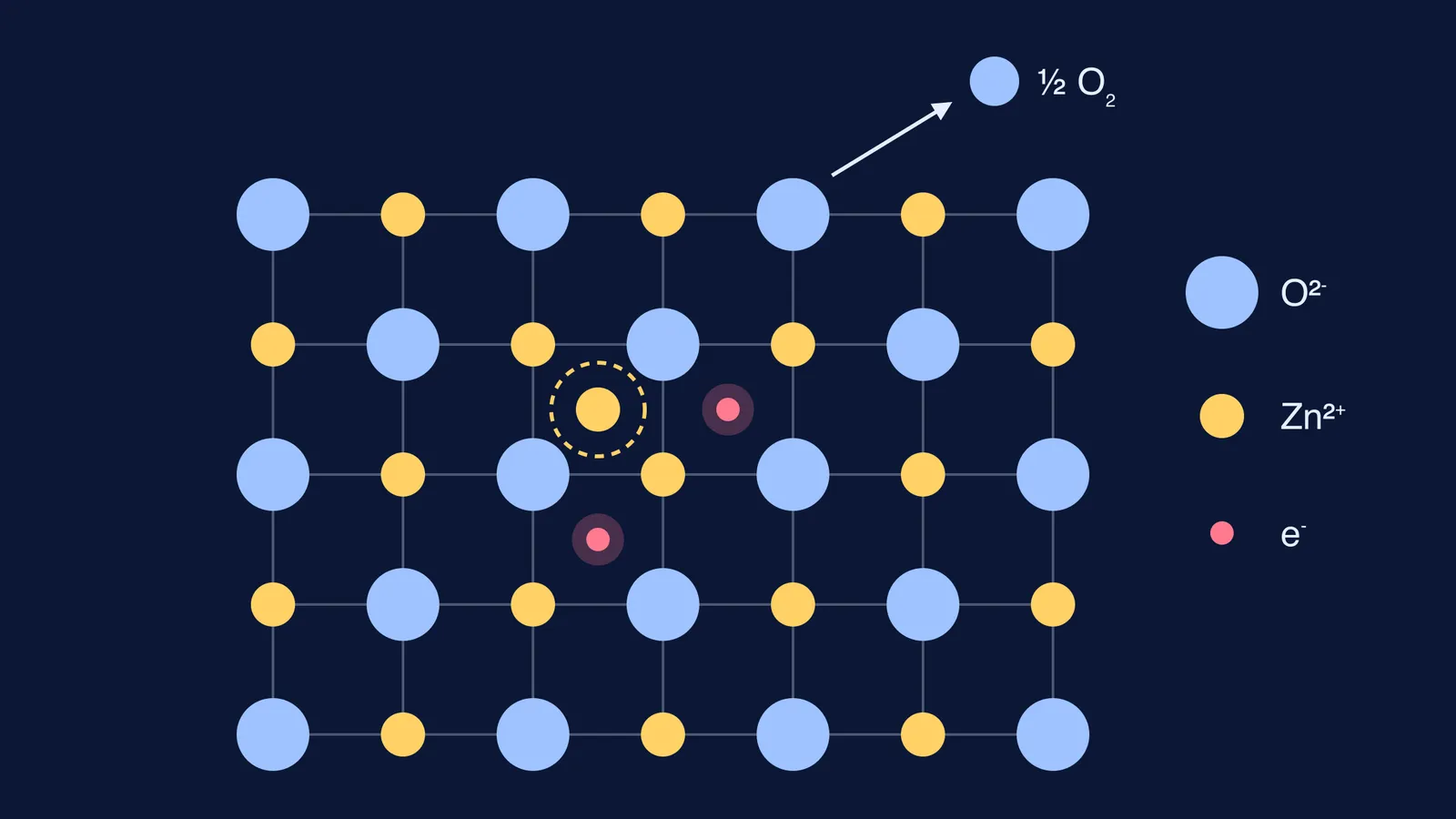
ZnO(s) → Zn²⁺ + ½O₂(g) + 2e⁻
The oxygen escapes as gas. The zinc stays behind as Zn²⁺ ions, which move into interstitial sites (the gaps between the normal lattice positions). The two electrons released by each lost oxygen get trapped at nearby interstitial sites, which keeps the crystal electrically neutral. The crystal now holds slightly more zinc than oxygen, so it is no longer exactly 1:1. Chemists call this non-stoichiometric. The reference entry on zinc oxide also puts the colour change down to a small loss of oxygen at high temperature, giving Zn₁₊ₓO with x = 0.00007 at 800 °C.
This is a metal excess defect caused by extra cations in interstitial sites. The same review by Rodnyi and Khodyuk notes that interstitial zinc ions in wurtzite ZnO can sit in either octahedral or tetrahedral sites.
If you want the NaCl case side by side, read our explainer on why F-centres colour NaCl crystals. For the opposite case, metal deficiency, work through the fraction of Fe³⁺ in non-stoichiometric FeO.
Why do trapped electrons make ZnO look yellow?
The trapped electrons are not bound as tightly as electrons in the full lattice. They can be excited by much less energy than 3.37 eV, so they absorb some visible light. According to the question bank answer, these electrons absorb radiation of a particular colour, and the solid looks yellow.
Put simply, some of the white light is absorbed and what is left looks yellow. On cooling in air, the textbook picture is that the crystal takes the oxygen back up, the defects disappear and it turns white again.
How should you write this in an exam?
A full-marks answer usually needs four points. Use this template for a 3-mark "give reason" question:
Observation: ZnO is white when cold and turns yellow on heating.
Equation: ZnO → Zn²⁺ + ½O₂ + 2e⁻ (oxygen is lost on heating).
Defect: the excess Zn²⁺ ions occupy interstitial sites and the electrons are trapped at neighbouring interstitial sites. This is a metal excess defect.
Colour: the trapped electrons absorb part of visible light, so the crystal appears yellow.
Check your answer for these common slips:
Calling it a Schottky or Frenkel defect. Those are stoichiometric defects; compare them in our post on how Schottky and Frenkel defects change density.
Writing "metal deficiency". ZnO gains relative zinc; it doesn't lose it.
Putting the electrons in anion vacancies. That is the NaCl F-centre picture, not the ZnO one.
Leaving out electrical neutrality. Two electrons balance each Zn²⁺.
If defects keep blurring into one another, the Fermi Concept Library gives each chemistry concept its own lesson and shows its place in the map. That can help you see stoichiometric and non-stoichiometric defects as separate branches.
Is the textbook model the whole story?
For exams, yes. In research, the defect chemistry of ZnO is still being argued about. Janotti and Van de Walle (2009) note that even the cause of the n-type conductivity commonly seen in as-grown ZnO is still under debate. Rodnyi and Khodyuk's review says the origin of the shallow donors in as-grown crystals "remains to be discussed". The interstitial-zinc model is the answer exams expect, but it simplifies what real crystals do.
For practice, the Fermi Problem Library has worked problems with a step-by-step solver that explains the reasoning rather than printing an answer.