On this page
Every catalyst speeds up a reaction. A zeolite also does a second job: its crystal is full of channels of fixed, molecular size, so it decides which molecules get in and which come out. In the early 1970s the oil company Mobil developed a process that uses this to turn methanol, a simple alcohol, into petrol, and New Zealand later built a full-scale plant around it (New Zealand Institute of Chemistry).
What is shape-selective catalysis?
Shape-selective catalysis is catalysis where the size and shape of a catalyst's pores control which molecules can react and which products can leave. P. B. Weisz and V. J. Frilette described it in a 1960 paper on molecular-shape-selective catalysis by zeolites.
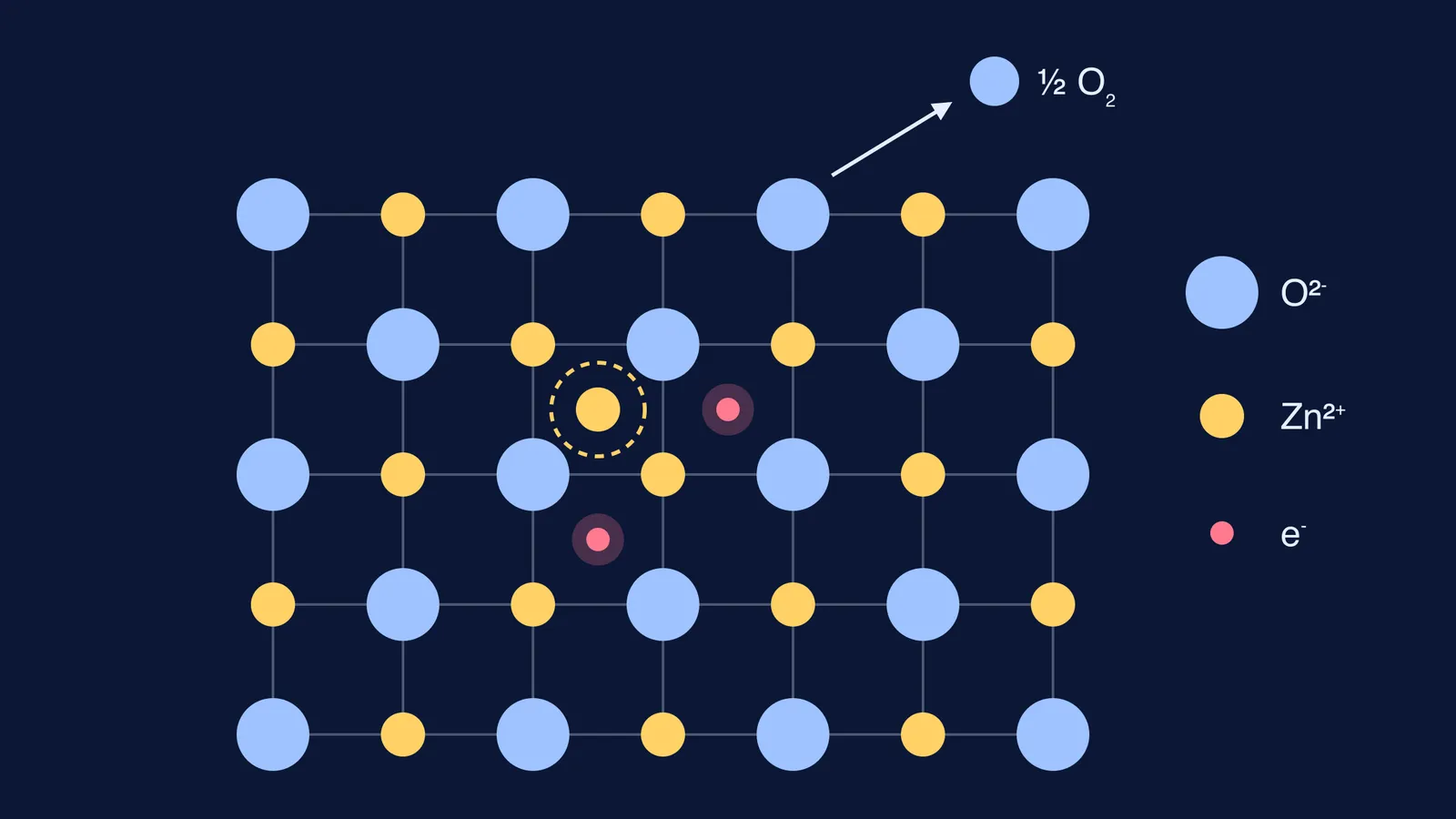
Zeolites are porous crystals whose frameworks are built from linked SiO4 and AlO4 tetrahedra (NZIC). Because the framework repeats, its pores come in a few fixed sizes throughout the crystal, like a sieve with identical holes.
ZSM-5 is a solid acting on gases, so it is a heterogeneous catalyst; see our explainer on homogeneous and heterogeneous catalysis with examples.
How big are the pores in ZSM-5?
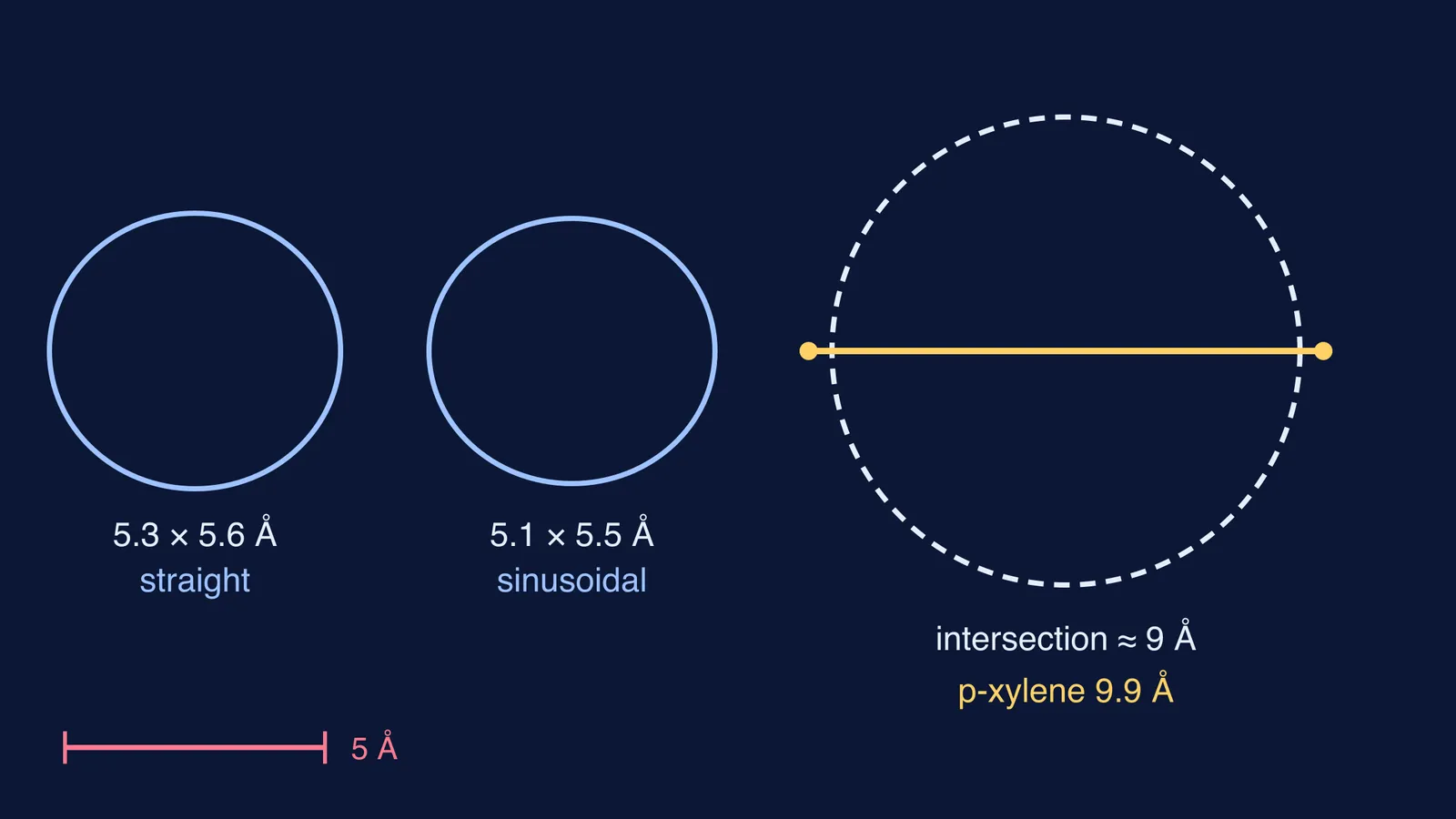
ZSM-5 has two sets of channels, each ringed by 10 oxygen-linked atoms. The zigzag (sinusoidal) channels measure 5.1 × 5.5 Å and the straight channels measure 5.3 × 5.6 Å, according to a 2023 review in Chemical Synthesis. One ångström (Å) is 10^-10 m, so these channels are about half a nanometre wide.
Where the two channels cross, there is slightly more room, close to 0.9 nm, the same review reports. A p-xylene molecule is 0.99 nm long, so it is hard for it to turn crosswise even there.
How does ZSM-5 convert methanol into petrol?
The Motunui plant in New Zealand ran the reaction in two stages (NZIC):
Methanol vapour at 300 to 320 °C passes over alumina, which dehydrates about 75% of it to an equilibrium mixture with dimethyl ether: 2CH3OH ⇌ CH3OCH3 + H2O.
At 400 to 420 °C, the mixture passes over ZSM-5. The ether loses more water to form small alkenes, which join together and close into rings.
Conversion of methanol is essentially 100%, and about 85 to 90% of the hydrocarbons formed can be used as petrol.
The pore size limits how big the products get. NZIC describes ZSM-5 as producing molecules in the C4 to C10 range, with practically no hydrocarbons above C10, and credits its channel shapes and sizes for this. Much bigger molecules have little room to form inside the channels or to diffuse out.
The plant's own problems show the ceiling. The product included durene (C10H14), a ten-carbon molecule at the top of that range, which melts at 79 °C, so the plant needed an extra step to convert it.
New Zealand chose this route in 1979 to cut its dependence on imported crude oil. The Motunui plant made about 14,000 barrels a day of unleaded petrol with an octane rating of 92 to 94, and it was taken out of production in late 1996 for economic reasons (NZIC). For the chemist behind many zeolite frameworks, read our profile of Edith Flanigen and her work on zeolites.
How is a zeolite like an enzyme?
In 1894 Emil Fischer published a paper on how the configuration of a sugar affects enzyme action. The idea it gave biology is the lock-and-key model: the substrate fits into the enzyme's active site to form an enzyme-substrate complex (University of Wisconsin chemistry). In 1958 Daniel Koshland Jr. proposed induced fit: binding changes the shape of both enzyme and substrate to give a better fit.
A zeolite channel is closer to Fischer's rigid lock:
The lock: a fixed silicate pore in ZSM-5; a folded protein pocket in an enzyme.
Chosen by: mostly size and shape in ZSM-5; shape plus the chemical groups lining the pocket in an enzyme.
Flexibility: very little in the zeolite; the enzyme reshapes as the substrate binds.
Conditions: about 400 °C for ZSM-5; body temperature for human enzymes.
In an exam, saying both are specific earns little; saying why each is specific earns the marks. For the kinetics side of enzymes, see our post on Michaelis-Menten enzyme kinetics.
How should you answer a question on zeolite catalysis?
A four-step answer for most textbook questions:
Define: the catalyst's pore size decides which reactants enter and which products leave.
Name the material: zeolites, porous aluminosilicate crystals with pores of fixed, molecular size.
Give the example: ZSM-5 dehydrates methanol to a mixture of hydrocarbons in the petrol range.
Say why it stops at petrol: larger molecules cannot easily form or escape through channels about 0.5 nm wide (Chemical Synthesis review).
One trap: the zeolite does not filter petrol out of a mixture. It builds the hydrocarbons inside its own channels.
If active site, adsorption and heterogeneous still blur together, the Fermi Concept Library gives every concept in chemistry and biology its own lesson and its place in the map, so you can see how catalysis connects to enzymes. To test yourself, the Fermi Problem Library has worked problems with a step-by-step solver that explains the reasoning rather than printing an answer.