

On this page
Edith Flanigen spent 42 years making crystals full of holes, first at Union Carbide and then at UOP. According to her National Inventors Hall of Fame profile, she was born on 28 January 1929, held 109 US patents, invented or co-invented more than 200 synthetic materials, and died on 6 January 2026. Those crystals now sit inside oil refineries, detergents and water clean-up systems.
Who was Edith Flanigen?
She was born in Buffalo, New York, and joined Union Carbide as a research chemist in 1952, the year she finished a master's degree at Syracuse University, says the Lemelson-MIT profile. She moved to molecular sieves in 1956 and pioneered mid-infrared spectroscopy for working out zeolite structures. The Hall of Fame records that she became head of Union Carbide's molecular sieve research team in 1968, was the first woman to receive the Perkin Medal, and received the US National Medal of Technology and Innovation in 2012.
What is a zeolite, and why do the pores matter?
A zeolite is a crystalline aluminosilicate whose framework contains channels and cages the size of small molecules. The Hall of Fame describes molecular sieves as crystals with molecule-sized pores that sort, separate and purify mixtures, and can also speed up hydrocarbon reactions.
One ångström (Å) is 0.1 nanometre, roughly the size of an atom. In ZSM-5, a widely used zeolite, the straight channels measure 5.3 × 5.6 Å and the sinusoidal (zigzag) channels 5.1 × 5.5 Å, according to a 2023 review in Chemical Synthesis.
Shape-selective catalysis means the pore decides the reaction: only molecules that fit can get in, only products that fit can get out, and only transition states that fit can form. The same review describes a classic case: slim para-xylene moves freely through both kinds of ZSM-5 channel, while bulkier ortho- and meta-xylene can only squeeze slowly through the straight ones. Para-xylene gets out faster, which is why ZSM-5 can favour it.
How did Edith Flanigen create synthetic zeolites?
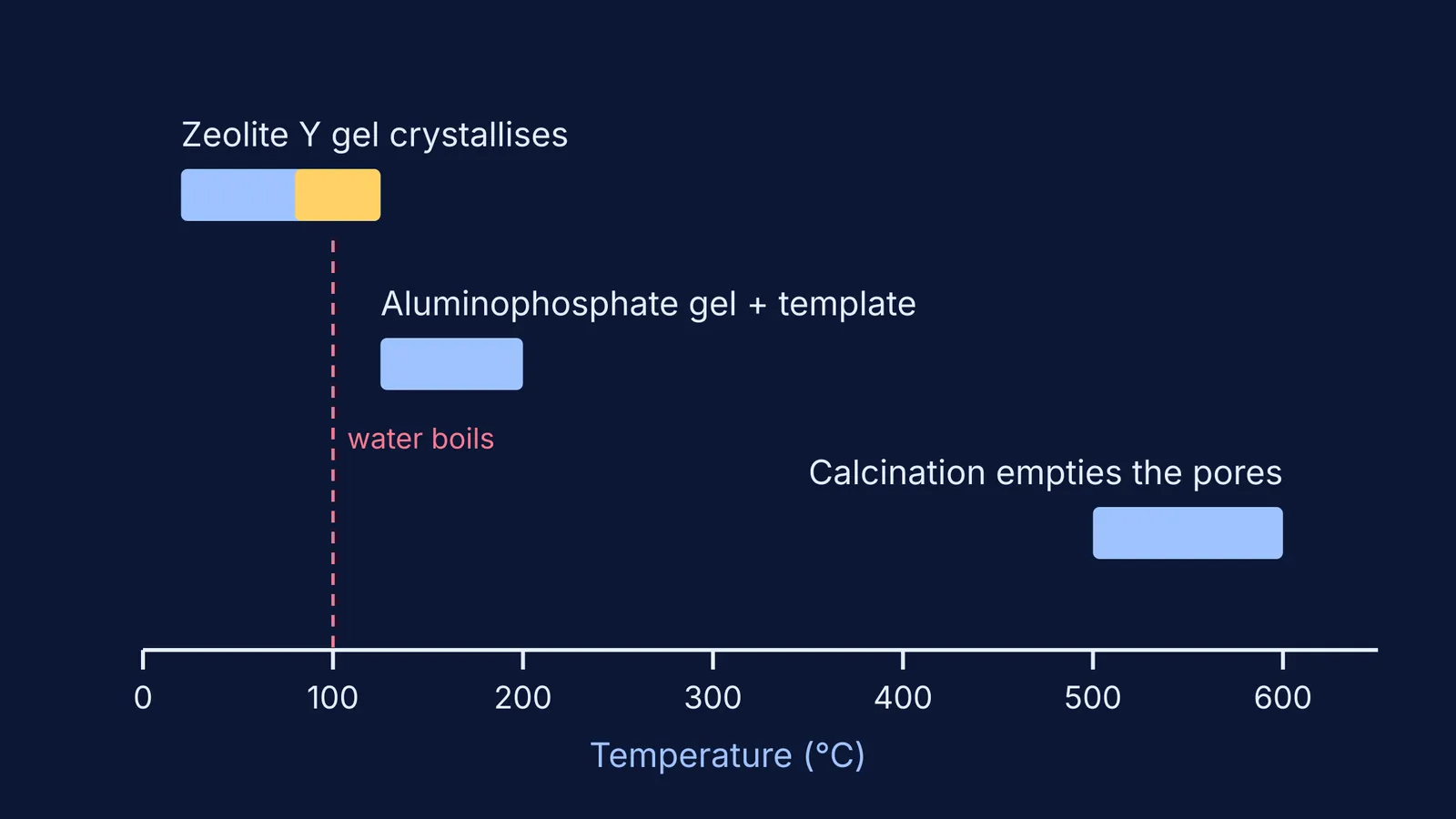
The Union Carbide method was to grow crystals from a gel in hot water, not to dig them up. The zeolite Y patent, filed in 1961 by her colleague Donald Breck, shows the recipe:
Mix a source of alumina (such as sodium aluminate) with a source of silica (such as sodium silicate or colloidal silica), plus sodium hydroxide to help control pH.
Hold the wet mixture between about 20 and 125 °C, preferably 80 to 125 °C, until crystals form.
Check the product: the patent defines zeolite Y as a sodium aluminosilicate with more than 3 and up to about 6 SiO2 units for every Al2O3.
The patent names Breck as the inventor, and the Hall of Fame's story of her work credits Flanigen with substantial contributions to developing zeolite Y for refining.
Her own big step was to change the ingredients. In a 1982 patent with Stephen Wilson and Brent Lok, she dropped silica, used phosphoric acid with an alumina source, and added an organic amine as a template, a molecule the crystal grows around. The gel crystallised at 125 to 200 °C for one to seven days. Heating the product in air at about 500 to 600 °C for 2 hours burned the template away, leaving uniform pores of about 3 to 10 Å. The team announced these aluminophosphates as "a new class of microporous crystalline inorganic solids" in the title of a 1982 paper in the Journal of the American Chemical Society.
Where are zeolites used today?
In 1962, refineries began putting synthetic faujasites, zeolite X at first and zeolite Y slightly later, into fluid catalytic cracking, the process that breaks heavy oil into petrol. The publisher's description of Catalysis and Zeolites says these catalysts were orders of magnitude more active than the older silica-alumina ones and raised petrol yield substantially.
The Hall of Fame also lists laundry detergents, water purification and cleaning contaminated water at Japan's Fukushima Daiichi nuclear plant.
How can you explain shape-selective catalysis in an exam answer?
Use this four-line frame for any "why are zeolites good catalysts?" question:
Structure: crystalline aluminosilicate with a honeycomb of pores and cages of fixed size.
Rule: a molecule reacts only if it fits the pore, and a product leaves only if it fits.
Example: in ZSM-5, para-xylene escapes the channels more easily than ortho- or meta-xylene, so it can be favoured.
Use: petrol from heavy oil (zeolite Y) and xylene chemistry (ZSM-5).
If rates still feel shaky, revisit collision theory and catalysts, with numbers, compare why transition metals make good catalysts, or go back to Elizabeth Fulhame and the first idea of catalysis.
If words like adsorption or aluminosilicate trip you up, the Fermi Concept Library gives each chemistry concept its own lesson and its place in the map, so you can fill the gap first.
As the National Inventors Hall of Fame quotes her: "Good ideas are even better ideas when they can improve people's lives and help the Earth."


