On this page
If a question gives you Fe0.93O and asks what fraction of the iron is Fe³⁺, you need one idea: the crystal must be electrically neutral. Below is the full method, a quick check that catches slips, and a formula that works for any FeₓO in seconds.
Why is FeO written as Fe0.93O?
Iron(II) oxide, the mineral wüstite, almost never has a perfect 1:1 ratio of iron to oxygen. A 2025 study in npj Computational Materials describes wüstite as an oxide with a NaCl-type structure and a high proportion of iron vacancies. The same paper gives its composition as Fe₁₋ₓO with x between 5.4 × 10⁻² and 1.6 × 10⁻¹, so Fe0.93O (x = 0.07) sits inside the real range.
Textbooks call this a metal deficiency defect. Some Fe²⁺ sites are empty, which removes positive charge. Some of the remaining iron is oxidised to Fe³⁺ to make up the loss.
How do you find the fraction of Fe³⁺ ions in Fe0.93O?
Take one formula unit: 0.93 iron ions and one O²⁻ ion, the Fe₁₋ₓO composition with x = 0.07.
Let the number of Fe²⁺ ions be a and the number of Fe³⁺ ions be b.
Count the iron: a + b = 0.93.
Balance the charge: 2a + 3b = 2, because one O²⁻ carries −2.
Multiply the first equation by 2: 2a + 2b = 1.86.
Subtract it from the charge equation: b = 2 − 1.86 = 0.14.
So a = 0.93 − 0.14 = 0.79.
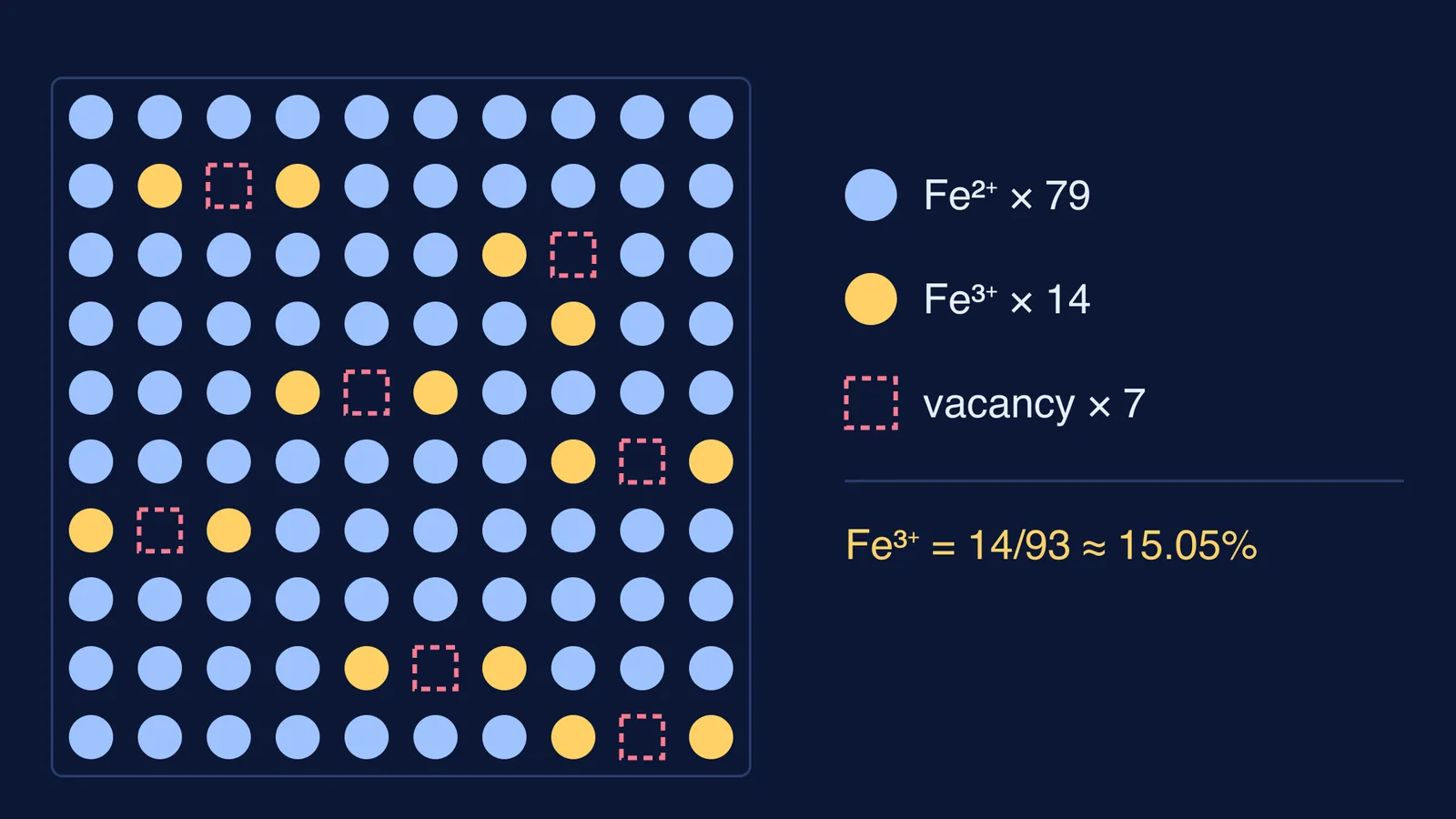
Fraction of Fe³⁺ = 0.14 / 0.93 = 0.1505, or about 15.05%.
Fraction of Fe²⁺ = 0.79 / 0.93 = 0.8495, or about 84.95%.
The two percentages add to 100%. Scale up to 100 oxide ions and you get 79 Fe²⁺, 14 Fe³⁺ and 7 empty iron sites, which is what the diagram at the top shows.
How can you check the answer in ten seconds?
Use the vacancies. Perfect FeO has 1.00 iron per oxygen, so Fe0.93O is missing 0.07 Fe²⁺ ions, a charge shortfall of 0.07 × 2 = 0.14. Each Fe²⁺ that becomes Fe³⁺ adds back +1, so you need 0.14 Fe³⁺ ions. If the two methods disagree, one of them has an arithmetic slip.
Is there a shortcut for any FeₓO question?
Yes. Solve the same two equations with n iron ions instead of 0.93, for any n in the range reported for real wüstite:
Fe³⁺ ions per formula unit: b = 2 − 2n
Fe²⁺ ions per formula unit: a = 3n − 2
Percentage of iron as Fe³⁺: (2 − 2n) / n × 100
Try it on the versions examiners like to swap in:
Fe0.95O: b = 0.10 and a = 0.85, so Fe³⁺ is 0.10 / 0.95, about 10.53% of the iron.
Fe0.98O: b = 0.04 and a = 0.94, so Fe³⁺ is about 4.08%.
Fe0.85O: b = 0.30 and a = 0.55, so Fe³⁺ is about 35.29%.
Two sanity checks are built in. At n = 1 the formula gives b = 0: ordinary FeO with no Fe³⁺. At n = 2/3 it gives a = 0: that is Fe₂O₃ scaled to one oxygen, where all the iron is Fe³⁺.
What do real crystals add to the textbook picture?
The exam model puts every Fe³⁺ on a normal iron site. The npj Computational Materials paper by Zeng Liang and colleagues notes that a portion of the iron sits in interstitial sites, and its simulations found that iron vacancies tend to gather into stable clusters rather than scatter at random.
That does not change your answer. Charge balance counts ions, not where they sit, so 0.14 Fe³⁺ per formula unit holds whichever sites they occupy. It is still worth knowing: it explains why Fe0.93O is best read as an average over a whole crystal, not a description of every unit cell.
What mistakes cost marks on this question?
Dividing by 1 instead of 0.93. The fraction of iron present as Fe³⁺ is 0.14 / 0.93, not 0.14.
Answering the wrong ratio. A percentage of Fe³⁺ is usually out of all the iron; the ratio Fe³⁺ : Fe²⁺ is 14 : 79, a different quantity. Read which one is asked.
Rounding too early. Keep 0.14 and 0.79 exact until the last step.
Counting one Fe³⁺ per vacancy. Each missing Fe²⁺ is balanced by two Fe³⁺, never one.
If the set-up is where you went wrong, the Fermi Problem Library has worked problems with a step-by-step solver that explains the reasoning rather than printing an answer. To revise defects in solids from the start, the Fermi Concept Library gives each chemistry concept its own lesson and its place in the map.
Your next step: cover this page, solve Fe0.95O on paper, and check your answer against the shortcut list above.