

On this page
When physics students encounter an X-ray tube problem, one question routinely catches them off guard: if the tube's accelerating potential difference doubles, how does the shortest wavelength of the emitted X-rays change? Many guess that the wavelength doubles or that it shifts by the square root of two because kinetic energy involves velocity squared. In reality, the cutoff wavelength is cut cleanly in half. This inverse relationship—known as the Duane–Hunt law—anchors one of the cleanest demonstrations of energy conservation and photon quantization in modern physics.
What happens to the shortest X-ray wavelength when tube voltage doubles?
In an X-ray tube, electrons emitted from a heated cathode accelerate across an electric potential difference V toward a heavy metal anode. Each electron arrives at the target with kinetic energy K = eV, where e is the elementary charge. When these energetic electrons strike target atoms, they decelerate abruptly in the strong electrostatic fields of the target nuclei. This deceleration produces continuous radiation known as bremsstrahlung, or braking radiation.
Most electrons lose their energy through multiple successive collisions, shedding energy as heat or emitting lower-energy, longer-wavelength photons. However, the maximum possible photon energy occurs during a single, head-on impact where an electron surrenders its entire kinetic energy at once. Conservation of energy requires that this maximum photon energy cannot exceed the electron's kinetic energy: E_max = hν_max = hc / λ_min = eV.
In 1915, physicists William Duane and Franklin L. Hunt established this relationship experimentally in the Physical Review. Rearranging their formula shows that the cutoff wavelength is strictly inversely proportional to the accelerating voltage:
λ_min = hc / (eV)
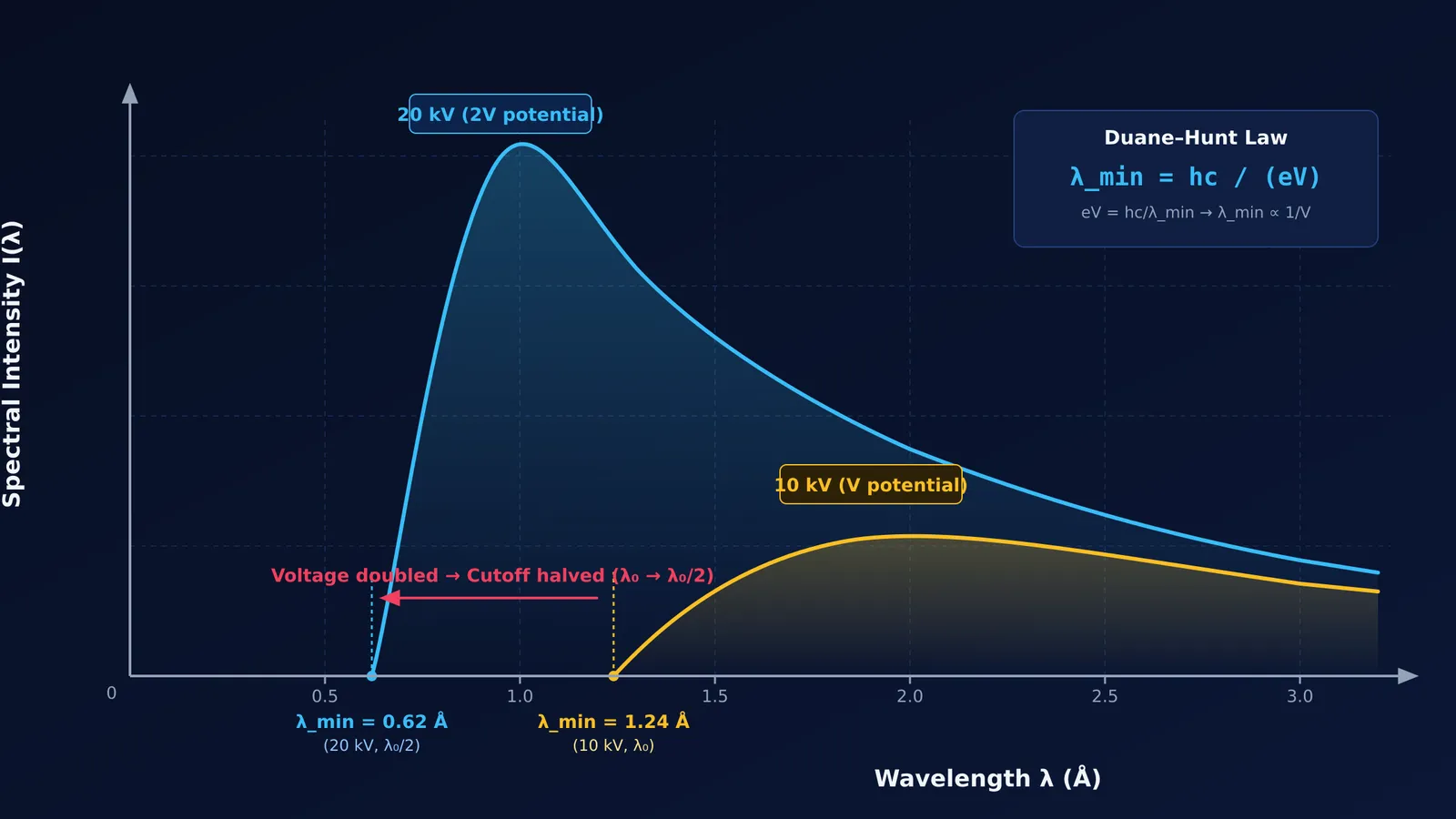
If you double the tube voltage from V to 2V, the new cutoff wavelength becomes λ′_min = hc / (2eV) = λ_min / 2. The threshold shifts to exactly half its original value.
Why does predicting the outcome before calculating change how you learn?
Knowing the formula is rarely enough to build lasting physical intuition. In classroom settings, students often memorise λ_min ∝ 1/V without confronting their implicit mental models. When faced with a real problem, they easily confuse the electron's de Broglie wavelength—which scales as 1/√V—with the emitted photon's cutoff wavelength, which scales as 1/V.
Active prediction breaks this trap. In an investigation on classroom demonstrations published in the American Journal of Physics, Catherine H. Crouch, Adam P. Fagen, J. Paul Callan, and Eric Mazur demonstrated that passive observation yields little learning. Students who merely watched a demonstration achieved 70% correct outcome identification and 24% correct explanations on conceptual tests, showing no statistically significant gain in explanation over students who saw no demonstration at all (61% outcome, 22% explanation). But when students were asked to predict the outcome first, correct outcomes rose to 77% and correct explanations reached 30%.
When you write down a prediction before seeing the result, your brain commits to an explicit hypothesis. If the observation contradicts your guess, the resulting cognitive conflict forces you to pinpoint where your reasoning failed. Research comparing interactive simulations versus static textbook diagrams confirms that manipulating variables in real time helps anchor these concepts. When students struggle to visualise how changing tube voltage reshapes the entire continuous spectrum while leaving characteristic peaks fixed, the Fermi Simulation Lab offers interactive simulations for ideas that are easier to see than to read.
How do you calculate cutoff wavelength with eV = hc/λ?
To turn this relationship into rapid numerical answers, you can combine the universal constants. According to the NIST Reference on Constants, Units, and Uncertainty, Planck's constant is h = 6.62607015 × 10⁻³⁴ J s, the speed of light in vacuum is c = 299792458 m/s, and the elementary charge is e = 1.602176634 × 10⁻¹⁹ C.
Multiplying these values yields hc / e ≈ 1.23984 × 10⁻⁶ V m, or 1239.84 V nm. For competitive exams, rounding gives the standard working shortcuts:
In angstroms: λ_min (in Å) ≈ 12400 / V (in Volts)
In nanometers: λ_min (in nm) ≈ 1240 / V (in Volts)
Our guide on the shortcut for photon energy E = 1240/λ explains how to apply this conversion across modern physics problems.
Consider an X-ray tube operating at V₁ = 10 kV (10,000 V): λ_min,1 ≈ 12400 / 10000 = 1.24 Å (0.124 nm)
When the potential difference doubles to V₂ = 20 kV (20,000 V): λ_min,2 ≈ 12400 / 20000 = 0.62 Å (0.062 nm)
The cutoff wavelength drops by exactly 50%. If you want to practice multi-step problems connecting accelerating potential to photon frequency and momentum, the Fermi Problem Library provides worked problems with a step-by-step solver that explains the reasoning rather than printing an answer.
What are the most common exam traps around X-ray cutoff?
Questions in JEE and NEET often combine voltage changes with other experimental adjustments to test whether you understand what governs the continuum versus line spectra:
Target anode material: Switching from a tungsten target to a molybdenum target changes the sharp characteristic spikes, which obey Moseley's law and characteristic X-ray wavelengths. However, it does not shift λ_min at all.
Filament current: Increasing the filament heating current raises the number of thermionic electrons hitting the target per second. This increases the total intensity and height of the spectrum, but λ_min remains identical.
De Broglie vs photon wavelength: The de Broglie wavelength of an electron entering the target is λ_e = h / √(2m eV), scaling with 1/√V. The shortest emitted X-ray photon wavelength is λ_min = hc / (eV), scaling with 1/V. Confusing these two equations is the single most frequent calculation error.
For learners who want to trace how kinetic energy transforms into electromagnetic radiation from first principles, the Fermi Concept Library covers every concept in physics, each with its own lesson and its place in the map.


