

On this page
In late February 2026, six planets (Mercury, Venus, Jupiter, Saturn, Uranus and Neptune) were in the sky at the same time, and National Geographic was one of many outlets calling it a planetary parade. The planets had not formed a queue in space. What lined up was our view of them, and the reason tells you how the solar system is built.
What is a planetary parade?
“Planet parade” isn't a technical term in astronomy, according to NASA's skywatching guide; it is a popular name for times when several planets are visible at once. NASA notes that five planets can be seen without optical aid: Mercury, Venus, Mars, Jupiter and Saturn.
So a “six-planet parade” is not six bright dots to the naked eye. National Geographic points out that Uranus and Neptune need a telescope.
These line-ups are not once-in-a-lifetime events. NASA says line-ups of four or five naked-eye planets with good visibility “typically occur every few years”, and its list of upcoming line-ups includes late October 2028, when five planets should be visible at once before sunrise (NASA).
Why do planets line up in the sky?
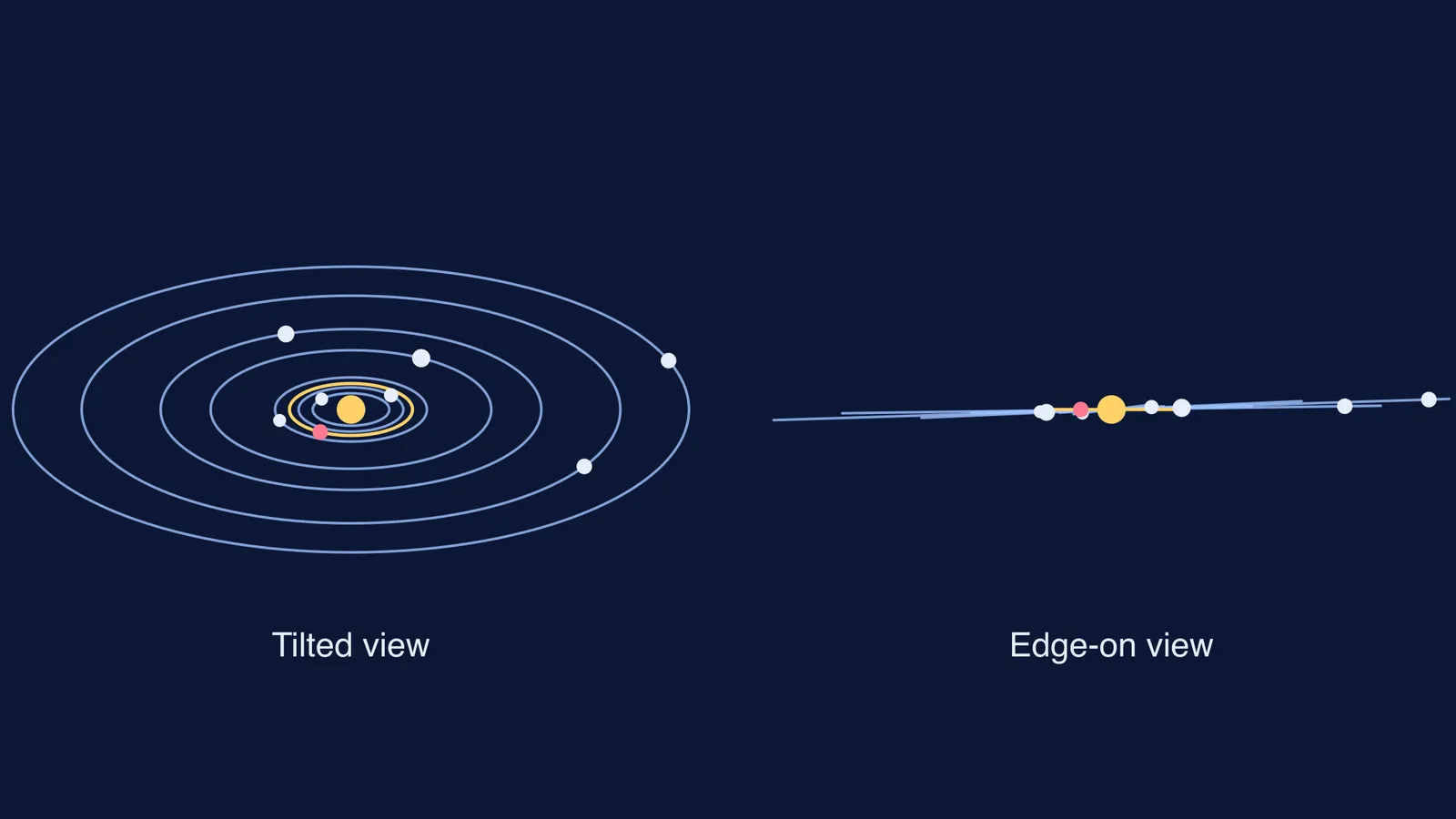
The planets orbit the Sun in a relatively flat, disc-shaped plane, and because we look at that disc edge-on from inside it, it appears as a line called the ecliptic (NASA).
Picture a steel thali with a few peas scattered across it. From above, the peas are spread all over the plate. Crouch until your eye is level with the rim and every pea seems to sit on one line, near or far. Earth is one of those peas, so we always see the others from the rim.
The disc really is flat. NASA's planetary fact sheet gives each planet's orbital inclination, the tilt of its orbit compared with Earth's:
Mercury: 7.0°
Venus: 3.4°
Mars: 1.8°
Jupiter: 1.3°
Saturn: 2.5°
Uranus: 0.8°
Neptune: 1.8°
No planet's orbit is tilted more than 7.0° from Earth's, according to the same fact sheet. That is why the planets never wander far from the ecliptic, and why the orbits in the diagram above collapse into a thin bundle when seen edge-on.
Why is it an arc and not a straight line?
NASA describes the planets as appearing “along a line or arc across the sky” (NASA). The ecliptic is a circle running all the way round the sky, so a long stretch of it seen against the dome above you bends. Expect a loose curve of bright points, not a ruler-straight row.
Do planetary alignments affect Earth?
No. Planetary alignments don't trigger natural disasters or meaningfully change Earth's gravity, and the combined pull of the other planets is negligible next to the Moon's and the Sun's, as National Geographic explains. If a family WhatsApp forward says otherwise, the thali picture is a calm reply: the planets look lined up because of where we stand.
How can you see a planetary parade from India?
Here is a plan for one evening with a parent or friend.
Pick your time. Mercury and Venus orbit closer to the Sun than Earth does, so they never stray far from it in our sky; NASA says Mercury is visible only just after sunset or just before sunrise (NASA). Check a sky calendar for which side of the night your parade is on.
Find a low, open horizon, such as a terrace or a field. NASA advises that a planet needs to be at least a few degrees above the horizon to be seen, and 10° or higher is best, because air near the ground dims objects.
Measure with your hand. Held at arm's length, your little finger covers about 1° and the span from thumb to little finger about 25°, according to NASA JPL's Night Sky Network.
Start with the brightest point. In the evening or morning sky that is often Venus; here is why Venus is the brightest planet.
Join the dots: trace a curve through the Sun's setting point and the bright planets.
Come back three nights later. The planets will have shifted along the same path, and sometimes one appears to reverse; see why Mars appears to move backwards.
To feel how far apart the “parade” really is, build a solar system scale model at home and then look along it from one end.
How do you picture this for exams?
The hard part is switching between two views: the solar system from above, and the sky from Earth. If that switch is difficult to hold in your head, the Fermi Simulation Lab has interactive simulations for the ideas that are easier to see than to read.
Next clear evening, go outside after sunset, find Venus, and trace the ecliptic from there.


