

On this page
Most textbook pictures put the planets in a neat row, evenly spaced. NASA's Jet Propulsion Laboratory points out that this picture is misleading, and its Solar System Scroll activity shows the real spacing with a strip of paper. You can do the same at home in two sizes: one that fits in your hands, and one that needs your whole lane or colony road. Only the scale changes.
How do you make a pocket solar system from a toilet roll?
This version comes from JPL's Solar System Scroll, which suggests a strip about one "wingspan" long (fingertip to fingertip with arms spread) and says it takes under 30 minutes. You need a roll of toilet paper or accounting paper and a marker.
Tear off a strip as long as your child's arm span. Draw the Sun at one end and Pluto at the other.
Fold the strip in half and open it. Mark Uranus at the crease (the 1/2 point).
Fold the Sun end to the middle crease. That new crease, at 1/4, is Saturn. Fold the Pluto end to the middle too: that crease, at 3/4, is Neptune.
Fold the Sun end to the Saturn crease. That 1/8 point is Jupiter.
Fold again: 1/16 is the asteroid belt, and 1/32 is Mars.
Now squeeze Mercury, Venus and Earth into the tiny gap between the Sun and Mars.
Every fold halves the distance, and the four rocky planets end up crowded at one end. JPL notes that this crowding is why they are called the inner planets.
How far apart are the planets really?
The numbers behind both models come from NASA's Planetary Fact Sheet. Earth's average distance from the Sun is 149.6 million km. Jupiter is 778.5 million km away, Uranus 2,867 million km and Neptune 4,515 million km.
The folding trick works because, from Jupiter outwards, each planet is very roughly twice as far out as the one before. Half of Pluto's 5,906 million km is about 2,953 million km, close to Uranus. A quarter is about 1,477 million km, close to Saturn's 1,432 million km. The fit is not perfect, so if your child spots that Mars sits a bit further out than 1/32, praise the sharp eye.
How do you build a street-sized solar system in your lane?
For the big model we picked a scale where 1 astronomical unit (Earth's distance from the Sun) is 10 metres. We worked out every distance below from NASA's Planetary Fact Sheet, and every size from the same page plus NASA's Sun Fact Sheet, which gives the Sun's radius as 695,700 km.
At this scale the Sun is a ball about 9.3 cm across. Earth is a dot under 1 mm wide, a pencil tip pressed onto card. Jupiter, the largest planet, is under 1 cm.
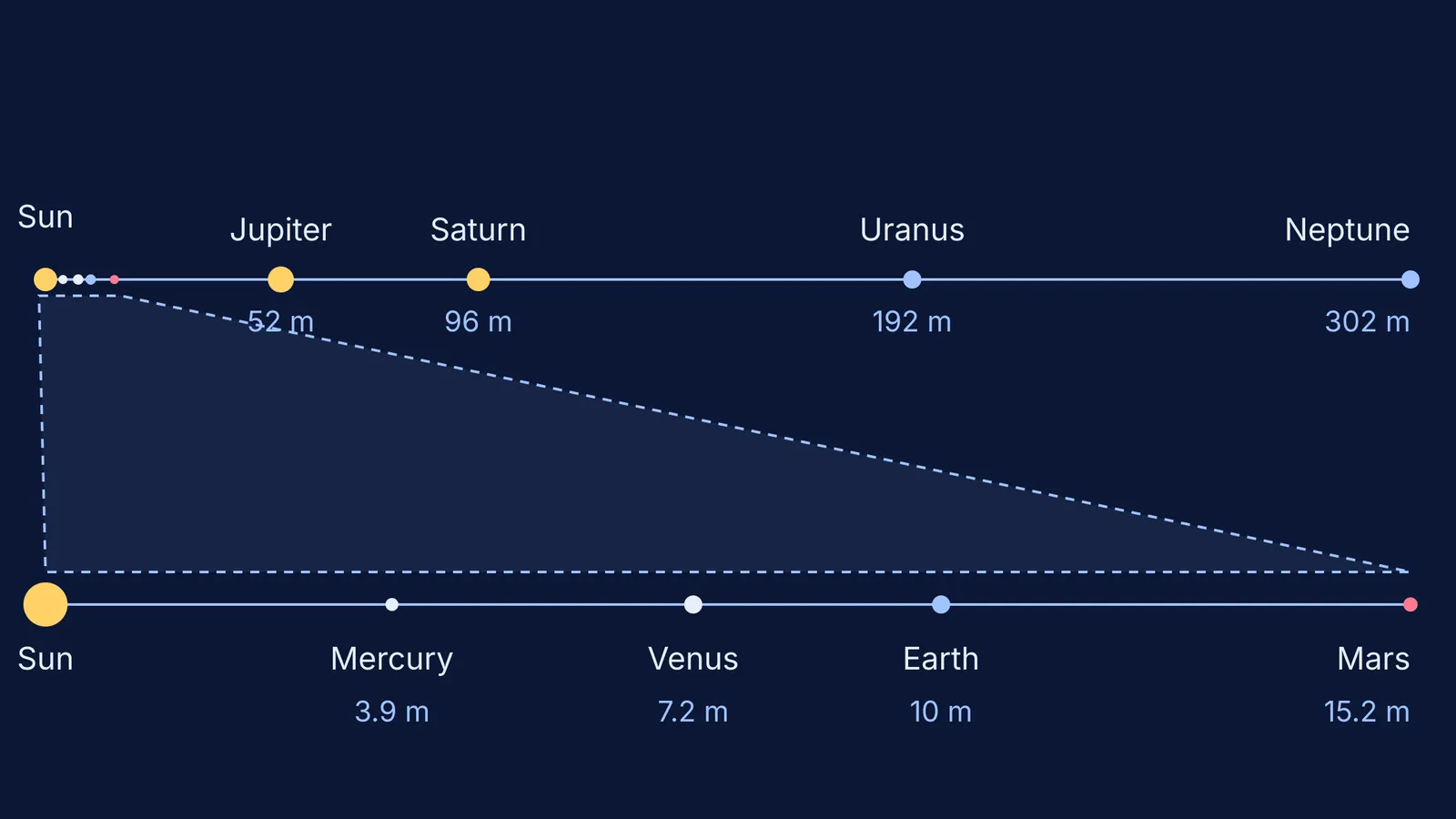
Place each object this far from the Sun:
Mercury: 3.9 m (a 0.3 mm speck)
Venus: 7.2 m (0.8 mm)
Earth: 10 m (0.9 mm)
Mars: 15.2 m (0.5 mm)
Jupiter: 52 m (9.6 mm)
Saturn: 96 m (8.1 mm)
Uranus: 192 m (3.4 mm)
Neptune: 302 m (3.3 mm)
Stick each planet on a card and let a child hold it at its spot. Most lanes run out long before Neptune, and that is the point. Stand at Earth, look back at the 9 cm Sun, then look towards the end of the road where Saturn and the rest are still waiting.
What should you say while you walk it?
A short script helps the idea stick without turning it into a lecture:
At Earth: "Everything you have ever seen with your own eyes, apart from the sky, is on this dot."
Halfway to Jupiter: "How many steps since the last planet? What was in between?" (Mostly empty space.)
At Jupiter: "This is the biggest planet. Is it bigger or smaller than the Sun ball?"
At the end of the lane: "Neptune is still further than this. Where do you think it would be?"
Ask your child to count paces between planets and write them down. Guess first, then measure, the same habit as in our estimation games for kids. Older children can check the scale themselves: divide each distance on NASA's Planetary Fact Sheet by 14.96 million km to get metres.
What can you do after the model?
The models show where the planets are, not how they move. A teenager who wants to see why the outer planets crawl around their orbits can read our guide to planetary orbits with a gravity simulation, then explore the Fermi Simulation Lab, which has interactive simulations for ideas that are easier to see than to read. For younger children, the real sky is the next step: our 30-night stargazing plan for a city balcony helps you find the bright planets you just paced out.


