On this page
Ask a seven-year-old how long the dining table is and you may hear "a hundred metres". That's a child who knows numbers but hasn't linked them to real sizes yet. Guess-then-measure games build that link: your child commits to a guess, checks it with a ruler, kitchen scale or measuring jug, and sees how far off they were. All you need is ten minutes and your kitchen.
Why does guessing before measuring help?
Researchers call this skill measurement estimation. A 1998 review by Elana Joram, Kaveri Subrahmanyam and Rochel Gelman describes skilled estimators as people who "move fluently back and forth" between a written or spoken measurement and a sense of how big it really is (Review of Educational Research, 1998).
A later study tested one strategy directly. In a 2005 study of 44 third-graders, children who used a reference point had more accurate ideas of standard units and more accurate length estimates than children who did not (Joram and colleagues, Journal for Research in Mathematics Education, 2005). Half the children were taught the reference point strategy and half a plain guess-and-check routine. The authors note that children rarely use reference points on their own, so this is where you come in.
Research on number games offers a related clue. Low-income preschoolers (mean age 5.4 years) who played a linear number board game for roughly an hour improved at number line estimation and three other number tasks, and the gains remained nine weeks later (Ramani and Siegler, Child Development, 2008). In children aged 6 to 8, number line estimates correlated strongly with maths achievement test scores (Siegler and Booth, Child Development, 2004). That's a link, not proof that games raise marks.
How do you play guess-then-measure at home?
Pick one quantity: length (ruler or tape), mass (kitchen scale) or volume (measuring jug).
Your child says a number and a unit out loud before touching any tool. Write it down.
Measure together, and let your child read the scale.
Work out how far off the guess was: the difference divided by the measured amount, times 100.
Score it: within 10% earns 3 points, within 25% earns 2 and within 50% earns 1.
Before the next guess, pick a benchmark: something you have just measured, or a body part such as a handspan.
For children under seven, skip the percentages and just ask: "Too big or too small?"
What does a 10-minute round look like?
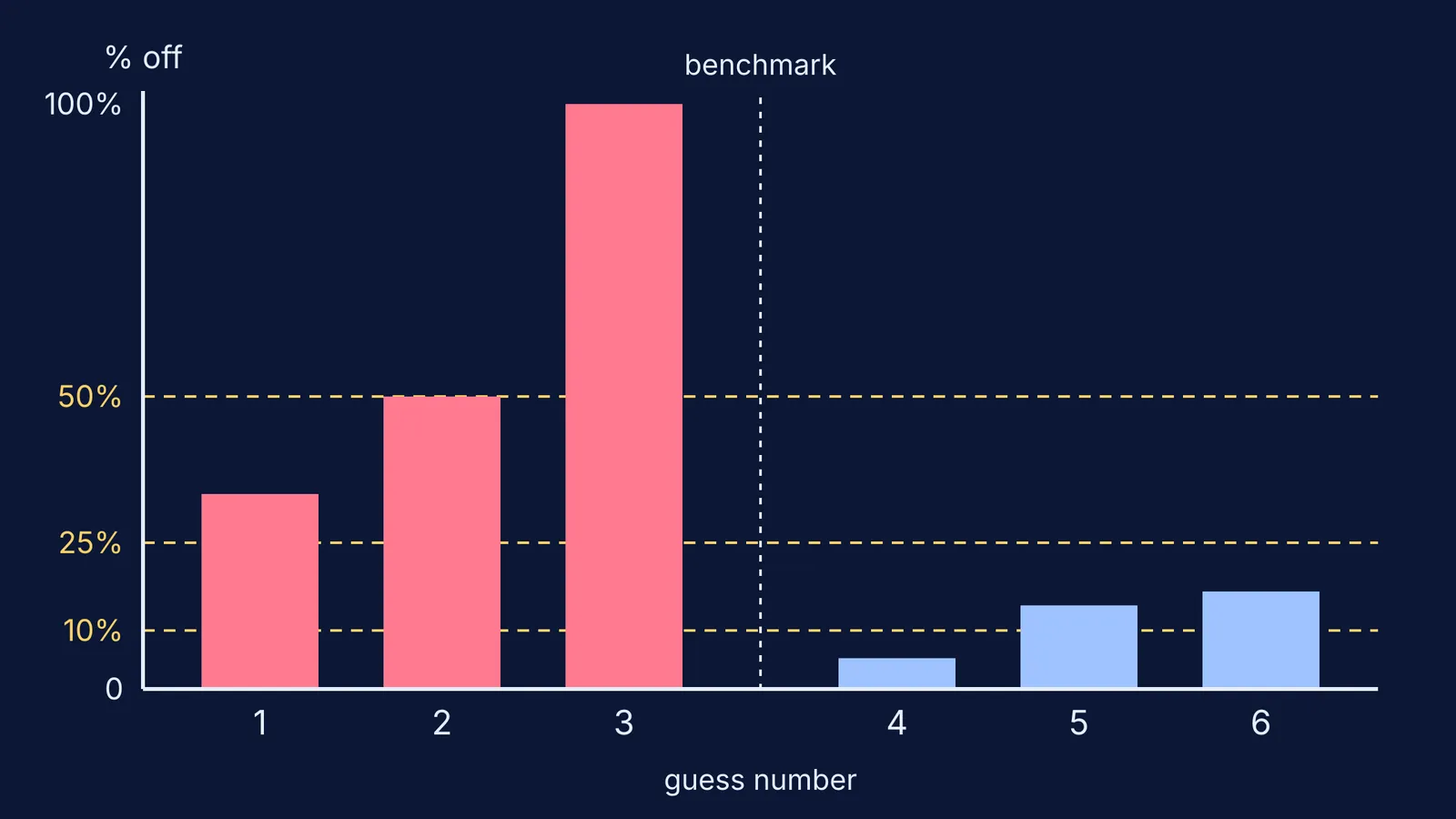
Here is one made-up evening with an eight-year-old, before and after benchmarks (the chart above uses these numbers).
Dining table: guess 100 cm, measured 150 cm. 50 divided by 150 is about 33% off: 1 point.
Bag of potatoes: guess 3 kg, measured 2 kg. 50% off: 1 point.
Steel tumbler of water: guess 500 ml, measured 250 ml. 100% off: 0 points.
Now the benchmark step. Your child measures their handspan (say 20 cm), holds a 1 kg salt packet and pours a 1 litre bottle into the jug.
Bed: "nine handspans", so 180 cm; measured 190 cm. About 5% off: 3 points.
School bag: "four salt packets", so 4 kg; measured 3.5 kg. About 14% off: 2 points.
Bathroom mug: "one bottle", so 1 litre; measured 1.2 litres. About 17% off: 2 points.
The score went from 2 points to 7, and every later guess started from something your child had held or measured.
Which estimation games work for length, mass and volume?
Length, string snake: cut string to a guessed 50 cm, then check it against a ruler.
Mass, heavier or lighter: sort five things by holding them in your hands, then check the order on the kitchen scale.
Mass, apple count: guess how many apples make 1 kg, then add them to the scale one at a time.
Volume, fill to the line: pour what you think is 200 ml into a glass, then check it in the jug.
These go well with our five safe kitchen science experiments. For what school adds later, see our guide to measurement of length and motion in Class 6.
What should you say when the guess is way off?
Wild guesses are fine; the measuring is what teaches. Try these lines:
"Interesting. What made you think 3 kg?"
"Was it too big or too small? Which way will you go next time?"
"What do we already know that's about that size?"
"My guess was further off than yours. Let's both try again."
Avoid "That's wrong" or "Guess properly." If maths makes you tense yourself, read what research found about parents' maths anxiety and what to do about it. A game where everyone guesses, you included, takes the pressure off.
If an older sibling asks why a tall glass and a wide bowl can hold the same water, and the answer is beyond what you remember from school, the Fermi Concept Library has a lesson for every concept in physics and mathematics.
Start tonight with one object, one tool and one guess written on a sticky note on the fridge.