

On this page
The sky above a city balcony is not empty. The Moon, a few planets and the International Space Station shine through the glow, and watching them for a month builds a scientist's habits: look, record, predict, check.
What can children see from a city without a telescope?
Light pollution is why city skies look bare. A 2016 world atlas of night sky brightness found that more than 80% of the world's people live under light-polluted skies, and the Milky Way is hidden from more than one-third of humanity. The atlas's country table puts about 19.5% of India's population under skies bright enough to hide the Milky Way.
It is getting worse. Using 51,351 naked-eye observations from citizen scientists, a 2023 study in Science found that the number of visible stars fell by an amount that matches the sky brightening by 7 to 10% per year between 2011 and 2022.
Here is what still gets through, even from a bright city:
The Moon, in every phase except the few days around new moon.
Planets. NASA notes that five planets are visible without optical aid: Mercury, Venus, Mars, Jupiter and Saturn.
The space station. NASA's Spot the Station page describes it as looking like a very bright star moving across the sky, with no flashing lights, seen within a few hours of sunrise or sunset.
The brightest stars, often enough to pick out a constellation.
How do you start stargazing on a balcony tonight?
You need nothing new. NASA's skywatching guide says your own eyes are often the best way to enjoy observing, with binoculars as a sensible first instrument later.
Switch off the lights behind you. Our eyes take approximately 30 minutes to adapt to the dark, according to NASA's Night Sky Network, and white light undoes it. Red light lets pupils stay open longer, so read the notebook by a red torch.
Find west. Note where the Sun sets. The young crescent Moon sets soon after it, so in week one you look low on that side.
Learn the fist ruler. The width of your fist held at arm's length equals about 10 degrees, for children too, because smaller fists come with shorter arms.
Pick a fixed spot. Stand in the same place each night, beside a railing or building edge you can use as a marker.
How do you run a month of moon-watching with kids?
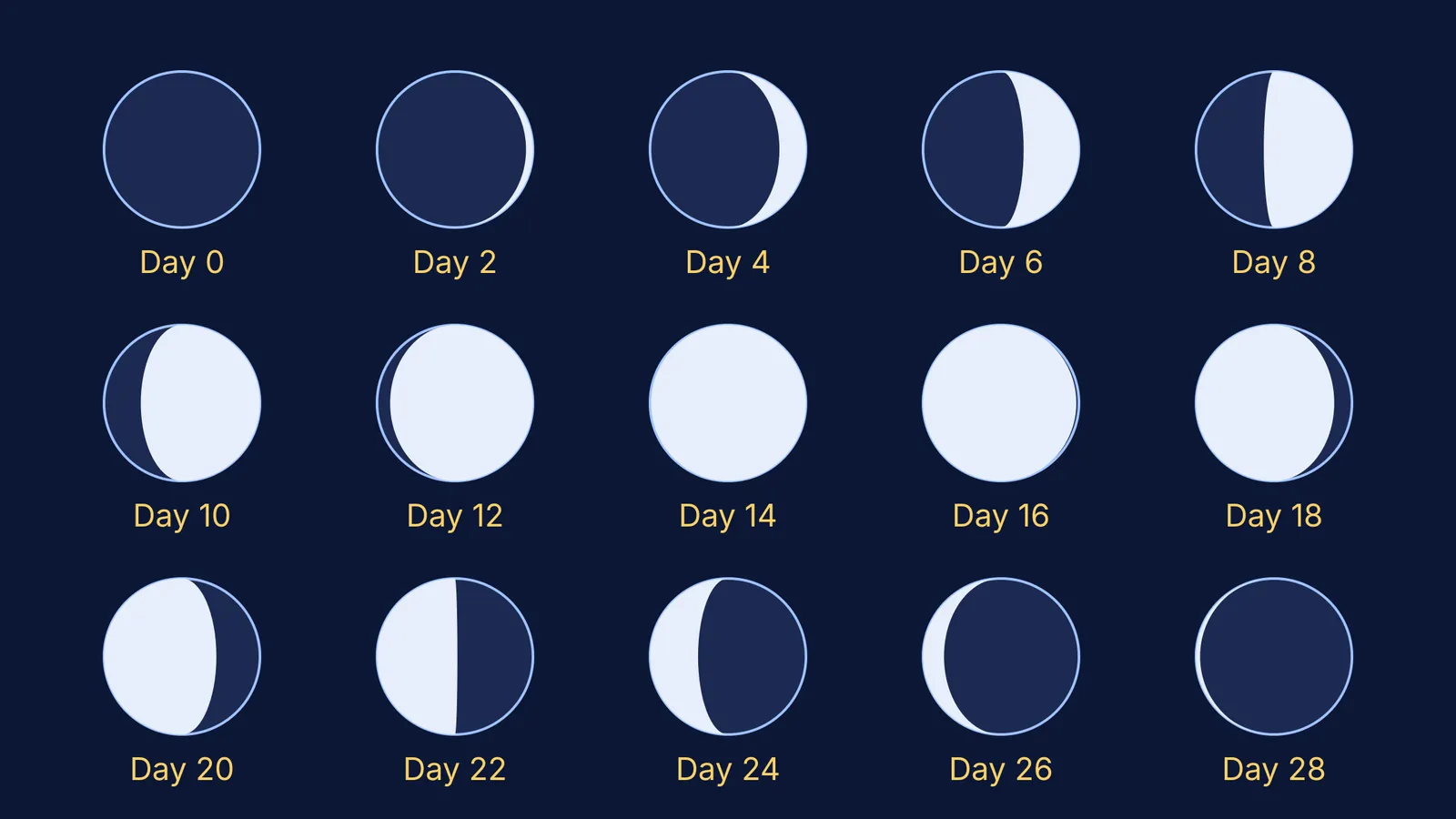
The Moon goes through all its phases about once every 29.5 days, so one month covers one full cycle. Start two or three days after new moon (amavasya on a family calendar), when a thin crescent appears in the west after sunset.
Each evening at the same time, your child records the Moon's shape, direction and height in fists.
Week 1, crescent to half. Draw the shape. Which side is lit?
Week 2, half to full. Predict tonight's position before going out, then measure it.
Week 3, full to half. The Moon rises later each evening; try after dinner and on a weekend morning.
Week 4, waning crescent. It moves to the pre-dawn sky, then vanishes at new moon. Use those dark evenings for planets.
What should the moon notebook show each night?
As the Moon orbits Earth, it rises about 50 minutes later each day, which we see as an eastward jump of about 13 degrees against the stars. That is a little more than one fist per night.
A worked example: on day 3 at 7 pm, your child finds a crescent two fists above the western horizon. At 7 pm on day 4, it sits about one fist further east, and fatter. Seven nights of 13 degrees make roughly 90, so around day 7 a half-lit Moon is high in the sky at dusk. Around day 14 or 15 it is about 180 degrees from the Sun, so the full Moon rises in the east as the Sun sets in the west. Each is a prediction the notebook can test.
Which questions turn sky-watching into science?
Ask instead of explaining:
“Which side of the Moon is lit, and where is the Sun right now?”
“Where will the Moon be tomorrow at this time? Mark it with your fist.”
“It was here yesterday. How far did it move? Is it the same every night?”
“If the Moon made its own light, would its shape change?”
Let wrong guesses stand until the data answers them; our guide to encouraging curiosity by asking questions instead of answering explains why. The notebook leads straight into moon phases and calendars in Class 8 Curiosity, and a planetarium visit planned around good questions is a natural next step.
If the reason the Moon changes shape is still hard to picture, the Fermi Simulation Lab has interactive simulations for ideas that are easier to see than to read.
Tonight, step out at sunset, find west, and make the first entry.


