On this page
Why does Diwali fall on a different date every year while Makar Sankranti barely moves? Why can you sometimes see the Moon in the afternoon? The Class 8 chapter Keeping Time with the Skies answers both, and shows how the calendars we live by come from watching the Sun and the Moon. This guide covers what the chapter teaches, three worked examples, the common mistakes and a month-long observing routine.
Where is this chapter in the Class 8 book?
Keeping Time with the Skies is Chapter 11 of Curiosity, the NCERT science textbook for Grade 8 (reprint 2026-27). You can read the chapter PDF free. It builds on the Class 7 chapter on the Earth, Moon and Sun, and ends with artificial satellites.
Why does the Moon have phases?
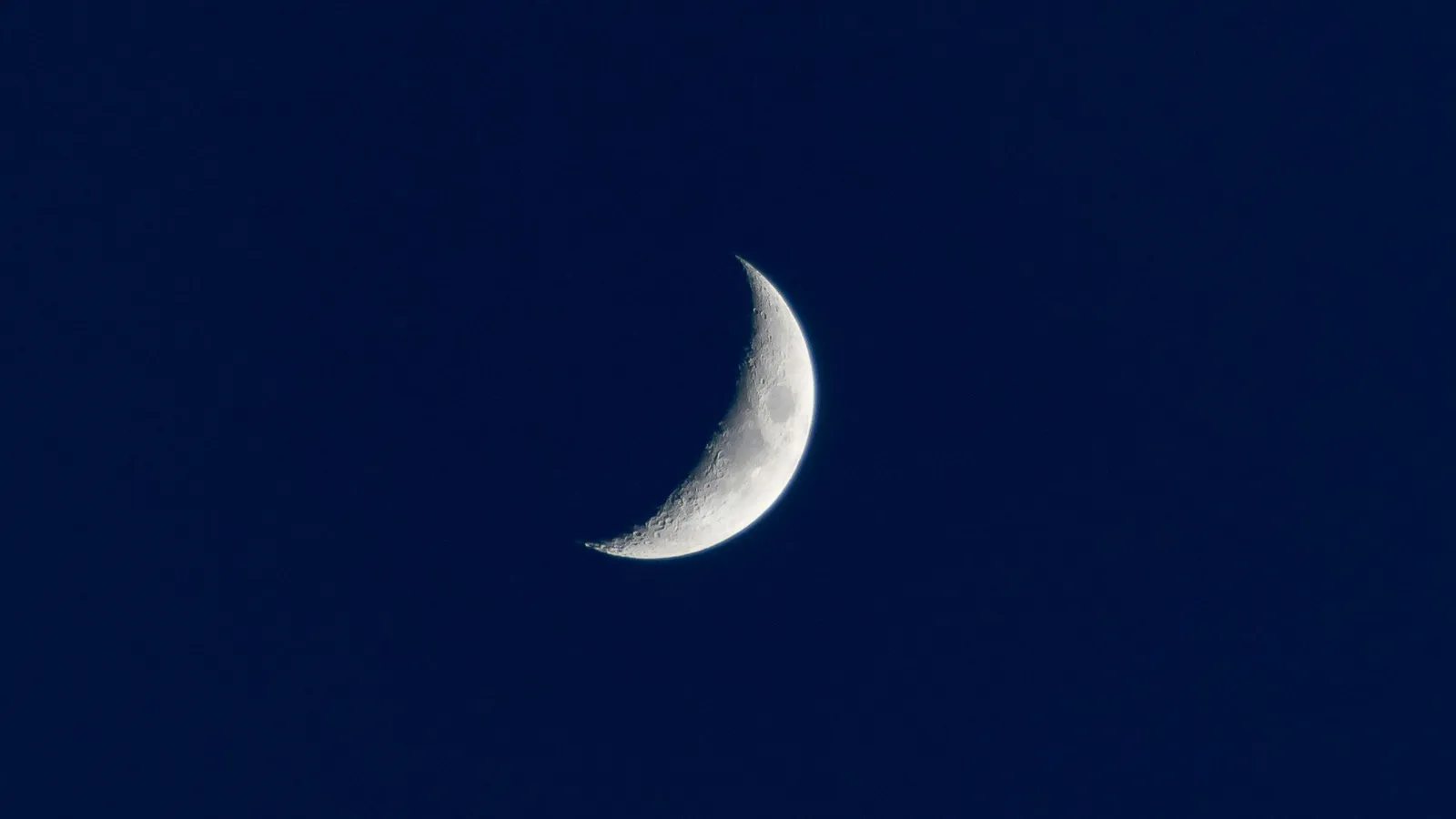
The Sun always lights half of the Moon. As the Moon goes round the Earth, we see different amounts of that lit half. At full Moon (Purnima) we face the whole lit half; at new Moon (Amavasya) we face only the dark half. The bright part shrinks during the waning period (Krishna Paksha) and grows during the waxing period (Shukla Paksha).
The chapter is firm on one point: phases are not caused by Earth's shadow. Earth's shadow on the Moon causes a lunar eclipse, which happens only at full Moon and not every month.
NASA's Moon phases page gives the numbers: the Moon takes about 27.3 days to orbit Earth, but 29.5 days to go from new Moon to new Moon, because Earth has moved along its own orbit in the meantime.
Worked example 1: why does the Moon rise about 50 minutes later each day?
The chapter asks you to check moonrise times and notice they are about 50 minutes later each day. Here is why.
The Moon's daily shift. It goes once round the sky relative to the Sun in about 29.5 days, so each day it moves 360° ÷ 29.5 ≈ 12.2°.
Earth's turning rate. Earth turns 360° in 24 hours, which is 1440 minutes, so it turns 1° every 4 minutes.
Extra time to catch up. 12.2° × 4 minutes ≈ 49 minutes.
So the Moon rises roughly 49 to 50 minutes later each day. This is why a waxing Moon is easy to spot in the afternoon or at sunset.
How do lunar, solar and luni-solar calendars differ?
Lunar calendars count months of about 29.5 days. Twelve of them make 354 days.
Solar calendars follow the seasons, which repeat in about 365 days. The Gregorian calendar is one.
Luni-solar calendars count lunar months but add an extra month, called Adhika Maasa, every few years to stay in step with the seasons.
The Indian National Calendar is a solar calendar. Its year starts on 22 March (21 March in a leap year), its months have 30 or 31 days, and it was adopted from 21 March 1956, which was 1 Chaitra 1878 Saka. The Calendar Reform Committee that recommended it was chaired by Meghnad Saha; read more in our profile of Meghnad Saha.
Worked example 2: the 11-day gap and the leap-year rule
Lunar versus solar. 12 × 29.5 = 354 days. 365 - 354 = 11 days short each year. After three years the gap is 3 × 11 = 33 days, more than a whole lunar month. That is why luni-solar calendars add a month every two to three years, and why a festival on a purely lunar calendar, such as Eid-ul-Fitr, moves about 11 days earlier each year.
Leap years. Earth takes nearly 365¼ days to go round the Sun; the NASA planetary fact sheet lists Earth's orbital period as 365.2 days. Adding a day every four years would give 365.25 days on average, slightly too much. So, as the chapter explains, century years are leap years only if divisible by 400: 1700, 1800 and 1900 were not, 1600 and 2000 were.
Count the leap days in 400 years: 100 years divisible by 4, minus 4 century years, plus 1 that is divisible by 400 = 97. The average year is 365 + 97 ÷ 400 = 365.2425 days. Is 2100 a leap year? No: it is a century year not divisible by 400.
Worked example 3: 37 full Moons in three years
The chapter asks you to show that if 37 full Moons happen in 3 years, at least two fall in the same month. Three years have 3 × 12 = 36 months. With 37 full Moons and only 36 months, at least one month must hold two. Mathematicians call this the pigeonhole principle.
Which mistakes do students make?
Saying Earth's shadow causes phases. It causes eclipses.
Thinking the Moon is only visible at night. It is often up in daylight.
Using 27.3 days for the cycle of phases. That is the orbit; the phase cycle is about 29.5 days.
Applying "divisible by 4" to century years. Check the 400 rule.
Mixing up Amant and Purnimant. In Amant calendars the month ends on new Moon; in Purnimant, on full Moon.
A month-long observing routine
Moon diary. For 30 days, sketch the Moon's shape and note where it is at sunrise or sunset, as in Activity 11.1.
Moonrise check. Note moonrise times for five days and work out the average daily delay.
Shadow stick. With a 1 m stick, mark the shortest shadow around noon on two days and find the length of a solar day.
Festival table. List the Gregorian dates of Diwali and Eid-ul-Fitr for five years and spot the 11-day shift.
The positions of the Sun, Earth and Moon are easier to see than to read. The Fermi Simulation Lab has interactive simulations for ideas that are easier to see than read. For the Class 7 groundwork, see our guide to Earth, Moon and the Sun.
Tonight, note where the Moon is and what shape it has, and check again at the same time tomorrow.