

On this page
When you look westward just after sunset, you will often spot a brilliant beacon piercing the twilight long before any star appears. Known as Shukra in Indian astronomy and the evening or morning star worldwide, Venus outshines every celestial object except the Sun and Moon, according to NASA Science.
At peak brilliancy, Venus reaches an apparent magnitude of -4.8, as recorded in the NASA Venus Fact Sheet. That makes it over 5 times brighter than Jupiter at its peak (-2.94, documented in the NASA Jupiter Fact Sheet) and over 20 times brighter than Sirius. Astronomers quantify these ratios using Pogson's logarithmic scale, explored in our profile of Norman Pogson and the 2.512 rule for star brightness. Venus dominates our night sky through three physical factors: cloud reflectivity, solar proximity, and distance from Earth.
How do sulfuric acid clouds reflect 77% of sunlight?
The first factor is reflectivity, or albedo. Airless rocky bodies absorb most sunlight: the Moon has a Bond albedo of 0.11, reflecting only 11% of incident rays, according to the NASA Moon Fact Sheet. Earth reflects 29.4%, largely from clouds and ice, as recorded in the NASA Earth Fact Sheet. By comparison, Venus reflects 77% of incoming sunlight with a Bond albedo of 0.77, confirmed by the NASA Venus Fact Sheet.
This planetary mirror is a continuous cloud deck roughly 20 kilometres thick, documented by NASA Science. Composed of micron-sized concentrated sulfuric acid droplets with a refractive index of about 1.45, the clouds produce Mie scattering with negligible visible absorption, bouncing photons back into space before they reach the surface.
How does the double inverse-square law boost brightness?
High albedo alone cannot explain Venus's dominance. Geometry and distance amplify its brilliance through two consecutive inverse-square relationships, connecting directly to the principles in our guide on EM wave energy density and intensity.
The first factor governs solar irradiance (1/r²). Venus orbits at an average distance of 0.723 astronomical units (108.2 million kilometres) from the Sun, according to the NASA Venus Fact Sheet. Jupiter orbits at 5.204 astronomical units (778.5 million kilometres), documented in the NASA Jupiter Fact Sheet. The squared ratio (5.204 / 0.723)² shows each square metre of Venus receives 51.8 times more solar flux than Jupiter.
The second factor governs reflected light returning to Earth (1/d²). Venus comes as close as 38.2 million kilometres (0.255 astronomical units) as recorded in the NASA Venus Fact Sheet, sitting near 64 to 67 million kilometres (0.43 to 0.45 astronomical units) at greatest brilliancy. Jupiter never comes closer than 588.5 million kilometres (3.93 astronomical units), according to the NASA Jupiter Fact Sheet. The distance ratio squared, (3.93 / 0.45)², gives Venus a 76.3-fold intensity advantage. Even though Jupiter's disc area is nearly 140 times larger, the double inverse-square advantage easily prevails.
Why does Venus look brightest as a thin crescent?
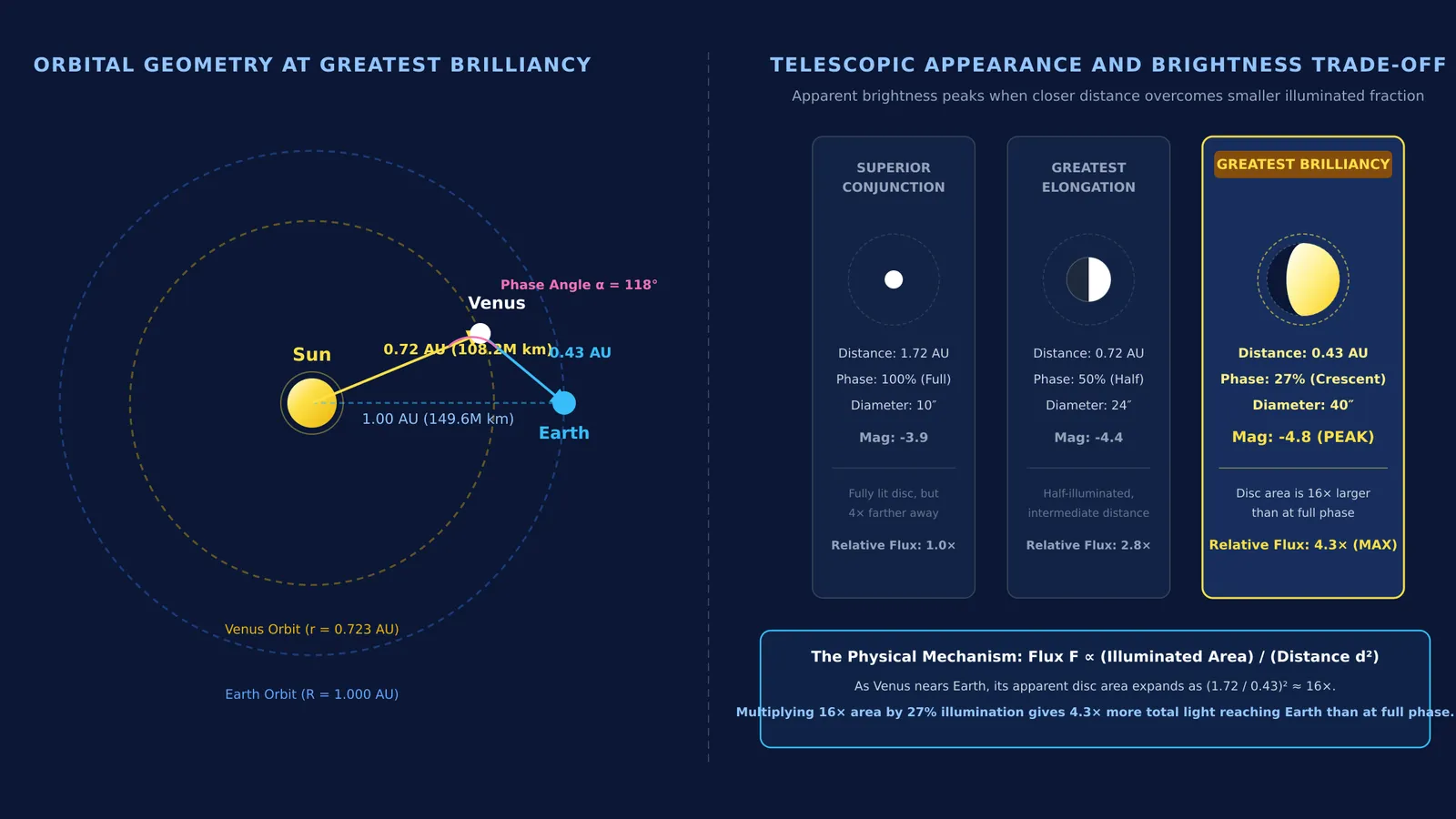
Because Venus orbits interior to Earth, its orbital geometry creates a trade-off between apparent angular size and illuminated phase.
When Venus is at superior conjunction on the far side of the Sun, its Earth-facing hemisphere is fully illuminated, but it is 1.72 astronomical units away, according to the NASA Venus Fact Sheet. At that distance, its angular diameter shrinks to 10 arcseconds. As Venus approaches Earth, its angular diameter swells to over 60 arcseconds (up to 66.1 arcseconds), but its sunlit side turns away from us.
Like the Moon, Venus exhibits phases as it circles the Sun, a cycle documented by NASA Science, which historically helped confirm the heliocentric system and was later built upon when astronomers such as Jeremiah Horrocks observed the transit of Venus. Because the apparent flux received on Earth is proportional to the illuminated area divided by the square of the distance, brightness reaches a peak known as greatest illuminated extent. This maximum occurs at a phase angle of roughly 118 degrees, where Venus appears as a crescent with about 27% illumination, roughly 36 days before or after inferior conjunction.
Visualising how orbital phase and angular size balance each other is difficult on a static page. The Fermi Simulation Lab provides interactive simulations for the ideas that are easier to see than to read, allowing students to manipulate planetary orbits and observe how phase angles alter apparent brightness in real time.
How do you calculate Venus's brightness compared to Jupiter?
For students comparing planetary brightness, the inverse-square law yields the flux ratio (F_Venus / F_Jupiter) received at Earth:
Solar irradiance ratio from distance r: (r_Jupiter / r_Venus)² = (5.204 / 0.723)² ≈ 51.8, based on the NASA Venus Fact Sheet and NASA Jupiter Fact Sheet.
Disc area ratio from radii R: (R_Venus / R_Jupiter)² = (6052 / 71492)² ≈ 1 / 139.5 ≈ 0.00717.
Geometric albedo ratio p: p_Venus / p_Jupiter = 0.689 / 0.538 ≈ 1.28.
Earth distance factor from distance d: (d_Jupiter / d_Venus)² = (3.93 / 0.45)² ≈ 76.3.
Visible phase fraction Φ: at greatest brilliancy, Venus has Φ ≈ 0.27, whereas Jupiter at opposition has Φ = 1.0.
Combined flux ratio: F_Venus / F_Jupiter = 51.8 × 0.00717 × 1.28 × 76.3 × 0.27 ≈ 9.8.
Under peak conditions, Venus delivers roughly 5 to 10 times more light to Earth than Jupiter at opposition. Pogson's formula confirms a magnitude gap between 1.8 and 2.5, matching astronomical observations.
Mastering multi-step physics problems requires breaking complex phenomena into fundamental laws. The Fermi Problem Library provides worked problems with a step-by-step solver that explains the reasoning rather than printing an answer, helping students build lasting problem-solving intuition.


