On this page
You step out of a warm bath on a December morning in Delhi or Lucknow and start shivering, even though the water was hot a second ago. The water is not the problem. The problem is the thin film of water still on your skin, and the physics of latent heat that you meet in school science.
Why does wet skin feel cold even after a hot bath?
Water molecules in that film are always moving, some faster than others. The fastest ones escape into the air as vapour, and the ones left behind are, on average, slower and cooler. To keep evaporating, the film has to pull in fresh heat, and the nearest supply is your skin.
The energy needed to turn a liquid into vapour without changing its temperature is called the latent heat of vaporisation. OpenStax College Physics notes that at body temperature this is about 2,430 kJ per kilogram, roughly 10 percent more than at 100 °C, and that the heat comes from the skin. Sweat cools you in summer the same way; after a bath, your whole body is wet at once.
For the textbook version, our explainer on matter in our surroundings, with evaporation and latent heat covers it step by step.
How much heat does one gram of water take from you?
Here is an estimate you can check with a calculator.
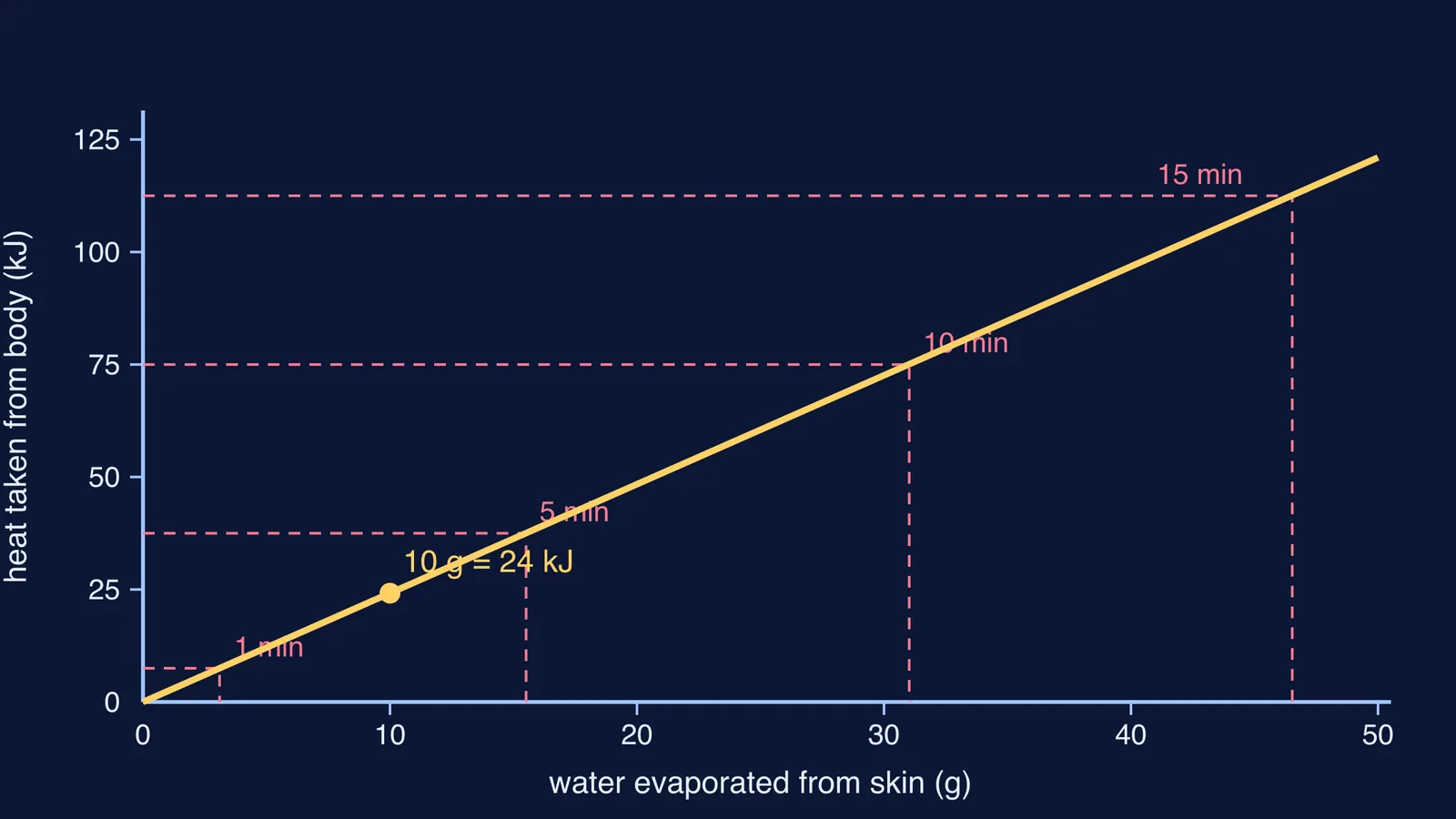
Latent heat at skin temperature. The NIST Chemistry WebBook steam data gives water at 35 °C an enthalpy of 146.6 kJ/kg as liquid and 2,564.5 kJ/kg as vapour. The difference, about 2,418 kJ/kg, is 2.42 kJ for every gram that evaporates.
Compare it with warming water. Liquid water needs about 4.19 J to warm 1 gram by 1 °C, per the OpenStax specific heat table. So evaporating 1 gram takes as much heat as warming about 580 grams of water by 1 °C (2,418 ÷ 4.19).
Pick a film size. Suppose 10 grams of water evaporate from your skin and hair after a quick wipe (an assumption to play with, not a measurement). 10 × 2.42 = about 24 kJ.
Compare it with your body's heat output. The OpenStax table of human power use puts standing relaxed at about 125 W, or 125 joules a second. 24,200 ÷ 125 is about 190 seconds: evaporating 10 grams takes the heat your body makes in three minutes of standing.
Ask where the heat comes from. The OpenStax specific heat table gives the human body 3,500 J/(kg·°C). Spread over a 60 kg body, 24 kJ is only about 0.1 °C. But the heat leaves through your outer skin first, and that is what you feel with.
Why do you feel colder after a bath in winter?
Two things in winter make the film evaporate faster.
Dry air. OpenStax explains that relative humidity compares the water vapour in the air with the maximum it can hold, and that evaporation is held back as air nears saturation. A steamy bathroom is close to saturation; a cold bedroom with dry winter air is not. The moment you open the door, evaporation speeds up.
Moving air. The US National Weather Service notes that as the wind increases, it draws heat from the body and drives down skin temperature. A ceiling fan or an open window does the same to wet skin. Our post on whether a ceiling fan cools the room or just you explains why.
How can you stay warm after a bath in winter?
The goal is to remove water by towel, not by evaporation, while you are still in warm, humid air.
Dry off inside the bathroom with the door shut, before you step into colder, drier air.
Do your hair first. Wrap it in a towel straight away; hair holds water close to your scalp and neck.
Pat, then rub. A towel soaks up water that would otherwise take its latent heat from you.
Switch off the exhaust fan and ceiling fan until you are dressed.
Keep clothes in the bathroom, so you dress in seconds, not minutes.
Take extra care with babies and older relatives, who can get cold quickly. If someone keeps shivering for a long time or feels unwell after bathing, speak to a doctor.
How can you practise latent heat questions?
The bath estimate has the shape of an exam numerical: mass times latent heat, then compare. Our post on why evaporation causes cooling shows the fastest molecules leaving a liquid. The Fermi Simulation Lab has interactive simulations for ideas that are easier to see than read. For practice, the Fermi Problem Library has worked problems with a step-by-step solver that explains the reasoning rather than printing an answer.
Tomorrow morning, try it yourself: towel your hair inside the bathroom and notice how much warmer the walk to your room feels.