

On this page
Many students leave a fan running in an empty study room, thinking it will keep the air cold for when they return. However, a fan acts on your body, not the ambient air.
Does a ceiling fan cool the room or just you?
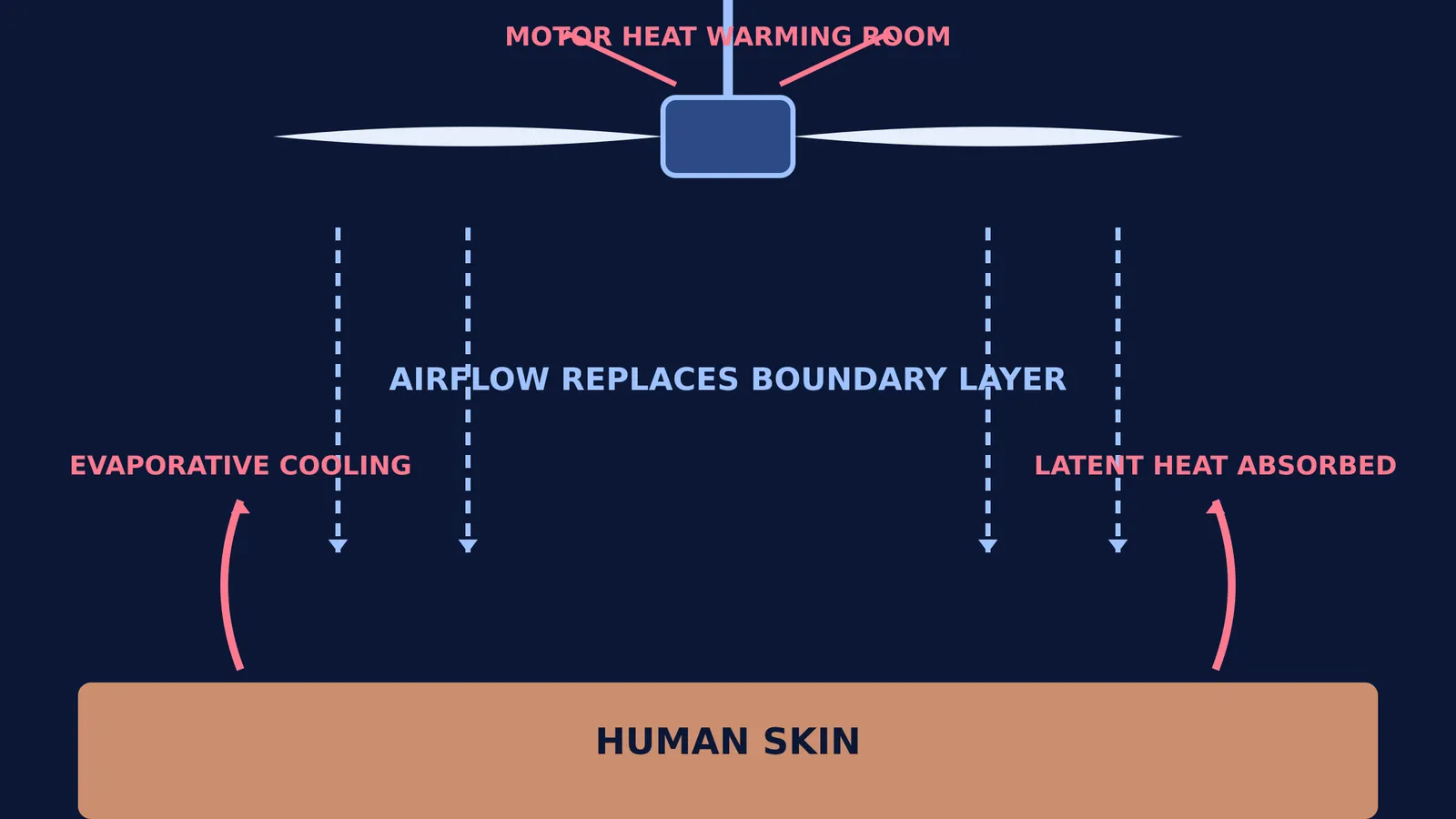
If you place a thermometer in a sealed room and turn on a ceiling fan, the temperature reading will not drop. ENERGY STAR confirms that fans cool people, not rooms. Leaving a fan running in an empty room actually makes the room slightly warmer over time, as the motor generates heat.
Because fans cool people rather than the space itself, you should turn them off when you leave a room to save electricity. The electrical energy saved can be significant over the course of a hot summer.
How does moving air cool you down?
If the fan does not lower the temperature of the air, why does it bring such relief on a hot day? The answer lies in the boundary layer and latent heat.
Your body naturally warms a thin layer of air immediately surrounding your skin. On a still day, this boundary layer traps heat and humidity. A ceiling fan creates a wind-chill effect by constantly sweeping away this warm, humid layer and replacing it with the slightly cooler, drier air of the room.
This continuous supply of drier air speeds up evaporation. Evaporation is an endothermic process, meaning it requires energy. As sweat turns from a liquid into a vapour, it absorbs latent heat directly from your skin, carrying that thermal energy away. You can explore how phase changes absorb energy in our guide to Matter in our surroundings: states, evaporation and latent heat.
This cooling mechanism is so effective that you can raise your air conditioner's thermostat setting by about 4 °F (around 2.2 °C) according to ENERGY STAR while the fan is running without losing any comfort.
Why does a fan heat the room?
To understand why the room itself gets warmer, we have to look at the First Law of Thermodynamics, which states that energy cannot be created or destroyed, only transformed.
A ceiling fan consumes electrical energy to operate. None of this energy disappears.
Some of it is immediately converted into heat due to electrical resistance in the motor's copper coils and mechanical friction in its bearings.
The rest is converted into the kinetic energy of the spinning blades, which push the air.
As that moving air circulates, it experiences internal friction (viscosity) and friction against the walls and furniture.
Eventually, all of the air's kinetic energy is dissipated as thermal energy. Because the room is a closed system, all the electrical energy eventually enters the air as heat.
A worked example: calculating the temperature rise
We can calculate exactly how much a fan warms a room using the principles of calorimetry and the specific heat capacity of air as detailed by standard reference data.
Imagine an empty, perfectly insulated study room measuring 3 metres by 3 metres by 3 metres.
The volume of the room is 27 cubic metres.
With air density at roughly 1.2 kilograms per cubic metre, the room holds about 32 kilograms of air.
The specific heat capacity of air is roughly 1,000 joules per kilogram per kelvin. Heating 32 kilograms of air by 1 degree Celsius requires 32,000 joules.
A 50-watt fan left on for one hour pumps in 50 joules per second for 3,600 seconds, adding a total of 180,000 joules of energy to the room.
Dividing the total energy by the heat capacity (180,000 joules divided by 32,000 joules per degree Celsius) gives a temperature rise of 5.6 degrees Celsius.
While real rooms are not perfectly insulated and heat escapes through the walls and windows, the underlying physics holds true: the fan is acting as a heater. You can apply this same method to other thermodynamic systems in our breakdown of Calorimetry and heat transfer: mixing, melting and conduction.
Studying thermodynamics requires shifting your perspective from human sensation (feeling cool) to strict energy transfer. If you find it difficult to picture how energy flows in closed systems like a room with a fan, the Fermi Simulation Lab has interactive simulations for the ideas that are easier to see than to read.


