On this page
This is question 14 of Exercise 5.3 in the NCERT Class 12 Mathematics textbook, Chapter 5, where it comes with the condition −1/√2 < x < 1/√2. One substitution turns it into a two-line answer. The catch is the interval: step outside it and the same substitution gives a derivative with the opposite sign.
How do you differentiate sin⁻¹(2x√(1 − x²))?
Put x = sin θ, so θ = sin⁻¹x.
The principal value branch of sin⁻¹ has range [−π/2, π/2], as NCERT Class 12 Chapter 2 defines it, so cos θ ≥ 0 and √(1 − x²) = cos θ.
Then 2x√(1 − x²) = 2 sin θ cos θ = sin 2θ, and y = sin⁻¹(sin 2θ).
sin⁻¹(sin 2θ) equals 2θ only when 2θ lies in [−π/2, π/2], that is, when −1/√2 ≤ x ≤ 1/√2.
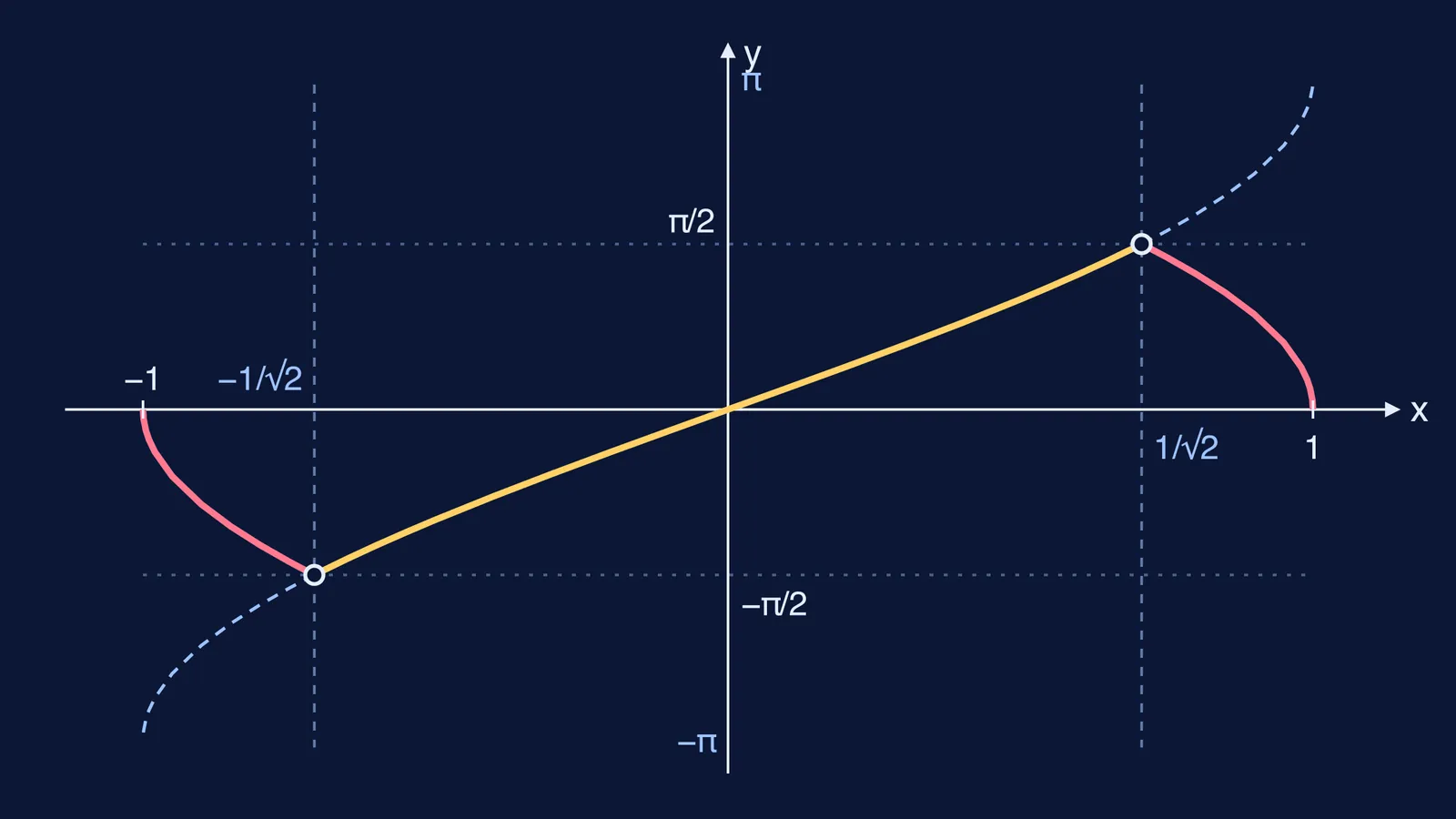
So y = 2 sin⁻¹x there, and for −1/√2 < x < 1/√2, dy/dx = 2/√(1 − x²).
The last step uses the standard result d/dx (sin⁻¹x) = 1/√(1 − x²) for x in (−1, 1), which NCERT derives in Example 24 of Chapter 5.
If step 4 feels like a leap, our post on why sin⁻¹(sin x) is not always x walks through the principal range in detail.
Why does the derivative change sign when |x| > 1/√2?
Take x between 1/√2 and 1. Now θ is between π/4 and π/2, so 2θ is between π/2 and π. sin⁻¹ cannot return 2θ, because that is outside its range. It returns the angle in [−π/2, π/2] with the same sine, which is π − 2θ.
So y = π − 2 sin⁻¹x there, and dy/dx = −2/√(1 − x²). The same reasoning on the left gives y = −π − 2 sin⁻¹x for −1 < x < −1/√2, with the same negative derivative. The full answer:
For −1 < x < −1/√2: y = −π − 2 sin⁻¹x and dy/dx = −2/√(1 − x²).
For −1/√2 < x < 1/√2: y = 2 sin⁻¹x and dy/dx = 2/√(1 − x²).
For 1/√2 < x < 1: y = π − 2 sin⁻¹x and dy/dx = −2/√(1 − x²).
At x = ±1/√2 the graph has a sharp corner where y reaches ±π/2, so the derivative does not exist there.
Does the brute-force chain rule agree?
It does, and it shows where the sign comes from. Differentiating directly:
The inside is u = 2x√(1 − x²), and du/dx = 2(1 − 2x²)/√(1 − x²).
The outer factor is 1/√(1 − u²), and 1 − u² = 1 − 4x² + 4x⁴ = (1 − 2x²)².
So √(1 − u²) = |1 − 2x²|, and dy/dx = 2(1 − 2x²) / (|1 − 2x²| √(1 − x²)).
The fraction (1 − 2x²)/|1 − 2x²| is +1 when x² < 1/2 and −1 when x² > 1/2. The square root quietly hid an absolute value, and that is the sign flip. Substitution makes it visible before you differentiate instead of after.
Does the same thing happen with x = tan θ?
Try y = tan⁻¹(2x/(1 − x²)). Put x = tan θ with θ in (−π/2, π/2), so 2x/(1 − x²) = tan 2θ.
For −1 < x < 1, 2θ stays inside (−π/2, π/2) and y = 2 tan⁻¹x.
For x > 1, 2θ lies between π/2 and π, so tan⁻¹ returns 2θ − π and y = 2 tan⁻¹x − π.
For x < −1, y = 2 tan⁻¹x + π.
Each piece differs from 2 tan⁻¹x by a constant, so dy/dx = 2/(1 + x²) wherever x ≠ ±1, using d/dx (tan⁻¹x) = 1/(1 + x²) from the same NCERT chapter on continuity and differentiability. No sign flip this time.
tan repeats every π, so its correction is a shift, which keeps the slope. Sine's correction is a reflection (π − 2θ), which reverses the slope.
A checklist before you differentiate
Match the pattern: √(1 − x²) suggests x = sin θ or cos θ; 2x/(1 − x²) or 2x/(1 + x²) suggests x = tan θ.
Write the range of θ from the principal value branch.
Work out the range of the new angle, such as 2θ or 3θ.
Inside the outer function's principal range, drop the inverse. Outside it, reflect for sin⁻¹ or shift by π for tan⁻¹.
Differentiate, then test one value of x numerically.
For more practice, see simplifying tan⁻¹(cos x/(1 − sin x)) with half-angle formulas and our Class 12 guide to differentiating with inverse trig substitutions, which works through tan⁻¹((3x − x³)/(1 − 3x²)).
If your answer and the book's disagree, the Fermi Problem Library has worked problems with a step-by-step solver that explains the reasoning rather than printing an answer, so you can find the step where the range went wrong. If principal values themselves feel shaky, the Fermi Concept Library gives each concept its own lesson.
Next time you see a square root inside an inverse trig function, write the interval before you write the derivative.