

On this page
When solving calculus or trigonometry problems in CBSE Class 12 and JEE Main, you often encounter expressions where an inverse trigonometric function encloses a cumbersome trigonometric fraction. A standard example is tan⁻¹(cos x / (1 − sin x)). If you attempt to manipulate this expression directly or differentiate it with the quotient and chain rules, the algebra quickly becomes unwieldy.
The cleanest path is to convert the interior fraction into a single tangent expression using half-angle formulas. Begin by rewriting both the numerator and the denominator in terms of x/2:
Replace cos x with the double-angle cosine identity: cos x = cos²(x/2) − sin²(x/2). Factoring this as a difference of squares yields (cos(x/2) − sin(x/2))(cos(x/2) + sin(x/2)).
Express the constant 1 as cos²(x/2) + sin²(x/2) and sin x as 2 sin(x/2) cos(x/2). The denominator 1 − sin x becomes cos²(x/2) + sin²(x/2) − 2 sin(x/2) cos(x/2), which factors into the perfect square (cos(x/2) − sin(x/2))².
Substituting these factorizations into the ratio cos x / (1 − sin x) allows you to cancel the common factor (cos(x/2) − sin(x/2)), provided it is non-zero:
(cos x) / (1 − sin x) = (cos(x/2) + sin(x/2)) / (cos(x/2) − sin(x/2))
Next, divide both the numerator and the denominator by cos(x/2):
(1 + tan(x/2)) / (1 − tan(x/2))
Because tan(π/4) = 1, this matches the addition identity tan(A + B) = (tan A + tan B) / (1 − tan A tan B), giving:
(cos x) / (1 − sin x) = tan(π/4 + x/2)
Taking the inverse tangent of both sides reduces the original expression to tan⁻¹(tan(π/4 + x/2)). In NCERT Class 12 Mathematics Chapter 2, this reduction forms the foundation of inverse trigonometric simplification. This algebraic transformation also mirrors the half-angle techniques used in half-angle substitution in trigonometric integration.
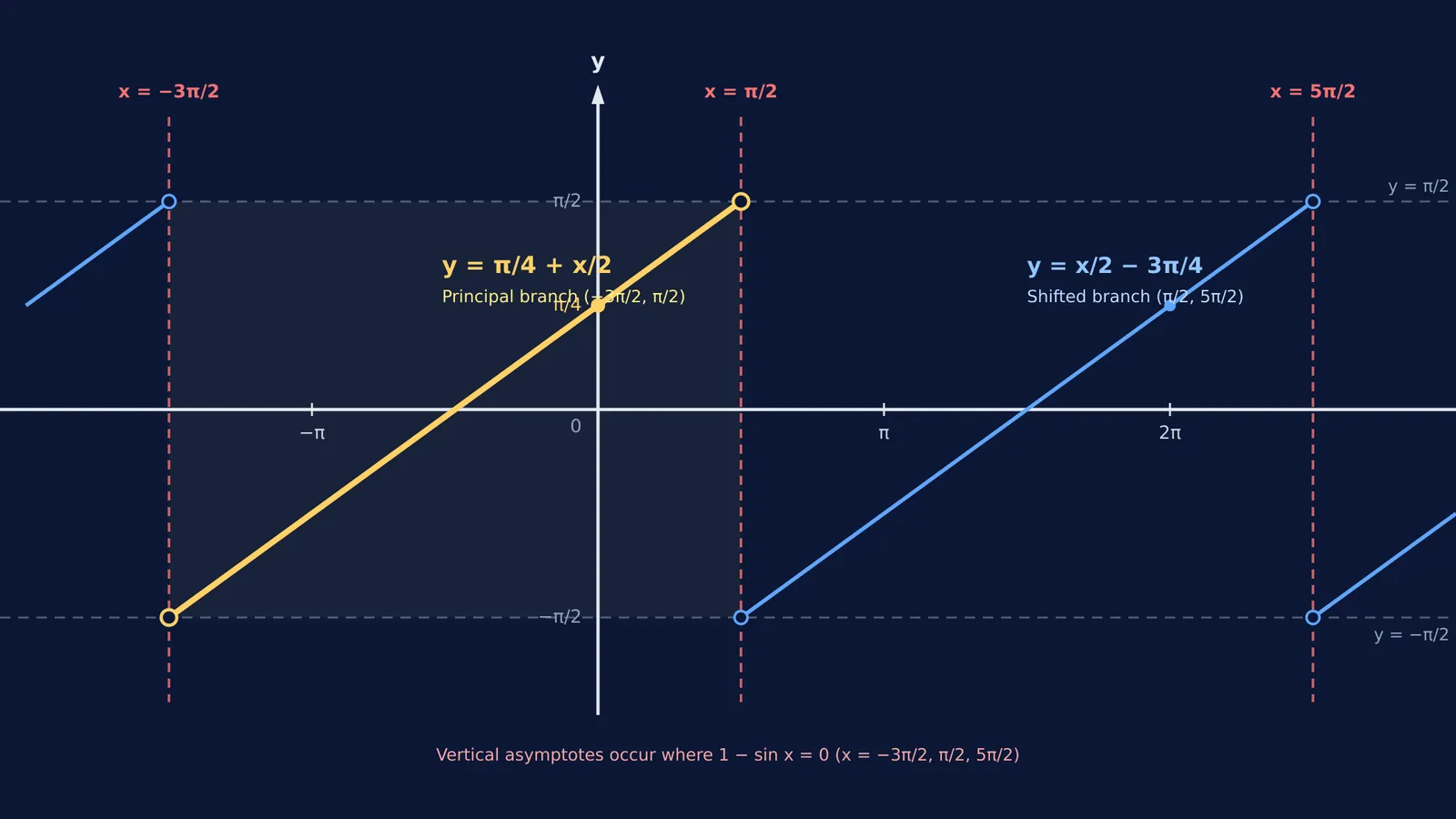
Why does the simplification hold only on −3π/2 < x < π/2?
Writing tan⁻¹(tan θ) = θ is valid only when θ belongs to the principal value branch of the inverse tangent function, which is the open interval (−π/2, π/2). Assuming that tan⁻¹(tan θ) always cancels to θ is one of the most widespread errors in senior secondary mathematics.
Here, the angle inside the tangent is θ = π/4 + x/2. Setting this argument inside the principal bounds gives the compound inequality:
−π/2 < π/4 + x/2 < π/2
To solve for x, subtract π/4 across all parts:
−3π/4 < x/2 < π/4
Multiplying every term by 2 gives:
−3π/2 < x < π/2
Thus, the simplification tan⁻¹(cos x / (1 − sin x)) = π/4 + x/2 is valid strictly for x ∈ (−3π/2, π/2). The endpoints are excluded because at x = π/2 and x = −3π/2, sin x = 1, causing the denominator 1 − sin x to equal zero and creating vertical asymptotes.
Educational research shows that students routinely miss these boundary conditions. In an empirical study of teacher trainees' understanding of the tangent function, researcher Priestly Malambo (2020) found that only 1 candidate (5%) out of 22 prospective teachers could accurately sketch and explain its graphical domain, while 10 teachers (45%) drew flawed curves that ignored vertical asymptotes and discontinuities, and 11 teachers (50%) failed to produce a graph. When students treat trigonometric functions as mechanical algebra without checking where expressions are defined, they forfeit marks on multi-concept questions.
The Fermi Problem Library has worked problems with a step-by-step solver that explains the reasoning rather than printing an answer, alerting you whenever a substitution crosses a branch boundary.
How do you evaluate the expression outside the principal branch?
What happens when an examination question asks for the value of tan⁻¹(cos x / (1 − sin x)) when x lies outside (−3π/2, π/2)? For instance, consider the interval x ∈ (π/2, 5π/2).
If x is between π/2 and 5π/2, then dividing by 2 and adding π/4 places θ = π/4 + x/2 in the interval (π/2, 3π/2). Because this lies above the upper principal limit of π/2, tan⁻¹(tan θ) cannot equal θ directly.
Because the tangent function has a fundamental period of π, subtracting π maintains the value of the tangent while shifting the angle into the principal range:
tan(θ − π) = tan θ
Since θ ∈ (π/2, 3π/2), subtracting π yields:
θ − π = (π/4 + x/2) − π = x/2 − 3π/4
Because x/2 − 3π/4 lies within (−π/2, π/2), the inverse tangent outputs:
tan⁻¹(cos x / (1 − sin x)) = x/2 − 3π/4
This creates a periodic sawtooth graph consisting of parallel lines of slope 1/2 separated by jumps at each point where 1 − sin x = 0, exactly like drawing sawtooth graphs for inverse trigonometric functions beyond their principal range.
To see how branch restrictions connect across trigonometry and calculus, the Fermi Concept Library maps every concept in physics, chemistry, biology, mathematics and computing, each with its own lesson and its place in the map.
What happens when you differentiate or integrate this expression?
Simplifying tan⁻¹(cos x / (1 − sin x)) to a linear form yields rapid solutions for derivatives and integrals in board exams and competitive tests.
If you differentiate y = tan⁻¹(cos x / (1 − sin x)) on (−3π/2, π/2) after substituting π/4 + x/2, the derivative is immediate:
dy/dx = d/dx [π/4 + x/2] = 1/2
Differentiating directly using the chain rule yields the same constant 1/2, but requires simplifying a nested quotient:
dy/dx = [1 / (1 + (cos x / (1 − sin x))²)] × [(−sin x)(1 − sin x) + cos²x] / (1 − sin x)² = 1/2
The simplified half-angle form avoids dozens of algebraic steps and removes opportunities for sign errors, as seen in differentiating one trigonometric expression with respect to another.
Similarly, integrating the expression on any sub-interval within (−3π/2, π/2) becomes a simple polynomial integral:
∫ tan⁻¹(cos x / (1 − sin x)) dx = ∫ (π/4 + x/2) dx = (π/4)x + x²/4 + C
Here is a quick four-step checklist to apply whenever you simplify inverse trigonometric fractions:
Express all trigonometric terms in the argument using half-angle formulas (x/2) to factor out common binomials.
Formulate the internal ratio as a compound tangent identity tan(A ± B).
Set the resulting angle inside the principal value branch (−π/2, π/2) and isolate x to determine the exact valid interval.
If x falls outside this interval, add or subtract integer multiples of π before dropping the inverse tangent operator.


