On this page
Watch a kettle come to the boil and look closely at the spout. Right at the opening there is a short stretch where you can see straight through the jet. The white cloud starts a little further out. That clear stretch is not empty. It is the steam.
What is the clear gap above a kettle spout?
Steam is water in the gas state, and it is transparent. Indiana Public Media's science series A Moment of Science puts it plainly: steam is invisible, and you can see right through it. The same piece notes that the white billows begin about half an inch from the nozzle, with clear gas in between, and that this clear gas is the actual steam.
The same is true of the water vapour around us every day. The US Geological Survey says the air is full of water vapour, although most of the time we cannot see it (USGS Water Science School).
Why does the white cloud form a little higher up?
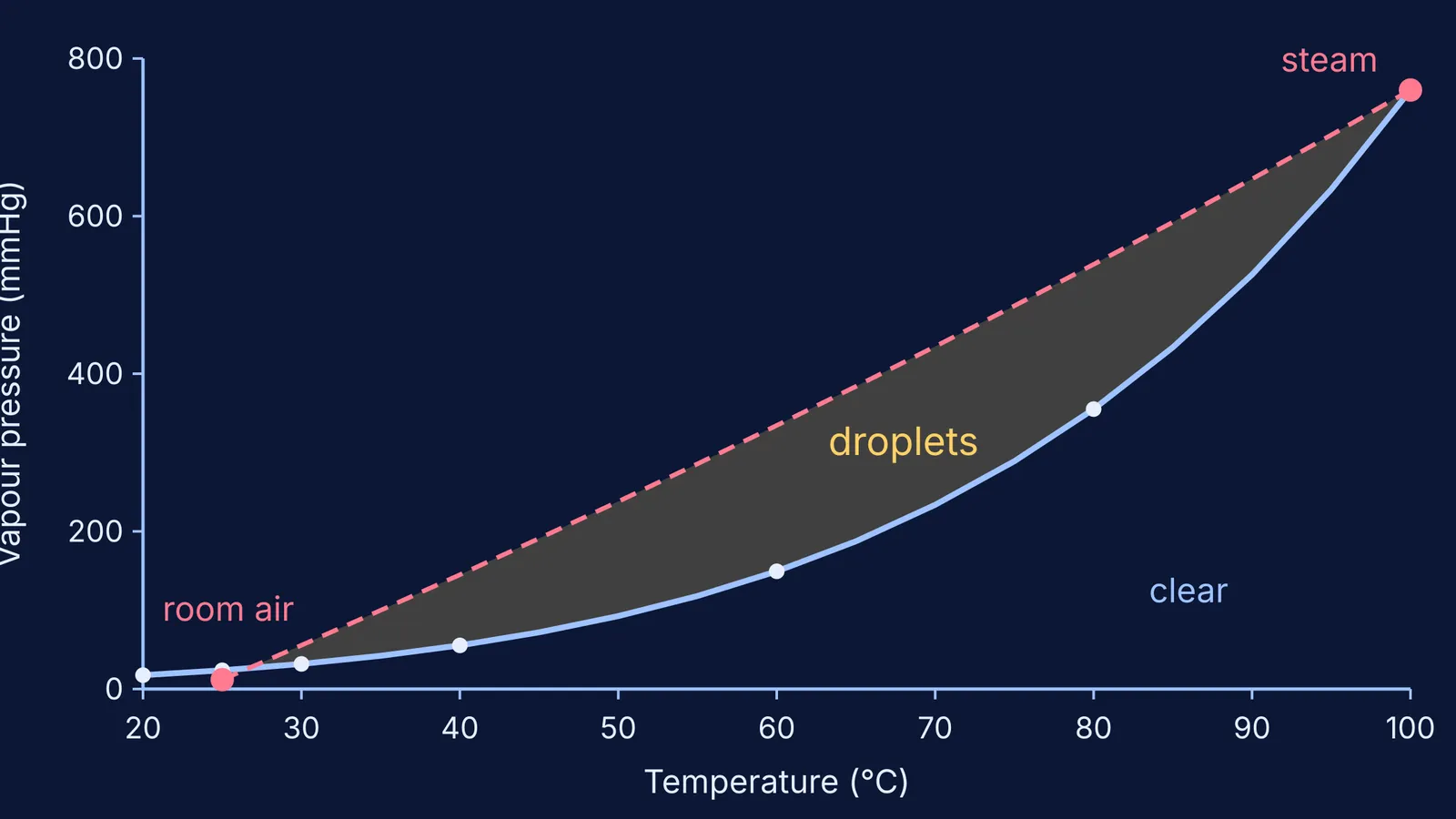
The answer is cooling. As the jet leaves the spout, it drags in cooler room air and mixes with it. A Moment of Science calls the result a mixing cloud: the hot, steamy gas cools quickly in the kitchen air, and that sudden cooling makes some of the vapour condense. Right at the spout, the jet has not yet mixed with much air, so it is still nearly pure, hot vapour. The cloud appears where enough cool air has mixed in.
The USGS defines condensation as water vapour in the air changing into liquid water (USGS).
Cooling forces water out of the gas because cooler air can hold far less water vapour. Here is a worked example using the HyperPhysics table of saturated vapour density:
At 100 °C, saturated vapour holds 598 grams of water per cubic metre.
At 20 °C, it is only 17.3 grams per cubic metre.
Divide 598 by 17.3 and you get about 35. The same space can hold about 35 times as much water as vapour at 100 °C than at 20 °C. As the jet cools towards room temperature, it carries much more water than the cooler mixture can hold as a gas. The extra water comes out as liquid.
Those droplets are tiny, but far bigger than single molecules. For comparison, the USGS says droplets in the clouds overhead range from about 10 microns (millionths of a metre) to 1 millimetre (USGS). The UK Met Office explains that water droplets like those in a cloud scatter all wavelengths with roughly the same effectiveness, so the light they scatter looks white (Met Office).
Why does the steam cloud disappear further up?
Keep watching and the plume fades. A University of Kentucky physics page on steam rising from hot coffee gives the reason: if the room air is not as humid as it could be, the little drops evaporate again as the cloud mixes in (University of Kentucky). The water is still there, but it has gone back to being an invisible gas.
So one jet passes through three stages on its short trip upwards:
Gas at the spout: hot and invisible.
Liquid droplets a little higher up: cooled past its limit and visible.
Gas again further up: spread into drier room air and invisible again.
Where else do you see the same thing?
The kettle is weather in miniature. In the sky, the USGS explains, water molecules combine with tiny particles of dust, salt and smoke to form cloud droplets (USGS). Our post on why dense fog covers north India on winter mornings follows the same idea at ground level, and why clouds come in different shapes shows what rising, cooling air does in the sky. Water turning to steam also explains why firewood crackles and pops.
How can you check this at home?
Do this with an adult nearby, and keep your hands and face well away from the jet. Clear steam can scald even though you cannot see it.
Boil water in a kettle with a spout, with a dark wall or cupboard behind it.
Find the clear stretch between the spout and the start of the white plume.
Notice where the plume fades. Compare a humid monsoon day with a dry winter afternoon: in drier air the droplets should evaporate sooner.
Label each stage with its state of matter and the change that happened there: condensation or evaporation.
Molecules leaving and rejoining a liquid are easier to see than to read about. The Fermi Simulation Lab has interactive simulations for ideas like this, and the Fermi Concept Library has a lesson for every concept in physics and chemistry if you want to revise states of matter properly.
Next time someone points at the white cloud and says "steam", look at the clear stretch below it. That is the steam.