On this page
A log can look dry and still hold plenty of water and sap. Here is why that liquid makes such a loud noise.
Why does firewood crackle and pop when it burns?
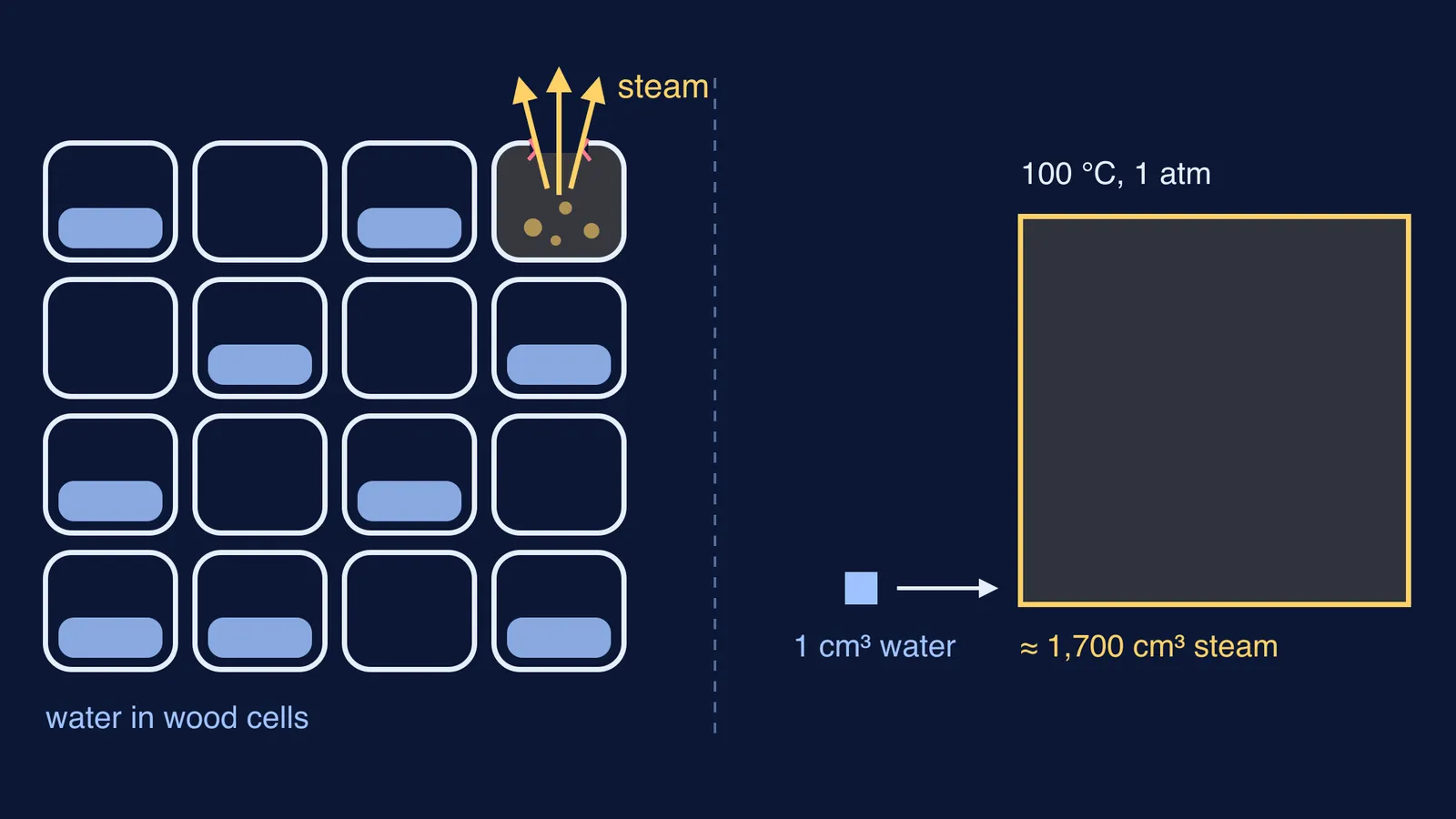
Wood is made of long, hollow cells. Water sits in two places: as liquid in the cell cavities, called lumens (free water), and in the cell walls (bound water), as a USDA Forest Products Laboratory chapter on wood moisture explains.
In a fire, the outside of a log heats first. Rachael Nolan, a postdoctoral research fellow at Western Sydney University, explained what happens for The Conversation: the water and sap inside "start to boil and turn into gas", the cellulose breaks down into gas too, and the expanding gases make "the pockets of trapped steam burst open from the wood, one by one."
Each pop is one pocket giving way: pressure builds until a cell wall or a weak line along the grain fails, and the gas escapes in one burst.
How much does water expand when it turns to steam?
Saturated steam at 1 bar (about 100 °C) takes up about 1.69 cubic metres per kilogram, according to The Engineering ToolBox steam table. The same kilogram of liquid water fills about one litre, so it takes up roughly 1,700 times more room as steam.
Water trapped in a sealed cell cannot expand freely, so the pressure climbs. Higher pressure raises the boiling point, as in a pressure cooker, so the water can get hotter than 100 °C. When the wall cracks, the pressure drops at once and that hot water flashes into steam.
Pressure and boiling point moving together is easier to see than to read, which is what the interactive simulations in the Fermi Simulation Lab are for.
Worked example: how much steam is hiding in 1 kg of wet pine?
Moisture content is the mass of water divided by the mass of oven-dry wood, which is why it can go above 100%. The USDA chapter lists an average of 148% for green ponderosa pine sapwood. We will use that, plus two figures from The Engineering ToolBox: 1.69 cubic metres of steam per kilogram, and about 2,258 kJ to vaporise each kilogram of water.
Take a 1 kg piece of freshly cut ponderosa pine sapwood:
Moisture content of 148% means water = 1.48 × dry wood, so the total mass = 2.48 × dry wood.
Dry wood = 1 ÷ 2.48 ≈ 0.40 kg. Water = 1 − 0.40 ≈ 0.60 kg.
As steam at 1 bar: 0.60 kg × 1.69 m³/kg ≈ 1.0 m³. That is a one-metre cube, from a log you can hold in one hand.
Dry the same wood to 20% moisture: water = 0.20 × 0.40 = 0.08 kg, which makes about 0.14 m³ of steam.
Energy to vaporise the water: 0.60 × 2,258 ≈ 1,350 kJ for the green piece, against 0.08 × 2,258 ≈ 180 kJ for the dried one.
The green piece carries about seven and a half times as much water, and all of it has to be driven off before that part of the wood burns hot. For why boiling soaks up so much energy, read our explainer on why latent heat of vaporisation is greater than latent heat of fusion.
Why does green wood pop more than seasoned wood?
In Nolan's words for The Conversation, "the more water and sap there is inside the wood, the noisier the fire will be."
Seasoning just means drying. The University of Illinois Extension says firewood should be below 20 percent moisture, which usually takes at least six to nine months of drying after cutting. It also warns that wetter wood gives more smoke and less heat, and that smoke from green wood adds to creosote build-up in chimneys, a fire hazard.
Pops can throw embers, so keep a screen in front of an open fire. Rising hot air then carries them: see why bonfire sparks fly upward. Once the water and gases are gone, the fire goes quiet, as we explain in why charcoal glows red without much flame.
How do you explain it in an exam answer?
A short answer can follow four steps, in order, using figures from The Engineering ToolBox and the University of Illinois Extension.
Cause: water and sap are trapped inside the wood's cells.
Change of state: heat makes them vaporise (liquid to gas), and cellulose also breaks down into gas.
Physics: steam takes up roughly 1,700 times the volume of the water, so in a closed cell the pressure rises.
Result: the cell walls rupture, the gas escapes suddenly, and you hear the crack.
You can add that wet or sappy wood pops more than seasoned wood below 20% moisture. If vaporisation or latent heat still feels shaky, the Fermi Concept Library gives each concept in physics and chemistry its own lesson.
Next time a log snaps, you are hearing a tiny pressure vessel fail: a cell full of water that ran out of room.