

On this page
Light a charcoal sigri and you see two stages. First the lumps catch with small yellow flames. Then the flames die down and the coals glow orange-red with hardly any flame. That second stage is a different kind of burning.
Why does charcoal glow without much flame?
A flame is gas burning. The NCERT Class 8 science textbook says it plainly: "The substances which vapourise during burning, give flames," while "Charcoal, on the other hand, does not vapourise and so does not produce a flame" (NCERT, Combustion and Flame).
Charcoal has already lost most of its gases. According to the FAO guide to charcoal making, dry wood heated to around 280 °C breaks down into charcoal plus water vapour, tars and gases such as hydrogen, carbon monoxide and carbon dioxide. Charcoal finished at 500 °C typically has about 85% fixed carbon and about 10% volatile matter, the same guide says. Once that small remainder of gas has burned off, there is little left to vaporise.
What remains is mostly solid carbon. Oxygen from the air reaches the hot surface and reacts right there: C + O₂ → CO₂. Combustion scientists call this smouldering. Guillermo Rein of the University of Edinburgh defines it as "the slow, low-temperature, flameless form of combustion of a condensed fuel": the reaction happens on the solid surface, not in the gas around it (Rein, 2009 review).
Michael Faraday showed this to a young audience at the Royal Institution. Burning charcoal in a jar of oxygen, he said: "You now see the charcoal burning, but not as a flame (or if there be a flame, it is the smallest possible one...)", and he traced that tiny flame to "the formation of a little carbonic oxide close upon the surface of the carbon" (Project Gutenberg text). Carbonic oxide is the old name for carbon monoxide. More in Faraday's Chemical History of a Candle: what the flame shows.
How hot is glowing charcoal compared with a flame?
Rein's review gives typical values in ordinary air (Rein, 2009):
Peak temperature: about 500-700 °C smouldering, about 1500-1800 °C flaming.
Average heat released: about 6-12 kJ per gram smouldering, 16-30 kJ per gram flaming.
Spread: about 10-30 mm per hour smouldering, roughly a hundred times slower than typical flame spread.
Why is the glow red and not white?
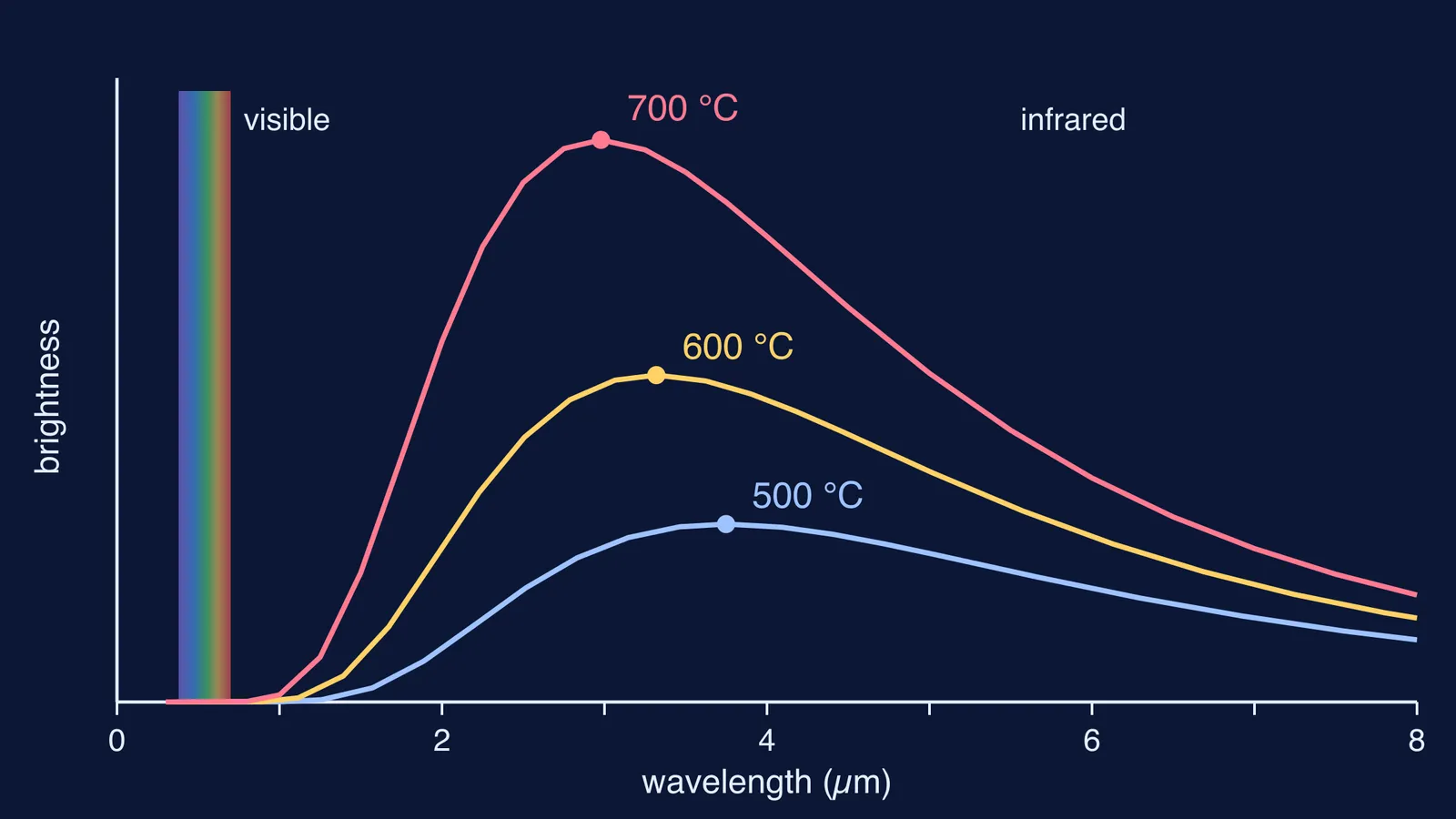
A hot surface's colour is set by its temperature. Wien's displacement law gives the wavelength where its light peaks: λmax = b/T, with b = 2.898 × 10⁻³ m·K (NIST).
Worked example: a coal at 700 °C
Convert to kelvin: T = 700 + 273 = 973 K.
λmax = (2.898 × 10⁻³ m·K) / 973 K ≈ 2.98 × 10⁻⁶ m, or about 3 µm.
NASA gives the visible range as roughly 380 to 700 nm, or 0.38 to 0.70 µm (NASA). The peak is far out in the infrared.
Only the tail of the curve reaches the visible band, and red is the end nearest the peak. For an ideal hot surface, Planck's law (with c₂ = 1.4388 × 10⁻² m·K from NIST) gives about 3,900 times more light at 650 nm (red) than at 450 nm (blue). At 500 °C the ratio is about 53,000.
So cooler coals look dull red and hotter ones orange. The same rule explains why blue stars are hotter than red stars. If these curves are hard to picture from an equation, the Fermi Simulation Lab has interactive simulations for ideas that are easier to see than to read.
Flame or glow? A quick check for any fuel
Ask three questions:
Does it melt or vaporise when heated, like wax or kerosene? It burns with a flame.
Does it give off gases as it heats, like fresh wood? Flames first, then glowing embers once the gases are gone.
Is it mostly carbon that stays solid, like charcoal? It glows, with at most a small flame from carbon monoxide near the surface.
If a step in this chain still feels shaky, the Fermi Concept Library covers every concept in physics, chemistry, biology, mathematics and computing, each with its own lesson.
Why is glowing charcoal dangerous in a closed room?
Smouldering is incomplete burning: Rein reports CO₂ to CO ratios of around 1, against around 10 in flaming, so carbon monoxide is a major hazard (Rein, 2009).
In January 2024, the news agency IANS reported that 15 people in Delhi had died that month after inhaling smoke from angithis, traditional braziers that burn coal or wood. Atul Garg, director of the Delhi Fire Service, told people heating a room to "keep a window or door slightly open for cross ventilation" (IANS). Simple rules for your home:
Never sleep with a lit angithi or sigri in a closed room.
Keep a window or door open whenever one is burning indoors.
If anyone near one feels unwell, get everyone out into fresh air and call an adult for help.
For how different fires are put out, read how different fire extinguishers work.


