

On this page
The red cylinders in your school corridor are not all the same. Each attacks a different part of what a fire needs, and the wrong one can make things worse.
What is the fire triangle?
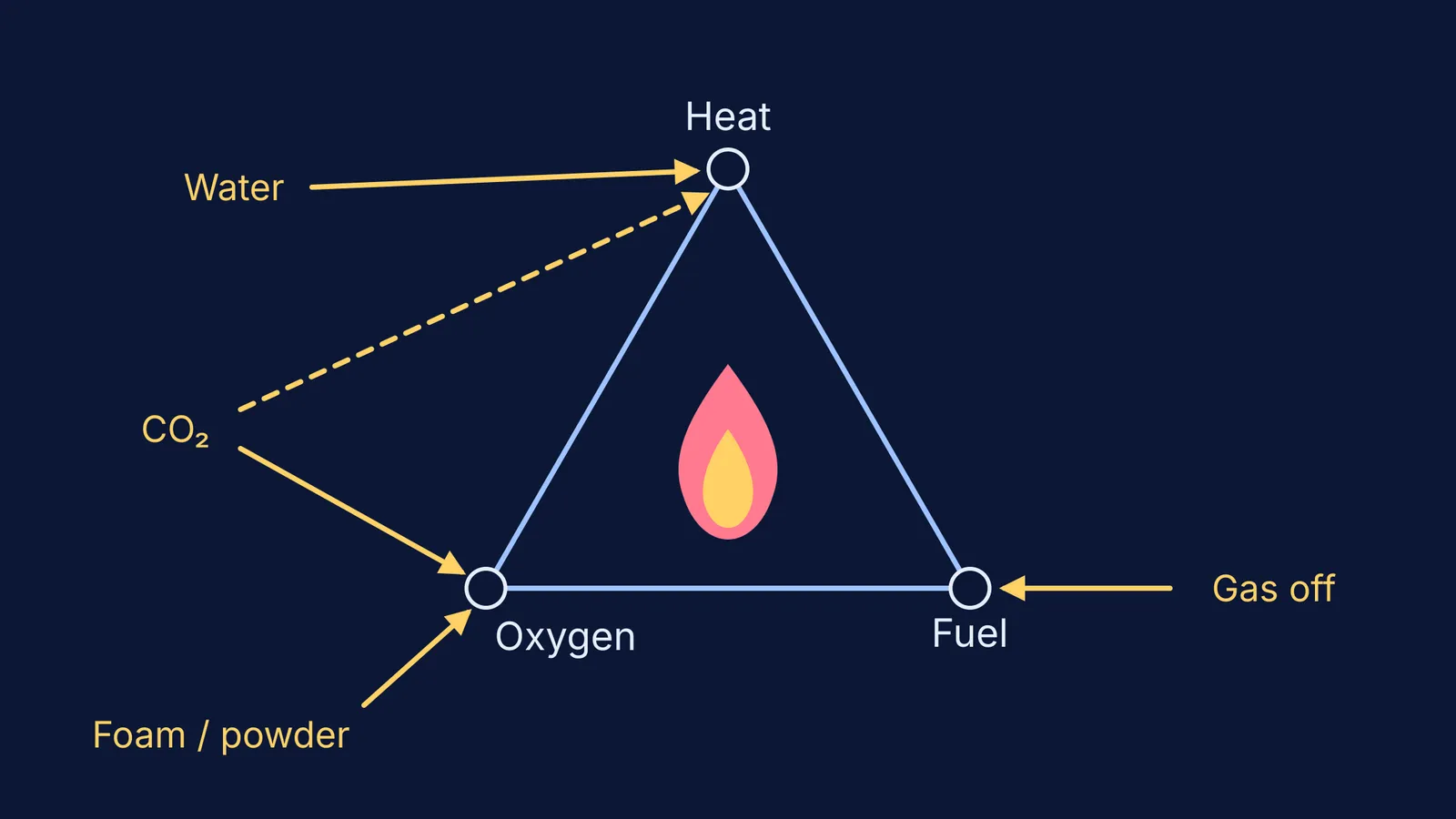
A fire needs three things at the same time: enough oxygen, enough heat to reach ignition temperature, and some fuel, according to the East Dunbartonshire Council fire extinguisher training manual. Take away any one of them and the fire goes out.
You have already seen this idea at work if you have tried the paper cup of water held over a flame: the water keeps the paper below its ignition temperature, so the heat side of the triangle never closes.
How does each type of fire extinguisher put out a fire?
The council's training manual describes five types of extinguisher, plus fire blankets. Here is what each one removes.
Water: takes away heat. It is meant for solids such as wood, paper and cloth.
Carbon dioxide (CO2): takes away oxygen by displacing air, and is cold enough to cool the fuel too. It leaves no mess and does not conduct electricity, but its range is short, about one to three metres.
Foam: floats on a burning liquid such as petrol and seals the surface, cutting the flames off from oxygen.
Dry powder (ABC): coats the fuel with a thin layer that separates it from the air, and also interrupts the chemical reaction of the flames.
Wet chemical: made for cooking-oil fires. A fine mist cools the flame front while potassium salts turn the surface of the oil into soap, leaving a layer of foam over it.
How cold does it get? The University of South Carolina notes that bits of dry ice may shoot out of the horn, and solid carbon dioxide sublimes at about -109 °F, roughly -78 °C, according to its PubChem entry. The manual warns that the horn can get cold enough to damage skin.
Why is water unsafe on oil and electrical fires?
On burning oil, water makes things worse. In Education in Chemistry, Declan Fleming gives the fire point of cooking oil as about 370 °C, well above both the boiling point of water and its Leidenfrost limit of about 200 °C. Water droplets sink through the hot oil, boil violently and throw the oil into the air with the steam, so the burning surface area jumps and you get a fireball.
On electrical fires, water conducts, so there is a risk of electrocution, says the University of South Carolina's page on water extinguishers. That is why the council manual lists CO2 and dry powder, not water or ordinary foam, for live electrical equipment.
How much heat can a litre of water take away?
Water is good at removing heat because boiling it costs so much energy. Using values from LibreTexts Chemistry/11%3A_Liquids_and_Intermolecular_Forces/11.04%3A_Phase_Changes): liquid water's specific heat is 4.184 J/(g °C), and its heat of vaporisation is 40.7 kJ/mol.
Take 1 litre of tap water, about 1,000 g, at 25 °C.
Warming it to 100 °C: 1,000 × 4.184 × 75 = 313,800 J, or about 314 kJ.
Boiling it away: 1,000 g ÷ 18.02 g/mol = 55.5 mol, and 55.5 × 40.7 = about 2,259 kJ.
Total: about 2,570 kJ, and boiling does roughly seven times as much cooling as warming.
So most of the cooling happens when water turns to steam on the hot fuel. The Fermi Simulation Lab has interactive simulations for the ideas that are easier to see than to read.
Which fire extinguisher should you use?
Before you touch an extinguisher, run this check, based on the council manual.
Raise the alarm and call for help first: 112 is India's national emergency number and 101 is fire, both listed on the Incredible India emergency page. Only then, and only if the fire is small and just starting, try an extinguisher. If it is spreading, leave and close doors behind you.
What is burning? Wood, paper or cloth: water, foam or ABC powder. Petrol or spirits: foam, CO2 or powder. Live electrics: CO2 or powder. Cooking oil: wet chemical or a fire blanket, never water, and turn off the gas if you can reach it safely, which removes the fuel.
Read the label. Class letters are not the same everywhere (in the UK manual, C means flammable gases), so trust the pictures and the "do not use on" warnings.
Use PASS: pull the pin, aim at the base of the fire, squeeze the handle, sweep side to side, starting 2 to 3 m away with an exit behind you. An extinguisher typically runs for only about 10 to 20 seconds, depending on its size.
To turn this into a family plan, read how to teach kids fire safety at home, and if combustion still feels hazy, the Fermi Concept Library has a lesson for every concept in chemistry.


