

On this page
Why does a paper cup with water not burn over a flame?
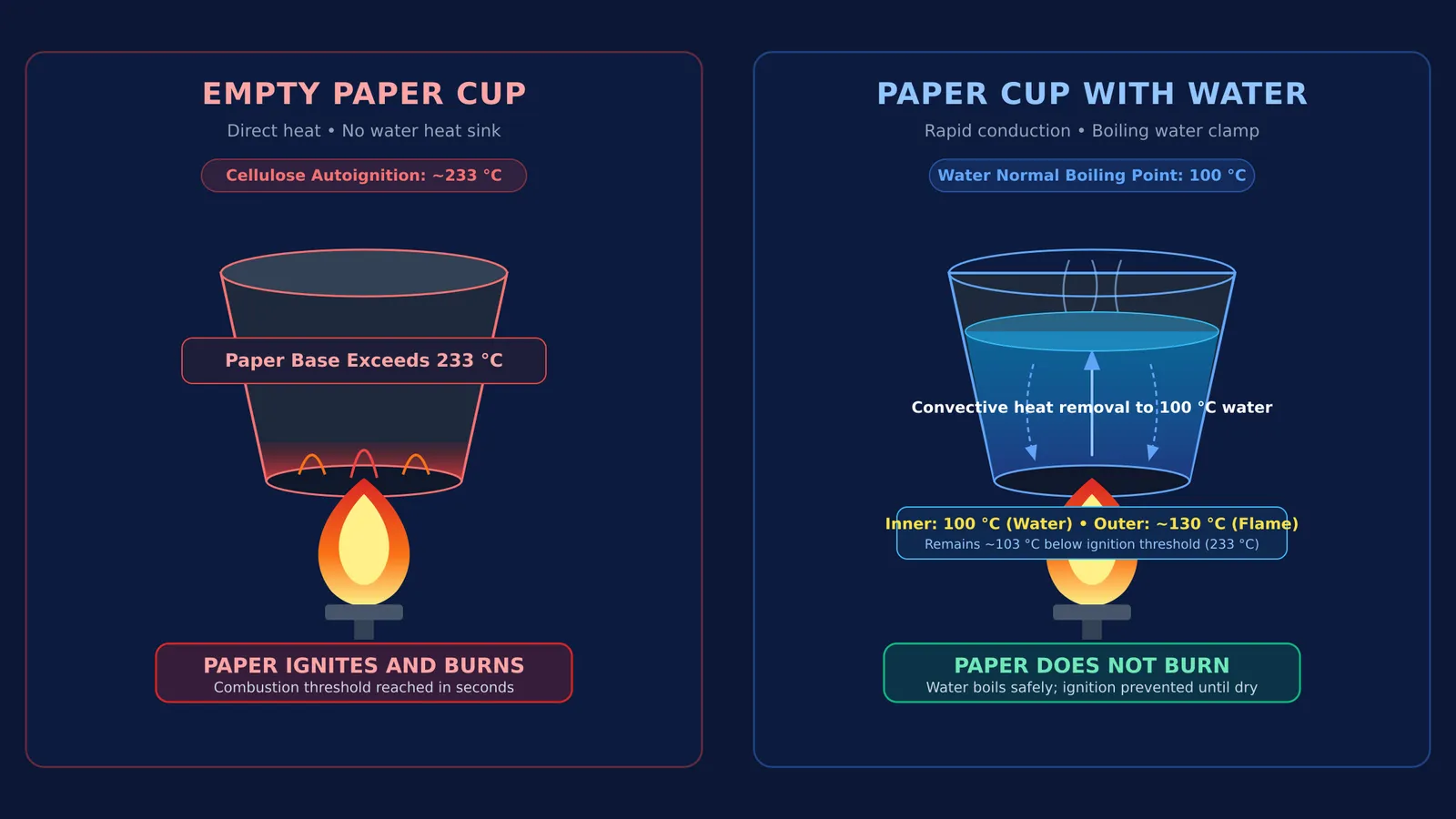
When you place an empty paper cup over a candle flame, it catches fire within seconds. But when you fill an identical paper cup with 50 mL of water and place it over the same flame, the paper refuses to ignite. The bottom surface collects soot, but the cup stays intact while the water warms until it boils. This classic experiment from NCERT Class 8 Science demonstrates the physical conditions required for combustion.
Combustion requires three ingredients: fuel, oxygen, and enough heat to reach the ignition temperature. Here, paper provides fuel and ambient air provides oxygen. However, combustion cannot start until paper reaches its autoignition temperature of roughly 233 °C (451 °F). As physics educator Thomas B. Greenslade Jr. highlights in *The Physics Teacher*, such demonstrations rely on keeping paper below this threshold while the liquid above absorbs the heat. Water at standard pressure cannot exceed its normal boiling point of 100 °C, according to the NIST Chemistry WebBook. Because water directly contacts the paper, it rapidly conducts heat away, keeping the cellulose fibers well below 233 °C.
How does water keep the paper below its ignition temperature?
As documented by the Royal Society of Chemistry, three thermal mechanisms protect the cup:
Rapid conduction across thin paper: Standard cup paper is roughly 0.15 mm thick. Heat conducts rapidly across this thin wall into the water, as explored in our guide on how thermal conductivity governs heat flow.
High specific heat capacity: Liquid water has a specific heat capacity of 4,184 J/(kg·K) at 25 °C, confirmed by NIST. It absorbs substantial energy with modest temperature rise, while natural convection circulates cooler water to the bottom.
Latent heat of vaporisation: At 100 °C, added heat converts water into steam rather than raising its temperature. As detailed in our guide on why temperature stays constant during phase changes, boiling water remains clamped at 100 °C while absorbing 2,257 kJ/kg, verified by NIST.
In *Scientific American*, physicist Jearl Walker noted that this liquid heat sink effect similarly protects barefoot firewalkers when thin moisture layers absorb thermal energy before skin burns.
How much heat can the paper and water transfer before boiling?
To understand why the outer wall never overheats, consider the temperature gradient across the base. The Royal Society of Chemistry notes in its thermal properties of water demonstration that a burner delivers steady heat flux to the cup floor.
Suppose a flame delivers a heat flux q″ of 20,000 W/m² across a paper wall of thickness d = 0.15 mm (1.5 × 10⁻⁴ m). With paper thermal conductivity k roughly 0.10 W/(m·K), Fourier conduction gives a temperature drop ΔT across the wall:
ΔT = q″ × (d / k) = (20,000 W/m²) × (1.5 × 10⁻⁴ m) / (0.10 W/(m·K)) = 30 °C.
Because boiling water holds the inner wall at 100 °C, the outer surface exposed to the flame reaches 130 °C. Even a fierce flame at 40,000 W/m² yields ΔT = 60 °C and an outer wall of 160 °C, still far below the 233 °C ignition point.
Boiling away 50 mL (0.05 kg) of water requires 15.7 kJ of sensible heat from 25 °C to 100 °C plus 112.9 kJ of latent heat, as catalogued in NIST thermophysical tables. To see why latent heat of vaporisation is so large, consider the energy required to break hydrogen bonds. A standard 50 W candle flame takes over 40 minutes to boil 50 mL dry. Only then does the dry paper ignite.
What does the paper cup experiment prove for exams?
Examiners frequently test the physical principles illustrated by this demonstration:
Ignition temperature is an absolute threshold: Combustion cannot occur until fuel reaches its specific ignition temperature.
Water acts as a thermal clamp: Water extinguishes fire primarily by cooling fuel below its ignition temperature, not just by smothering air.
Dry edges burn: If the flame touches paper above the water line, that uncooled section quickly chars and catches fire.
When connecting thermal physics principles to problem solving, the Fermi Concept Library covers every concept in physics, chemistry, biology, mathematics and computing, each with its own lesson and its place in the map. If you are working through numerical problems on heat conduction and calorimetry, the Fermi Problem Library has worked problems with a step-by-step solver that explains the reasoning rather than printing an answer. For learners who want to see convective heat flow and phase transitions visually, the Fermi Simulation Lab provides interactive simulations for the ideas that are easier to see than to read.


