

On this page
Leave a steel spoon and a wooden spoon on a kitchen counter overnight. The next morning, ask a child to predict which one will feel colder, and then have them touch both. They will confidently say the metal spoon is freezing, while the wooden one feels perfectly normal.
Now, place a kitchen thermometer against each spoon. The reading will show they are exactly the same temperature.
This simple observation is a powerful entry point into learning physics. It reveals how easily our physical senses can be tricked by the world around us. So, why does the hand lie?
Why does metal feel colder than wood at the same temperature?
To understand this illusion, we must first compare the temperature of your body to the environment around you. Your internal body temperature is near 37 °C (Wikipedia). While the surface of your skin is slightly cooler than your core, it is still significantly warmer than the air in a typical house. Standard room temperature is commonly defined as 20 °C to 22 °C (Wikipedia).
Because heat always flows from a warmer object to a cooler one, touching a room-temperature spoon means thermal energy immediately leaves your skin and enters the object.
Crucially, your sensory nerves do not act as absolute thermometers that measure the spoon's exact temperature. Instead, they function as heat flux sensors. They are highly sensitive to the *rate* at which heat is leaving your skin.
How does your skin sense temperature?
Underneath the surface of your skin are specialised nerve endings called thermoreceptors. You have distinct sets of receptors for sensing heat and sensing cold. When the temperature of your skin drops rapidly, the cold receptors fire a barrage of electrical signals to your brain.
If heat leaves your skin slowly, your body easily replaces it through blood flow, and the skin temperature barely changes. If heat is stripped away aggressively, the blood flow cannot keep up, the local skin temperature plummets, and your brain receives a strong warning signal that you are touching something freezing.
What is the role of thermal conductivity?
The true difference between the two spoons lies in a physical property called thermal conductivity (k), which measures how fast a material allows heat to pass through it.
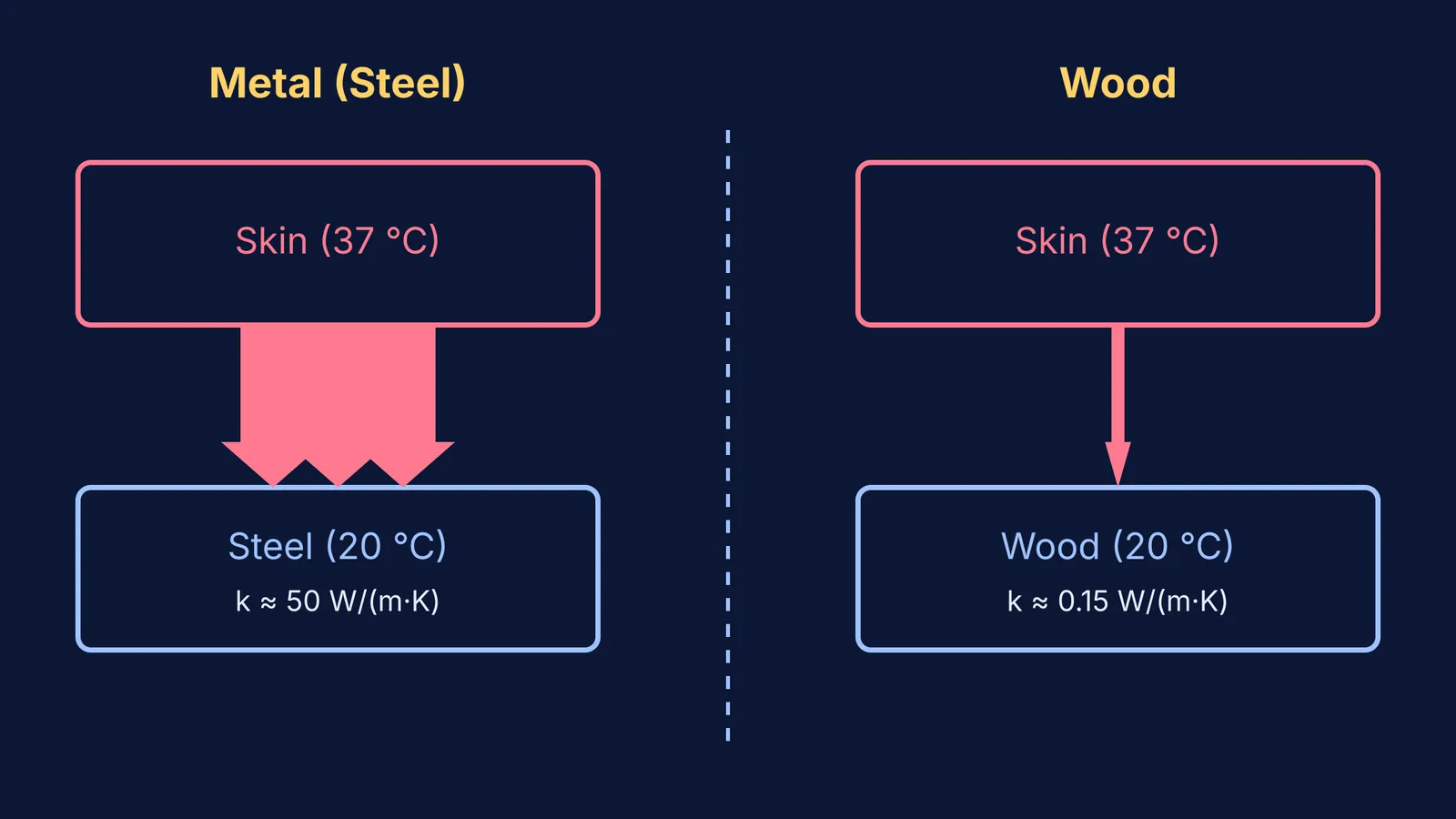
Wood is an excellent natural insulator. Common woods like oak or maple have a thermal conductivity around 0.14 to 0.16 W/(m·K) (Wikipedia). When you touch the wooden spoon, it slowly absorbs a tiny amount of heat from your hand. Because the heat cannot travel quickly through the wood, the very surface of the spoon warms up to match your skin temperature, effectively stopping further heat loss. Your hand's temperature stays stable, so you do not feel cold.
Steel, on the other hand, is a strong thermal conductor. Carbon steel has a thermal conductivity between 30 and 54 W/(m·K) (Wikipedia). This means steel conducts heat roughly 300 times faster than wood. When you press your warm hand against the steel spoon, it pulls heat out of your skin rapidly and continuously funnels it away into the rest of the metal handle. Because the heat is removed so aggressively, the temperature of your skin drops sharply. Your thermoreceptors register this sudden plunge and send an urgent "cold" signal to your brain.
How can we turn misconceptions into active learning?
When a student predicts that the metal spoon will have a lower absolute temperature, they are drawing a perfectly logical conclusion based on their daily experience. Overturning this kind of intuitive but incorrect assumption is a prime opportunity for active learning.
Instead of just telling them the answer, challenging them to use a thermometer creates a moment of surprise. The contradiction between the thermometer reading and their own sense of touch forces them to ask new questions and rethink their understanding of heat.
This phenomenon is a classic physics puzzle where our direct experience contradicts reality. Fully grasping it requires picturing the invisible flow of thermal energy. This is exactly where the Fermi Simulation Lab comes in—by letting students run interactive simulations for the ideas that are easier to see than to read, such as heat transfer across boundaries.
For older students studying thermodynamics or calculating the time for ice to form on a pond, these early hands-on principles eventually become rigorous, testable formulas. Whether they are measuring heat in isobaric and isochoric processes for an exam or simply touching a kitchen spoon, the core rule of conduction remains the same: it is not the temperature you feel, but the speed of the heat.


