

On this page
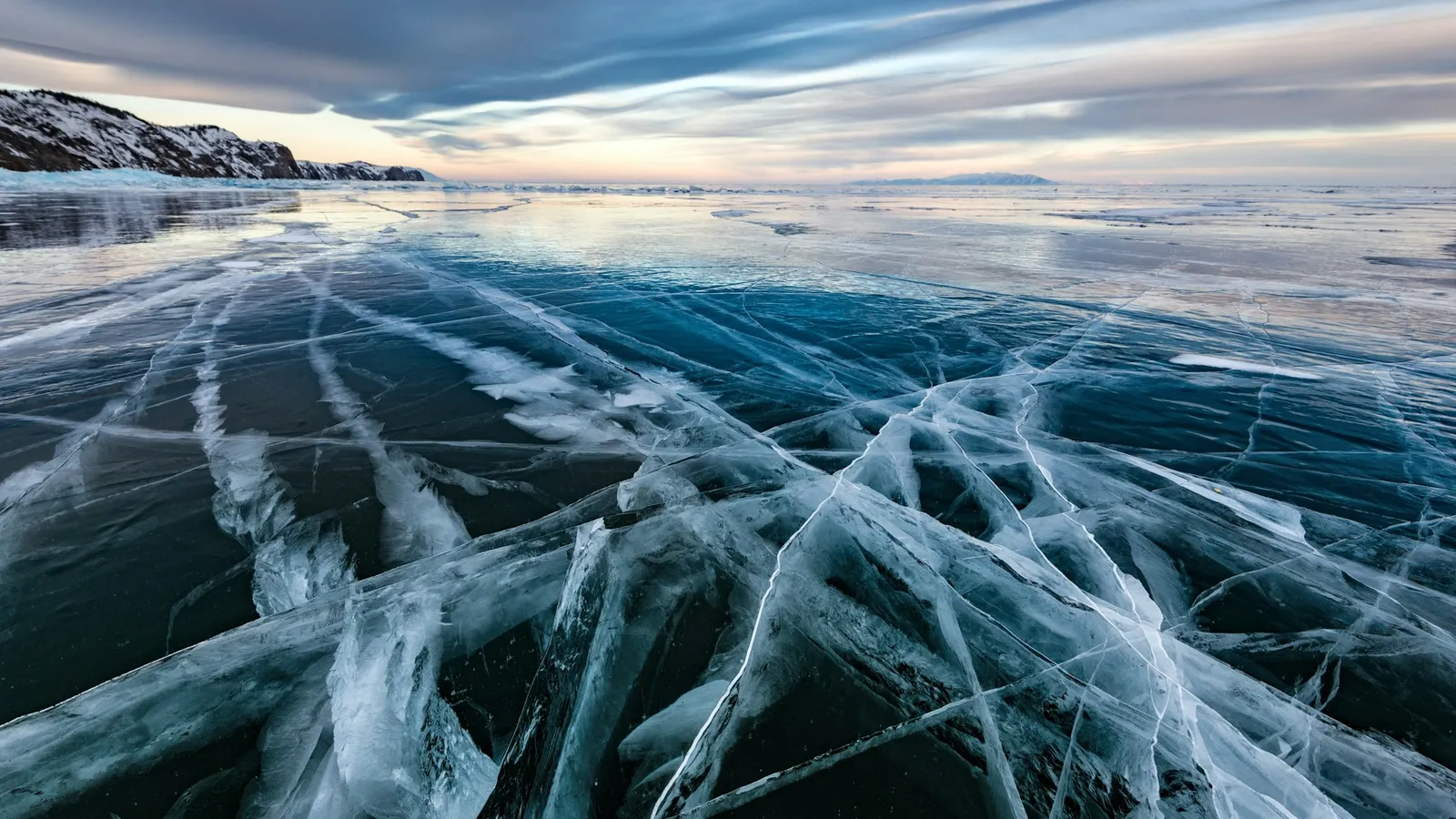
A pond in a cold winter freezes on top. The first thin layer forms quickly, then growth slows to a crawl. The reason is the ice itself: every joule released by freezing water must leak up through it. This classic JEE problem joins two ideas, conduction and latent heat, into one differential equation. This post sets it up, solves it, and works numbers you can check.
Is this on the syllabus?
The JEE (Main) 2026 syllabus lists "change of state, latent heat" and "Heat transfer: conduction, convection and radiation" in the thermal properties unit. The NEET (UG) 2026 syllabus lists the same ideas.
NCERT Class 11 Chapter 10, Thermal Properties of Matter (reprint 2026-27) gives you every ingredient: the conduction law H = KA(TC − TD)/L, a table with the thermal conductivity of ice as 1.6 W m⁻¹ K⁻¹, and the latent heat of fusion of water as 3.33 × 10⁵ J/kg. NCERT does not work this problem, so it is an application of listed ideas.
Why does a pond freeze from the top?
NCERT explains it with water's anomalous expansion. As a lake cools towards 4 °C, surface water becomes denser and sinks. Once the top falls below 4 °C, it becomes less dense, stays at the surface and freezes there. Water below stays liquid, so pond life survives. That is why the ice grows downward, from the top.
How do you set up the equation?
Let the ice be x thick at time t. Its top is at the air temperature, θ degrees below zero. Its bottom touches water at 0 °C. Assume the temperature falls in a straight line through the ice, as in steady conduction.
Heat flowing up through area A each second: H = KAθ/x.
To freeze a further thin layer dx, you must remove latent heat ρ(A dx)L, where ρ is the density of ice.
Equate the rates: ρAL dx/dt = KAθ/x.
The area cancels. Separate the variables: x dx = (Kθ/ρL) dt. Integrate from thickness x1 to x2:
t = ρL(x2² − x1²)/(2Kθ)
Starting from no ice, t = ρLx²/(2Kθ), or x = √(2Kθt/ρL). Ice thickness grows with the square root of time. The problem is old: in 1891 J. Stefan published a theory of ice formation, especially in the polar sea.
Worked example 1: a cold night
Air at −10 °C, so θ = 10 K. Use NCERT's K = 1.6 W m⁻¹ K⁻¹ and L = 3.33 × 10⁵ J/kg. Take the density of ice as 900 kg/m³, a sample value for this problem.
From 0 to 5 cm: t = 900 × 3.33 × 10⁵ × (0.05)²/(2 × 1.6 × 10) = 23,400 s, about 6.5 hours.
From 5 cm to 10 cm: t = 900 × 3.33 × 10⁵ × (0.10² − 0.05²)/32 = 70,200 s, about 19.5 hours.
Total to 10 cm: about 26 hours.
The second 5 cm takes three times as long as the first. After a full day (86,400 s), x = √(2 × 1.6 × 10 × 86,400/(900 × 3.33 × 10⁵)) = 0.096 m, just under 10 cm.
Halve the temperature to −20 °C and every time halves: the first 5 cm now takes about 3.3 hours.
Worked example 2: the odd-number pattern
A question says the first 1 cm of ice forms in 1 hour. How long does the next centimetre take?
t ∝ x², so 2 cm needs 2² = 4 hours in total.
The second centimetre takes 4 − 1 = 3 hours. The third takes 9 − 4 = 5 hours.
Each centimetre takes 1, 3, 5, 7... hours. No constants needed.
What does the model leave out?
The ice's top is assumed to sit at air temperature. In reality heat must also leave the surface by convection and radiation, so growth is slower.
The heat needed to cool the ice itself below 0 °C is ignored.
K and ρ are taken as constant. Data tables differ, so always use the values a question gives.
Which mistakes cost marks?
Writing t ∝ x. The thickening path makes it x².
Using (x2 − x1)² for an interval.
Using the latent heat of vaporisation (22.6 × 10⁵ J/kg) instead of fusion.
Using the conductivity of water. The heat goes through ice.
Leaving x in centimetres. A 5 cm layer is 0.05 m, and the square makes the error a factor of 10⁴.
If your set-up keeps going wrong, the Fermi Problem Library has worked problems with a step-by-step solver that explains the reasoning behind each line.
A practice routine
Derive t = ρL(x2² − x1²)/(2Kθ) from a blank page.
Redo example 1 at −5 °C. Every time doubles.
Solve the reverse problem: how thick is the ice after 12 hours at −10 °C?
Revise slabs and thermal resistance with our heat conduction guide, and latent heat with our calorimetry guide.
This week, solve one ice-growth problem from memory and check that it follows the square law.


