

On this page
Watch a bonfire at night and the sparks stream up, swirl, and fade high above your head. The air above it is rising, and the sparks ride on it. Three ideas explain this: hot air is less dense, less dense air rises, and anything light enough gets carried along.
Why does hot air rise above a fire?
Air follows the ideal gas relation p = ρRT, where p is pressure, ρ is density and T is temperature in kelvin (NASA Glenn Research Center). The same NASA page notes that with mass and pressure held constant, a gas's volume is proportional to its temperature, so its density falls as it heats.
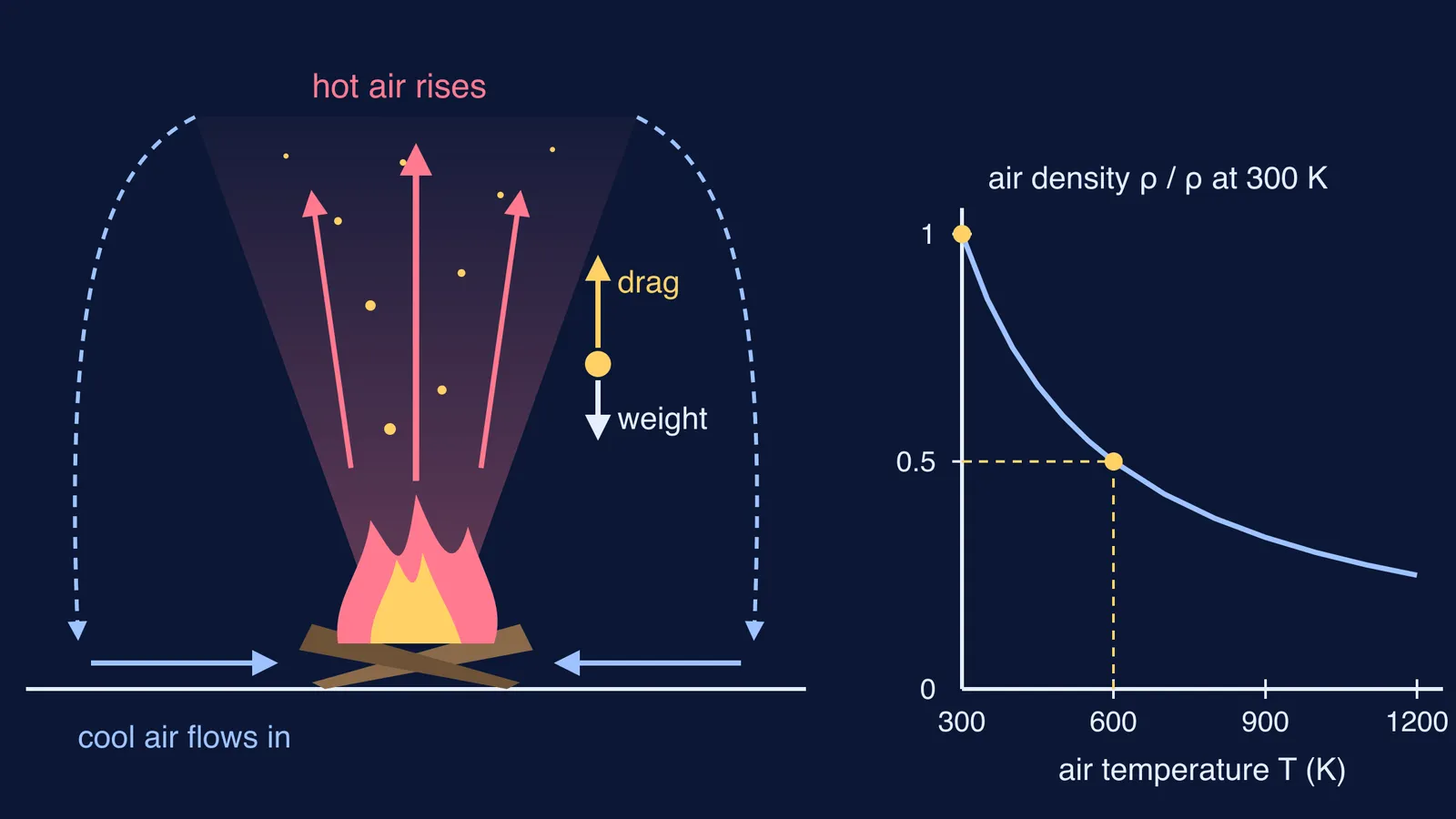
Air around a bonfire is at roughly the same pressure, so the air the fire heats becomes lighter for its size than the air around it. The cooler, denser air pushes in underneath and shoves the warm pocket upward. That push is buoyancy.
Convection is the transfer of heat energy in a fluid such as air or water (NOAA JetStream). NOAA describes a bubble of warm air rising and being replaced by the surrounding cooler, more dense air. Above a bonfire, hot air goes up the middle and cool air slides in along the ground. That loop is a convection current.
How much lighter is the air above a fire?
You can work it out in your head. Say the air on a cool evening is at 300 K (27 °C), and the air just above the flames is at 600 K (327 °C). With pressure the same, the ideal gas relation p = ρRT tells you that ρ × T is the same for both, so:
ρ(hot) / ρ(cool) = T(cool) / T(hot)
= 300 / 600 = 0.5
So each cubic metre of hot air has half the mass of a cubic metre of the cool air around it.
The net upward push per cubic metre is (ρ(cool) − ρ(hot)) × g, so the hotter the air, the harder it is pushed up. Use kelvin: plugging in 27 and 327 gives a wrong ratio of about 0.08.
Why do sparks go up with the air but logs don't?
A spark is a tiny burning flake of wood or ash. Its weight pulls down; drag from the rising air pushes up.
NASA gives the speed at which drag exactly balances weight, the terminal velocity, as V = √(2W / (Cd ρ A)), where W is weight, Cd is the drag coefficient, ρ is the air's density and A is the area facing the flow (NASA Glenn, terminal velocity). The same page notes that a lighter object, or one with a larger area, falls more slowly.
That gives you a simple rule:
If the updraft is faster than the ember's terminal velocity, the ember rises.
If the updraft is slower, the ember falls, just more slowly than it would in still air.
An ember is a thin, light flake with plenty of surface, so its terminal velocity is small; a log is far too heavy. Halving an ember's weight, with the same area, cuts its terminal velocity to √0.5, about 0.71 of what it was, and a burning spark keeps losing mass.
Why do sparks zigzag and then disappear?
The plume is turbulent, full of gusts and swirls, so sparks trace wobbly paths. As it rises it mixes with cool air and slows down. Meanwhile most sparks burn out or cool until they stop glowing, so they seem to vanish in mid-air.
Alec Petersen and Tirtha Banerjee of UC Irvine used high-speed imaging and particle tracking on a night-time pile fire at UC Berkeley's Blodgett Forest, and caught embers in sheet pans of water set out around the fire (Physics of Fluids, 2024). As UC Irvine's summary on Phys.org reports, ember creation was highly intermittent, coming in large bursts, and bursts of relatively large embers were thrown up together with strong, turbulent updrafts. Because of simplifications, present models can underestimate how far large embers may be lofted and carried.
How can you see convection for yourself?
Try these with an adult nearby:
Light an agarbatti in a still room and watch the smoke rise straight up before it curls. Our post on why incense smoke rises then curls explains the curl.
Hold your palm well above a candle, then the same distance to its side. Above feels far hotter, because convection carries heat upward. Why a candle flame always points upwards is the same physics.
To see the whole loop, try our walk-through of how convection currents form in a heated tank. The Fermi Simulation Lab has interactive simulations for ideas like this that are easier to see than to read. If the density-temperature link still feels shaky, the Fermi Concept Library gives every concept in physics its own lesson.
Next time you sit by a fire, look up. Every spark is showing you which way the air is moving.


