

On this page
If you have ever stared at a candle, you will have noticed that no matter how you tilt it, the flame always points up. It stretches into a familiar yellow teardrop, flickering slightly in the draft.
This simple observation reveals a lot about how heat, density and gravity interact in our atmosphere. The upward shape is not an inherent property of the fire itself, but a consequence of the environment it burns in. When you remove gravity, a flame forgets its shape entirely and behaves in a completely different way.
Why does a candle flame always point upwards?
On Earth, a burning candle rapidly heats the surrounding air. When a gas is heated, its molecules move faster and spread further apart. This hot air expands and becomes significantly less dense than the cooler air around it.
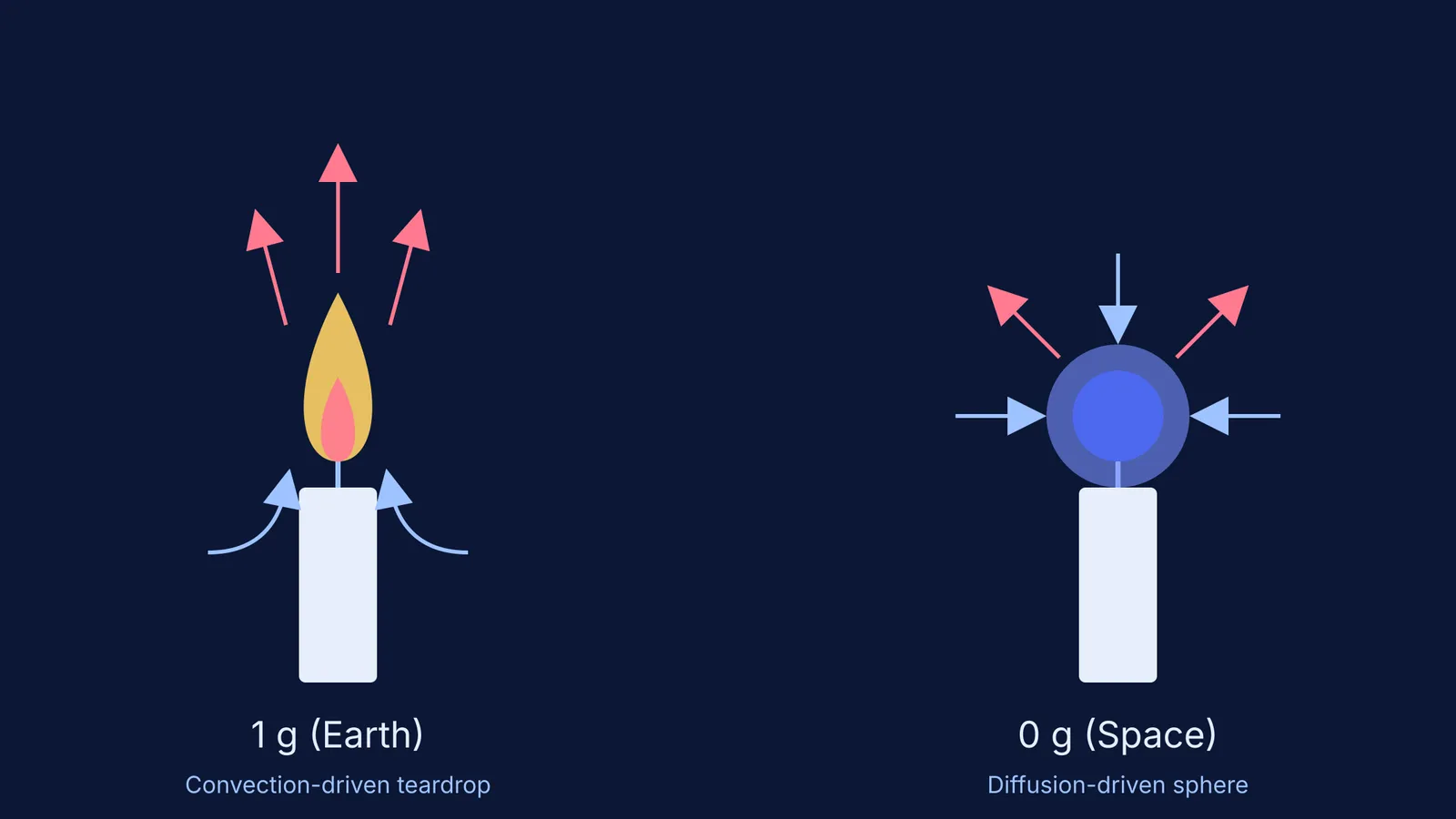
Gravity continuously pulls the denser, cooler air downwards towards the base of the candle. As this heavy, oxygen-rich air sinks, it physically displaces the lighter, hot exhaust gases, forcing them upward in a process known as buoyancy-driven convection (NASA).
This convection current acts exactly like an invisible chimney. It stretches the flame upwards into its pointed shape and constantly draws fresh oxygen to the wick to keep the fire burning vigorously. The upward draft also sweeps unburnt carbon particles (soot) into the hottest part of the flame. As these particles heat up, they undergo incandescence, glowing bright yellow before finally burning away at the tip.
If you find it difficult to visualise how density, temperature and pressure drive these invisible currents, the Fermi Simulation Lab lets you interact with fluid dynamics and heat transfer in real time. It is a practical way to make the unseen forces of convection easy to observe and measure.
What happens to a candle flame in microgravity?
If you take a candle onto the International Space Station, the physics of combustion change dramatically. In the microgravity environment of low Earth orbit, there is no meaningful "up" or "down". Hot air is still created by the flame, but because gravity is not pulling the cooler, heavier air down, the hot air does not rise.
Without buoyancy-driven convection, the flame immediately becomes a perfect sphere. Oxygen can no longer be drawn in by a rapid upward draft. Instead, it must slowly drift towards the wick through a process called molecular diffusion, moving passively from an area of high concentration in the cabin to the area of low concentration near the wick.
Because this diffusion process is much slower than convection, space flames behave very differently to those on Earth:
They are dim and blue. Without a strong upward draft to carry soot particles through the reaction zone quickly, the glowing yellow soot does not form in the same way. The flame burns with the dim blue light of excited molecules and radicals.
They burn much cooler and slower. In experiments like the Candle Flames in Microgravity (CFM) tests conducted on the Space Shuttle and the Mir space station, researchers found that these slow-burning flames can sometimes last for nearly 45 minutes on very little fuel, whereas they would burn out much faster on Earth (NASA).
They stand further from the wick. The spherical flame establishes a stable standoff distance further out from the fuel source. This is the exact radius where the slow inward drift of oxygen perfectly matches the outward drift of combustion products like carbon dioxide and water vapour.
How can you use this to solve physics problems?
The candle flame is a classic, practical example of how gravity subtly controls thermodynamic processes that we often think of as independent. Whether you are studying the free expansion of an ideal gas or modelling SHM through a tunnel across the Earth, checking your underlying assumptions about gravity is a crucial step in physics.
When solving problems involving fluids, gases or heat transfer, you can use this simple three-step checklist to ensure you have not missed a hidden force:
Identify the driving force. Is the fluid flow driven by an applied pressure, a temperature gradient, or a change in density? If density changes are involved and the problem is set on Earth, gravity is almost certainly pulling the strings.
Remove gravity as a thought experiment. Ask yourself what the system would do if it were placed in orbit. If the answer is "nothing would happen" or "it would stop moving", you have identified a gravity-driven convection mechanism.
Trace the flow of cold material. Do not focus on where the hot material wants to go. Always sketch where the cold, dense material goes. It will always fall, pushing the lighter material out of the way.
By questioning why things happen the way they do—even something as simple as a candle pointing upwards—you train yourself to spot the fundamental laws at work behind everyday phenomena.
For more examples of how gravity shapes physical systems, explore how it affects the free expansion of an ideal gas.


