On this page
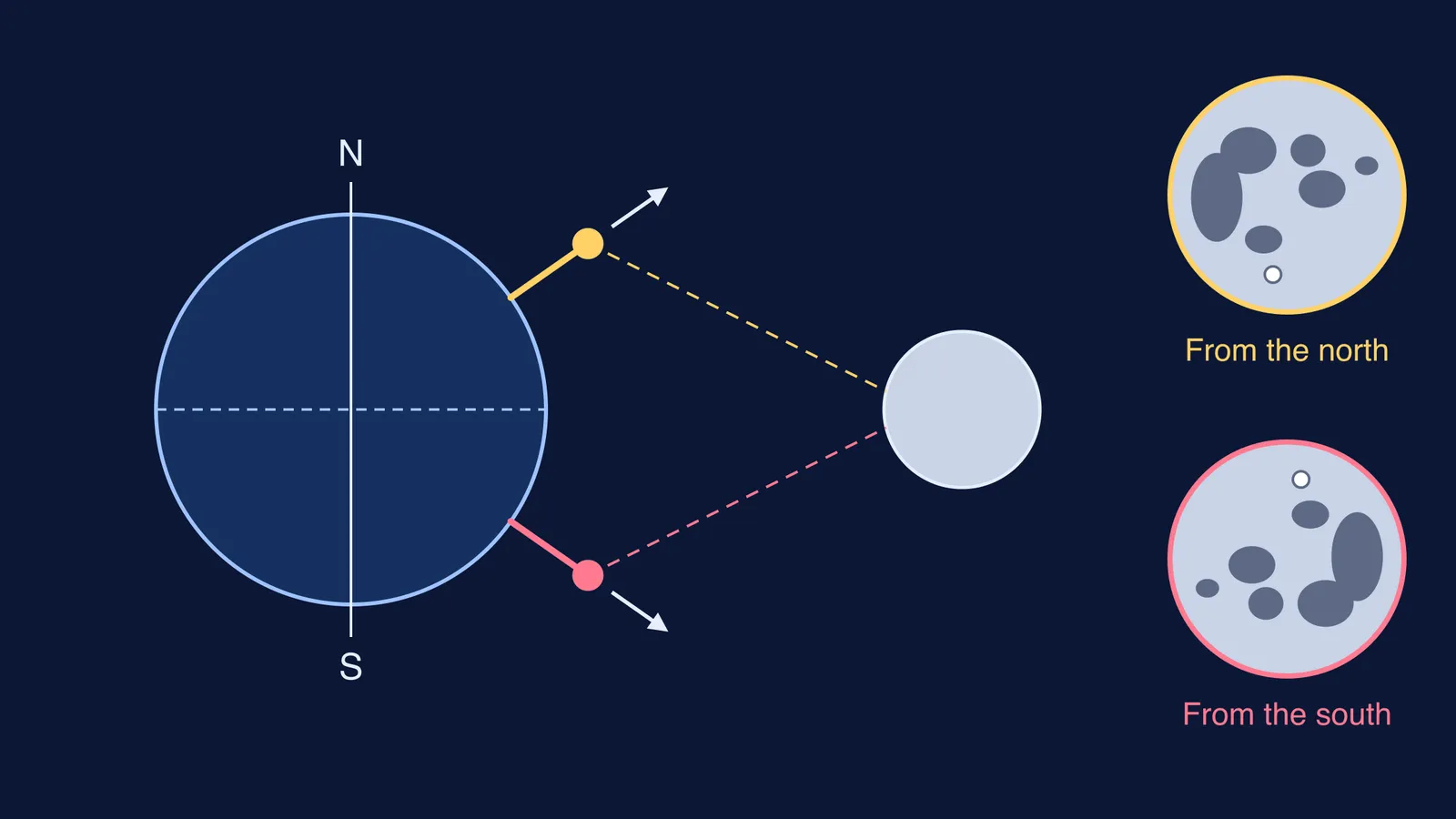
Compare full-moon photos from Sydney and Delhi, each taken with the Moon high in the sky, and the dark patches do not line up. They are the same patches, turned around. Kate Howells of The Planetary Society gives the reason plainly: "a person standing on Earth's north pole is upside down compared to someone on the south pole, their perspective of the Moon would be upside down as well."
Does the moon really look upside down in Australia?
Yes. Writing in BBC Science Focus, Dr Alastair Gunn, a radio astronomer at the Jodrell Bank Centre for Astrophysics, says the "Man in the Moon" is upside down in the southern hemisphere "and can actually look more like a rabbit."
It is not a mirror image. From the Southern Hemisphere, an object near the celestial equator appears "both upside down and reversed left to right", explains Michael E. Bakich, a senior editor at Astronomy magazine. Flip a picture top to bottom and left to right at the same time and you have simply turned it half a circle.
NASA's Scientific Visualization Studio publishes a separate "south up" version of its Moon animation for this reason: "Celestial south is up in these images, corresponding to the view from the southern hemisphere" (NASA SVS).
Why does your position on Earth flip the view?
Two things change when you cross the equator: the direction you face, and the direction your head points.
First, the direction you face. In the Northern Hemisphere you usually look south to see the Moon and the constellations near the celestial equator; in the Southern Hemisphere you look north. The Astronomy magazine explanation puts it simply: "When you face south, east is to your left," while "when you look north, east is to your right." Left and right swap.
Second, the direction of your head. "Up" for you always points straight away from Earth's centre, and on a round planet that direction tilts as you travel. The diagram at the top shows two observers at matching northern and southern latitudes viewing the same Moon. Their heads point different ways, so the edge of the Moon each calls the top is a different edge. Top and bottom swap. Gunn sums it up in BBC Science Focus: the two observers "are looking at the same object from opposite directions and naturally that means one sees the object flipped compared to the other."
If you have wondered why that face is always the same one, see why we always see the same side of the Moon.
What happens near the equator?
The change is gradual, not a switch that flips at the equator. The Planetary Society explains that near the equator the Moon passes almost overhead and "would set on the opposite side of the sky from where it rose", and that its orientation at rising and setting would "look sideways compared to what you'd see nearer either of the poles."
Latitude also changes how a thin crescent sits in the sky, which is why it can look tipped over from India, as we explain in why the crescent moon looks like a smile in India.
The view also shifts a little through the month, wherever you are. NASA SVS notes that the Moon "appears to roll back and forth", measured by the position angle of its axis. The hemisphere difference is a much bigger half-turn on top of that.
How can you see the southern view from India?
This short plan turns the idea into something you can check with your own eyes.
On the next clear night near full moon, sketch the Moon from your roof or balcony. Shade the dark patches and mark which edge is nearest the horizon.
Open the NASA SVS south-up animation page and pause on a full moon.
Put your sketch beside it. The patches will not match.
Turn your sketch upside down, a half-turn on the table, not a flip of the page. Now they should match.
Stick the sketch on a wall, stand with your back to it, bend over and look at it between your knees. Your head now points the other way, as a southern observer's does, and you see the southern view without touching the picture.
Ask yourself the real question: in step 4 the picture moved; in step 5 you moved. Which one happens when someone flies to Australia?
Where can you explore this next?
Ideas about viewpoint are easier to see than to read. The Fermi Simulation Lab has interactive simulations for ideas like this, and our guide to predicting the Moon's phases in a simulation is a good next step. Tonight, go outside and look at the Moon, and remember that someone in Australia is seeing the same face, turned the other way up.