

On this page
If you look at the western sky just after sunset in Chennai, Mumbai, or Bengaluru, a young crescent moon often lies flat on its back, curving upwards like a smile or a boat. In European or North American storybooks, however, the crescent is almost always drawn upright on its side, like the letter "C". This striking contrast is neither an optical illusion nor an artistic whim; it is direct observational proof of how spherical geometry and your latitude shape your view of the solar system.
Why does the crescent moon look like a smile in India?
The illuminated portion of the Moon always points directly toward the Sun. Because the Moon shines solely by reflecting sunlight, as documented by NASA Science, the boundary dividing lunar day and night—the terminator line—must run perpendicular to the line connecting Sun and Moon.
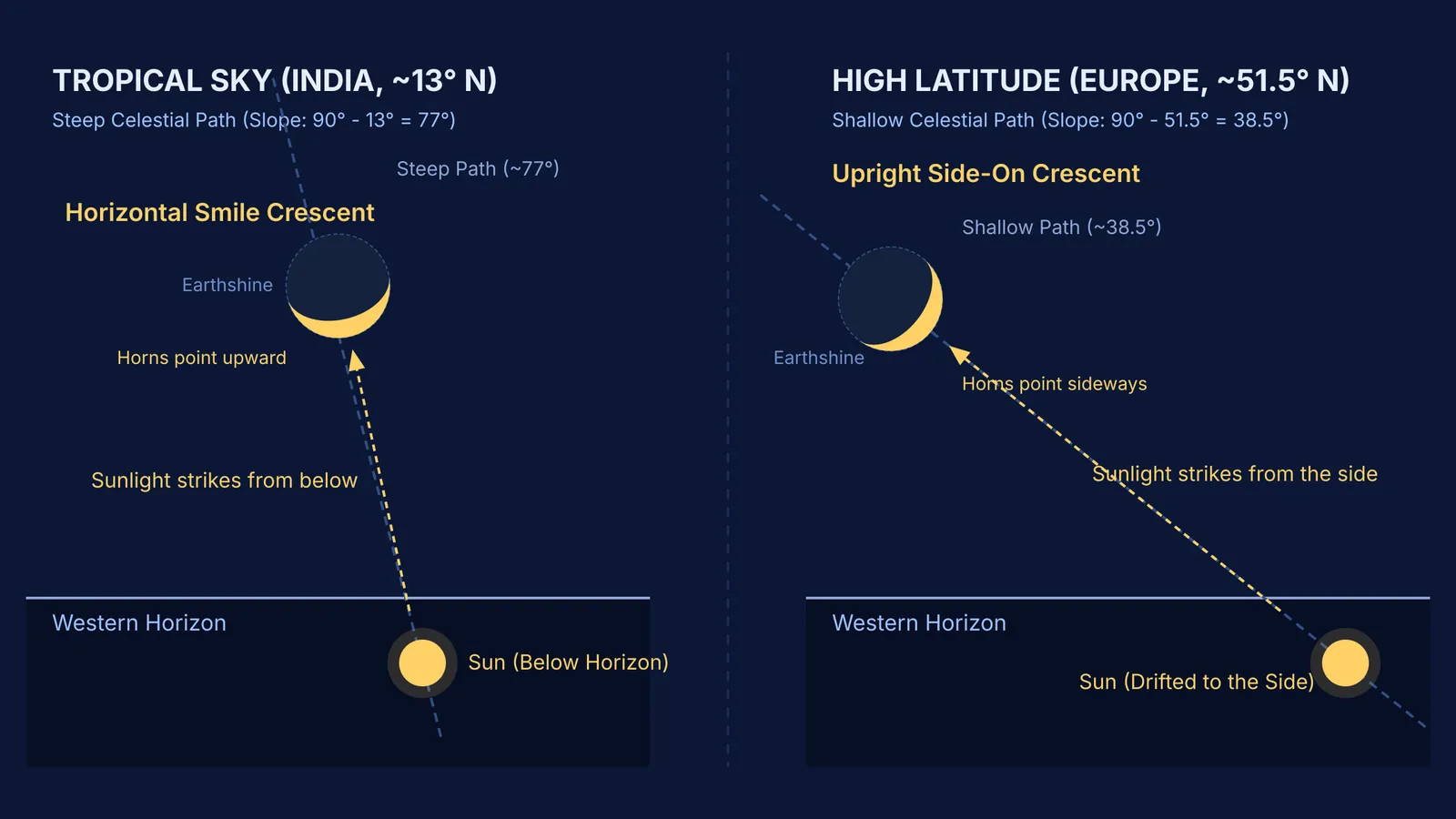
India spans tropical latitudes from roughly 8° N at Kanyakumari to 28° N at Delhi. Here, celestial paths plunge toward the western horizon at steep angles. When the Sun sets in the evening, it does not slide obliquely along the skyline; it drops almost vertically.
Because a waxing crescent trails closely behind the Sun at dusk, the set Sun sits almost directly underneath the Moon relative to your local horizon. Sunlight strikes the lunar disc from below, illuminating its bottom rim. The two tips of the crescent, known as cusps or horns, point straight up, creating what observers call a smiling moon or wet moon. In a 2008 observation, NASA APOD documented how this horizontal crescent Moon aligned with Venus and Jupiter to form a twilight smiley face in the evening sky.
How does latitude change the angle of the crescent moon?
As physicist Jack Higbie demonstrated in *The Physics Teacher*, observer latitude dictates how celestial coordinates project onto the local horizon. The crescent's tilt depends directly on the angle between the celestial equator and your local horizon, which equals 90° - φ, where φ represents your latitude.
In high-latitude cities such as London (51.5° N), the celestial equator meets the horizon at a shallow angle of 38.5°. Celestial bodies set diagonally. By twilight, the Sun has drifted far to the side of the Moon. Sunlight strikes from the side rather than from below, making the crescent appear upright, like a parenthesis.
In tropical India, the geometry is reversed. At Bengaluru (latitude 13° N), the celestial equator stands at 90° - 13° = 77° to the horizon—nearly perpendicular. Because the Sun drops straight down in southern India, sunlight illuminates the Moon's underside, tilting lunar orientations across the globe. For more on orbital geometry, see our guide on Why Do We Always See the Same Side of the Moon?.
Visualising 3D spherical geometry can feel tricky on a flat page. In the Fermi Simulation Lab, students can use interactive simulations to explore orbital paths and observer viewpoints, making spatial celestial geometry easier to see than to read.
Why does the tilt change between spring and autumn?
While tropical latitude provides the steep baseline, the exact angle of the smile shifts through the year because Earth's rotational axis is tilted by 23.44°, as documented in the NASA Goddard Earth Fact Sheet. The apparent solar path—the ecliptic—wobbles against the western horizon with each season.
Spring Equinox (February to April): In the evening sky, the ecliptic reaches its steepest Northern Hemisphere angle with the horizon: (90° - φ + 23.44°). In central India at latitude 20° N, this produces an angle of roughly 93.4°—virtually perpendicular. The Sun sets directly beneath the Moon, creating a horizontal smile.
Autumn Equinox (August to October): The ecliptic meets the western horizon at its shallowest evening angle: (90° - φ - 23.44°). At 20° N, this drops the angle to 46.6°, tilting the crescent onto its side like an angled bowl.
Thin evening crescents also govern key cultural observances across India. The precise visibility and tilt of the young crescent determine lunar calendars, as explored in Why the date of Eid depends on sighting the Moon.
How can you calculate the crescent moon angle tonight?
You can estimate tonight's crescent orientation using a 4-step framework derived from the coordinate projection principles in *The Physics Teacher*:
Find your colatitude: Subtract your latitude (φ) from 90°. For Mumbai (φ = 19° N), your colatitude is 90° - 19° = 71°.
Add the seasonal ecliptic shift: Add +23° near the spring equinox (March), subtract -23° near the autumn equinox (September), or use 0° near the solstices. For Mumbai in March, the evening ecliptic slope is approximately 71° + 23° = 94° (nearly vertical).
Trace the Sun-Moon line: At sunset, imagine a straight line from the Moon to the point where the Sun just dipped below the horizon. The bright crescent rim points directly along this line.
Check the cusp direction: The horns of the crescent always point 90° away from the Sun-Moon line. A vertical illumination line yields two upward-pointing horns: a smiling moon.
When physics problems require visualising 3D vectors and celestial mechanics, Fermi's AI tutor guides students step by step through coordinate systems rather than merely handing out formulas. You can explore orbital mechanics in Understanding planetary orbits with a gravity simulation or review fundamental astronomy topics in the Fermi Concept Library.


