

On this page
When you look up at the night sky, the Moon’s craters and dark patches always form the same familiar pattern. Whether it is a tiny sliver or a full, bright disc, the face looking back at Earth never changes.
For a long time, the side we could not see was a complete mystery. Humans had to wait until 1959, when a Soviet spacecraft finally flew past the Moon and beamed back the first images of the hidden hemisphere, according to NASA Science.
But why is one half of the Moon permanently hidden from us? The answer lies in a gravitational dance that has been playing out for billions of years.
Why do we always see the same side of the Moon?
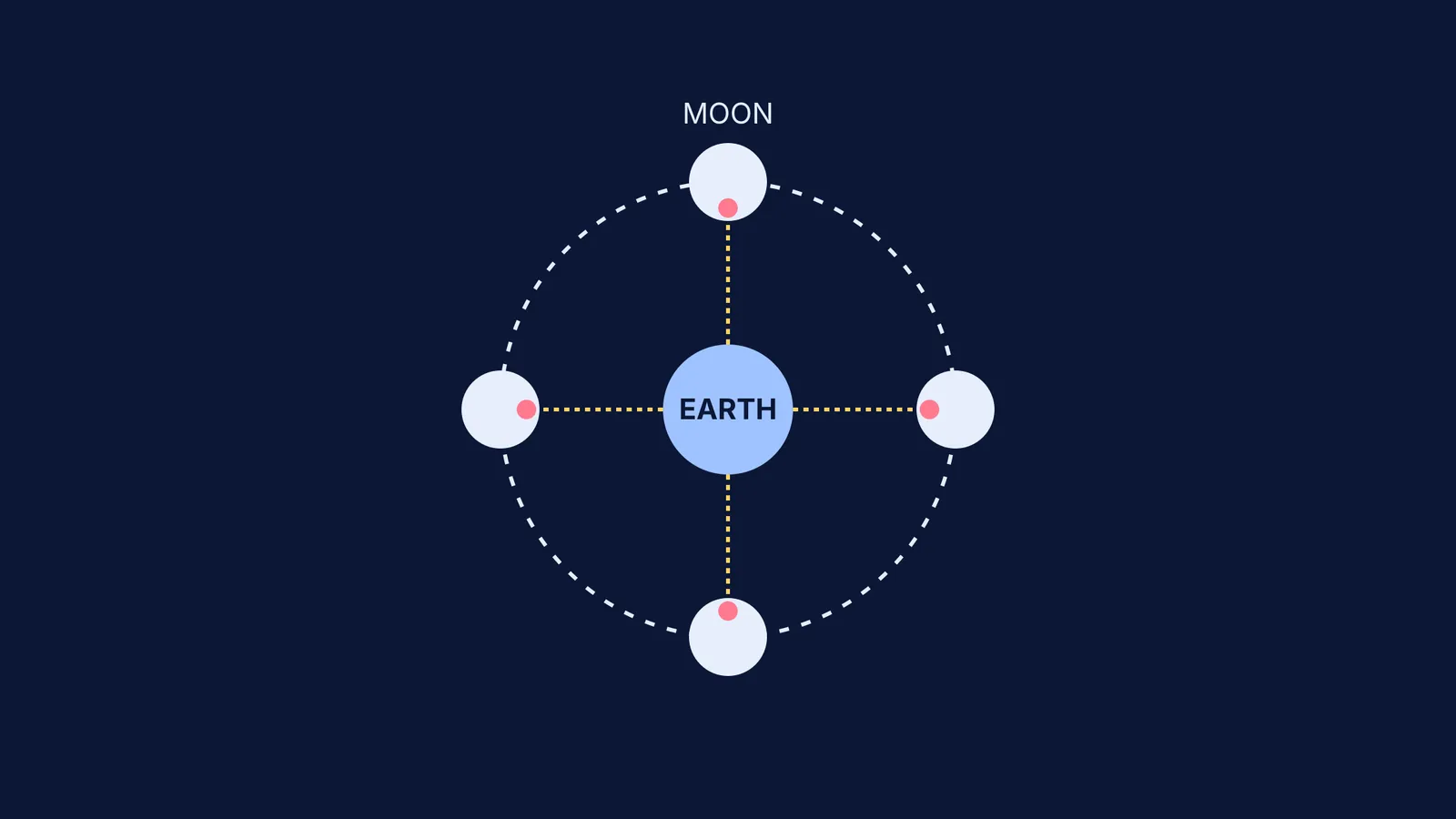
We always see the same face because of a phenomenon called synchronous rotation. The Moon makes a complete orbit around Earth in 27 Earth days, as measured by NASA Science. At the same time, it takes 27 Earth days to spin once on its own axis.
Because the Moon's rotation (its spin) and its revolution (its orbit) take the same amount of time, they are perfectly synchronized. If the Moon did not spin at all, we would see all sides of it as it travelled around our planet. If it spun faster or slower than its orbit, its surface would gradually turn, revealing different features night after night. But because the two motions are locked in a 1:1 ratio, the near side is permanently pointed towards us.
Students often struggle to picture this in their heads when learning about the Class 7 Earth, Moon and Sun. It feels counter-intuitive that something spinning on an axis never shows its back.
A living room demonstration of tidal locking
You can prove why synchronous rotation works using just two people in your living room.
Set the scene: Ask a friend or a parent to stand completely still in the centre of the room. They represent Earth. You are the Moon.
The locked orbit: Stand facing "Earth". Now, walk in a slow circle around them, making sure your face is always pointed directly at them.
The proof of rotation: Notice what your body has to do to keep facing them. As you complete one full circle around the room, you will have faced the north wall, the east wall, the south wall, and the west wall.
By the time you return to your starting point, you have spun around exactly once. You have completed one orbit and one rotation in the same amount of time. If you try to walk around your friend *without* turning your body (always facing the north wall, for example), they will eventually see the side of your head, and then the back of your head.
How did tidal locking happen?
The Moon was not always locked to Earth. Billions of years ago, it spun much faster. However, Earth's massive gravity exerted a powerful pull on the young Moon.
Because gravity pulls harder on things that are closer, Earth’s gravity tugged slightly more on the near side of the Moon than on the far side. This difference in pull stretched the Moon into a very slightly oblong shape, creating "tidal bulges" of solid rock. As the early Moon rotated quickly, these bulges were constantly being dragged and reshaped by Earth's gravity.
The constant shifting created immense internal friction inside the Moon, generating heat and acting like a giant brake. Over millions of years, this friction drained the Moon's rotational energy. The Moon spun slower and slower until it eventually settled into a stable, quiet state where the bulges pointed permanently toward and away from Earth. This final state is called tidal locking.
When you study gravitational forces and planetary motion, reading about friction and bulges can sometimes feel abstract. If you need to see how these forces balance out in space, the Fermi Simulation Lab offers interactive simulations for the ideas that are easier to see than to read.
Does the Moon have any wobble?
While we say we only see one side, that is not entirely true. The Moon's orbit is not a perfect circle; it is an ellipse, following the rules established in Kepler's laws.
Because the orbit is elliptical, the Moon moves slightly faster when it is closer to Earth and slower when it is further away. Its rotation speed, however, stays perfectly constant. This mismatch means the Moon seems to slowly rock back and forth from our perspective. Combined with a slight tilt in its axis, this "wobble"—known as libration—allows us to peek slightly over the edges. Over time, an observer on Earth can actually see a little more than half of the lunar surface.
Today, scientists do not just look at the near side. Missions from around the world have explored the hidden hemisphere. When the Indian Space Research Organisation launched Chandrayaan-1's hunt for water on the Moon, the spacecraft mapped deep craters across the entire lunar surface, proving that while Earth might be locked into one view, our science is not.
If you are a student working through orbital mechanics or gravitation, these concepts often spark deeper questions. You can sit down with Fermi's AI tutor to explore why gravity shapes our solar system exactly the way it does, one clear step at a time.


