

On this page
Every year, observers worldwide—including skywatchers following guides from the Royal Observatory Greenwich—look west at dusk for the young crescent moon to mark the end of Ramadan. In some years, Eid begins after the 29th day; in others, fasting continues for a 30th day. This shifting date is determined by celestial mechanics, orbital geometry, and the visual threshold of the human eye. Understanding why Eid al-Fitr requires sighting the young crescent connects school physics with an ancient observational tradition.
Why does the Islamic calendar follow the Moon instead of the Sun?
Most modern civil calendars, such as the Gregorian calendar, are solar. As documented by NASA on Moon phases and the lunar cycle, Earth completes a tropical year in roughly 365.24 days, keeping months aligned with solar seasons. In contrast, the Islamic (Hijri) calendar is purely lunar, tracking the synodic month—the period required for the Moon to cycle from one conjunction to the next.
The mean synodic month lasts 29.53059 days (about 29.53 days), giving a 12-month lunar year of roughly 354.37 days. Because calendar days must be integers, months last 29 or 30 days. This makes the lunar year roughly 11 days shorter than the solar year, shifting Islamic holidays through every season over a 33-year cycle.
Why is the astronomical new moon invisible to the naked eye?
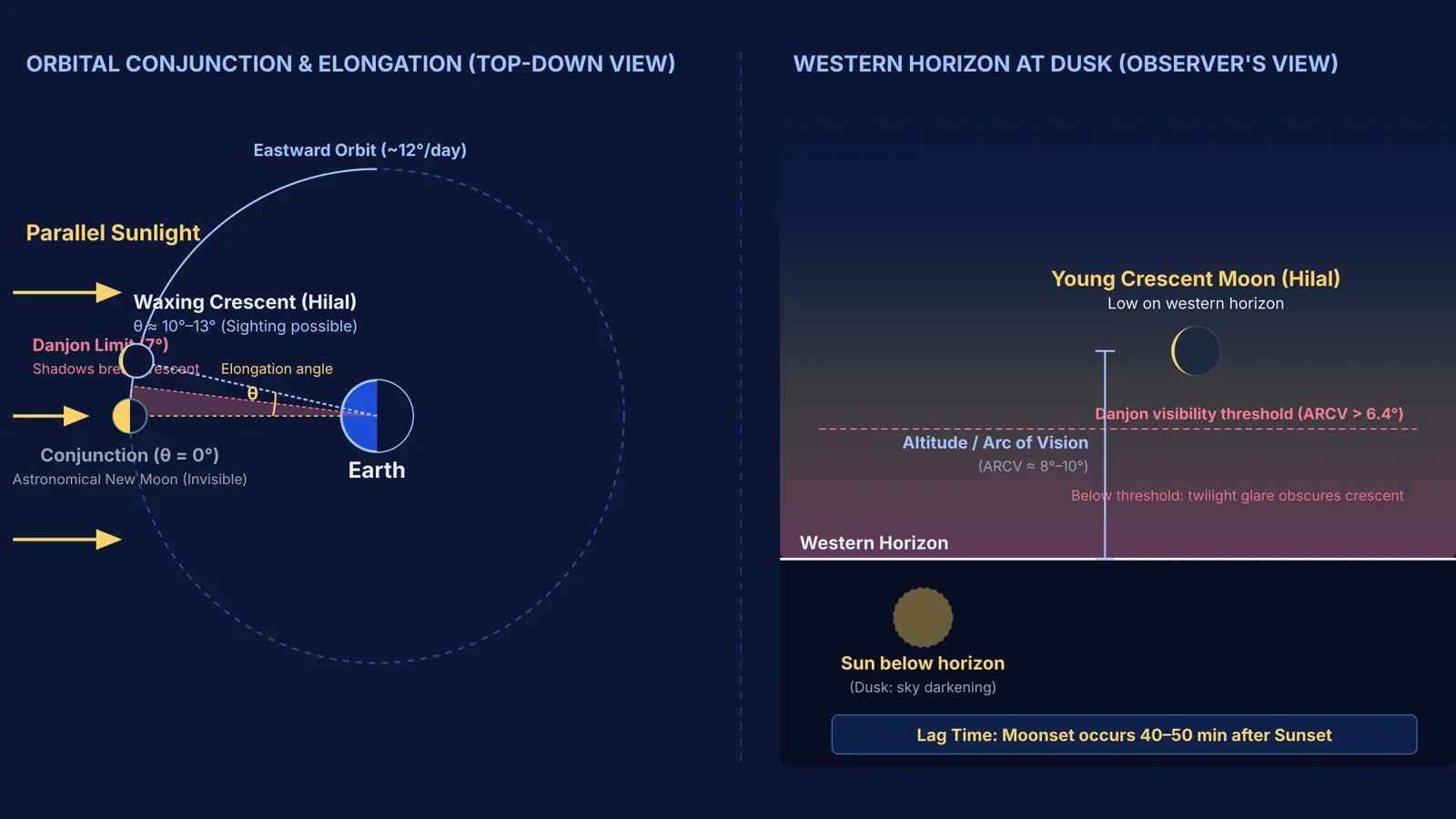
A common misconception is that the "new moon" marked on calendars is visible in the sky. Astronomically, the new moon is conjunction—the moment the Moon passes directly between Earth and the Sun at the same geocentric ecliptic longitude. Its illuminated side faces entirely away from Earth, while its dark face points toward us.
Lost in sunlight scattered by Earth's atmosphere, the lunar disk cannot be seen at conjunction. For the crescent to appear, the Moon must move eastward along its orbit to clear the solar glare. As demonstrated by Leroy E. Doggett and Bradley E. Schaefer in Icarus, sighting this young crescent requires sufficient angular separation from the Sun and the rapid fall in twilight sky brightness after sunset.
Students studying Earth, Moon, and Sun geometry learn that the Moon moves eastward relative to the Sun by roughly 12 degrees each day.
What physical conditions determine whether the crescent moon is visible?
The first visible waxing crescent after conjunction is called the hilal. Sighting the hilal on the 29th evening of Ramadan requires specific observational conditions:
Angular elongation: The Moon must separate from the Sun by at least 7° to 10°, exceeding the Danjon limit. In Experimental Astronomy, Mohammad Sh. Odeh evaluated 737 observations to define visibility thresholds using crescent width and topocentric arc of vision.
Horizon altitude and lag time: At sunset, the Sun dips below the horizon while the Moon remains above it. A lag time between sunset and moonset of 40 to 50 minutes is typically needed for naked-eye detection.
Atmospheric clarity: Clouds, dust, and urban smog easily extinguish the crescent's faint light.
Visualising these orbital planes can be challenging on a flat page. The Fermi Simulation Lab provides interactive simulations for the ideas that are easier to see than to read, allowing learners to adjust celestial angles and observe how phase illumination shifts.
How do astronomers calculate the 11-day annual drift of Eid?
Using observational data from NASA on Moon phases and the lunar cycle, we can calculate the annual drift of Eid al-Fitr against the solar Gregorian calendar:
Solar tropical year: 365.2422 days
Lunar calendar year (12 synodic months of 29.53059 days): 354.3671 days
Difference per year (drift): 365.2422 − 354.3671 = 10.8751 days ≈ 11 days
Because the lunar calendar is roughly 10.88 days shorter than the solar year, Eid arrives 10 to 12 days earlier on civil calendars each year. Dividing the solar year by this drift (365.2422 / 10.8751) yields approximately 33.58 solar years. In roughly 33 to 34 years, Eid cycles through every season, as explored in Moon phases and calendars in Class 8 science. For students exploring periodic cycles, the Fermi Concept Library offers dedicated lessons for every concept in physics, chemistry, biology, mathematics and computing.
Why can the date of Eid differ across countries and cities?
Because Earth rotates from west to east, sunset progresses gradually across longitudes, shifting the viewing window calculated by ephemeris centres like the Positional Astronomy Centre, Kolkata. When a crescent forms near the visibility threshold, cities further west experience sunset hours later. During those hours, the Moon travels further along its orbit, increasing its elongation and crescent width. A crescent invisible at dusk in India may therefore be spotted later that evening in Mecca or London.
In India, the Positional Astronomy Centre, Kolkata, computes sunset, moonset, and phase timings for the *Rashtriya Panchang* across 14 languages. Even so, many traditions follow direct ocular confirmation:
Observers scan the western horizon after sunset on the 29th day of Ramadan.
If the crescent is sighted, Ramadan ends and Eid al-Fitr begins the next morning.
If clouds or orbital position prevent sighting, Ramadan runs for 30 days.
This empirical protocol connects modern skywatchers with the historic practice of observational astronomical corrections, reminding us that lunar calendars remain living instruments tuned to celestial mechanics.


