

On this page
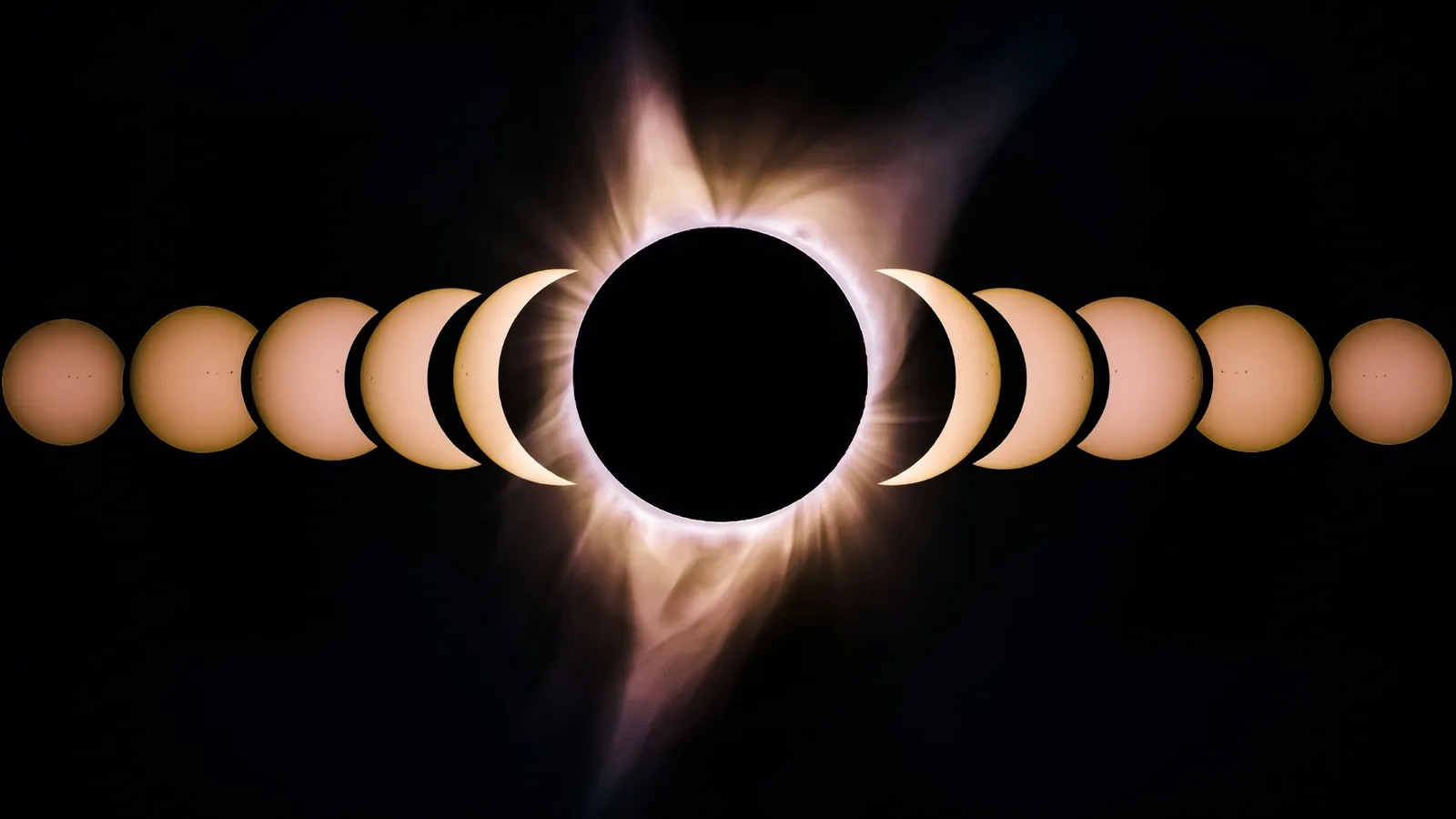
An eclipse is a public test of an astronomer's numbers. If the tables predict the Moon will start to cover the Sun at a certain hour and it does not, everyone can see the error. In 15th-century Kerala, Parameshvara treated each eclipse as that kind of test, wrote down what he saw, and changed the numbers when they failed. This post covers what he did, checks two of his figures with school-level maths, and shows why a small error in the tables becomes a large error in the sky.
Who was Parameshvara?
David Pingree's entry in the Dictionary of Scientific Biography gives his dates as about 1380 to 1460. The MacTutor biography gives about 1370 for his birth. Both agree on the place: his family house, Vatasseri, stood in the village of Alattur on the north bank of the river Nila, at its mouth. He named Rudra as his teacher, and Nilakantha, a pupil of Parameshvara's son Damodara, says he also studied under Narayana and Madhava. Our post on Nilakantha Somayaji picks up the story a generation later.
What did he observe?
Pingree reports that Parameshvara's eclipse observations ran from 1393 to 1432, including one at Navakshetra in 1422 and two at Gokarna in 1425 and 1430, all listed in his commentary Siddhantadipika. His latest recorded observation was in 1445. Nilakantha quotes a verse in which Parameshvara says he observed for fifty-five years. K. Ramasubramanian, in a 2022 paper for the International Congress of Mathematicians, repeats that he is reputed to have observed for around 55 years.
What was the Drgganita?
According to Pingree, Parameshvara's greatest achievements were revising the accepted planetary parameters of the parahita system, which went back to Aryabhata, and the method of computing eclipses, on the basis of his observations. He called the new system the drgganita. His book of that name, dated 1431, gives new mean motions for the planets, their mean positions at the start of the Kaliyuga, their two equations, and a table of those equations at intervals of 6 degrees. MacTutor adds that he kept comparing computed planetary positions with observed ones, trying to bring the model as close to observation as possible.
Worked example 1: where was Alattur?
Pingree notes that Parameshvara gave the sine of his latitude as 647, on the Indian convention of a circle of radius R = 3438. To turn that into an angle, divide by R:
sin φ = 647 ÷ 3438 = 0.18819
φ = arcsin(0.18819) = 10.847°
0.847° × 60 = 50.8 minutes of arc
So φ is about 10°51', which is the latitude Pingree gives. Why 3438? It is the number of minutes of arc in one radian, rounded: 180 × 60 ÷ π = 3437.7. With R chosen this way, the sine of a small angle is almost the same number as the angle itself measured in arc-minutes.
Worked example 2: why small errors move eclipses
A solar eclipse can only happen at new moon, when the Moon catches up with the Sun in the sky. The NASA Moon fact sheet gives the synodic period, new moon to new moon, as 29.53 days. In that time the Moon gains one full circle on the Sun, so:
relative motion = 360° ÷ 29.53 days = 12.19° per day
per hour: 12.19 ÷ 24 = 0.508°, or about 30.5 minutes of arc
Now suppose the tables put the Moon 15 minutes of arc in the wrong place. The predicted moment of conjunction moves by 15 ÷ 30.5 ≈ 0.49 hours, roughly half an hour. An error far too small to see in the Moon's position becomes a clear error on the clock. That is why eclipses were such a sharp test of a planetary table.
Common mistakes:
Using 360° ÷ 27.32 days, the sidereal month. That is the Moon's motion against the stars, not its gain on the Sun.
Forgetting to convert decimal degrees to minutes: 0.847° is 50.8', not 84.7'.
Treating the Indian "sine" as a ratio. A value of 647 only becomes a ratio after dividing by R.
What else did he find?
MacTutor credits him with a rule for the radius of the circle through the four corners of a cyclic quadrilateral, about 350 years before Lhuilier, studied by R. C. Gupta in Historia Mathematica (1977)90038-6). With sides a, b, c, d, the rule is r² = (ab + cd)(ac + bd)(ad + bc) ÷ [(a + b + c − d)(b + c + d − a)(c + d + a − b)(d + a + b − c)]. Test it on a 3 by 4 rectangle: the top is 24 × 25 × 24 = 14,400, the bottom is 6 × 8 × 6 × 8 = 2304, so r² = 6.25 and r = 2.5, half the diagonal of 5. MacTutor also reports an iterative method for sines in the Siddhantadipika that is essentially the modern secant method.
What can a student take from Parameshvara?
Let data overrule the formula. He kept a respected system until his observations showed it was off, then changed the parameters.
Record enough to check later. Date, place and result turned single sightings into evidence.
Ask how sensitive the answer is. Worked example 2 is a sensitivity estimate. Ask "if this input is off by a little, how much does the answer move?" in any numerical.
If the geometry of why eclipses happen only at some new moons is hard to picture, the Fermi Simulation Lab has interactive simulations for ideas that are easier to see than read.
Try it now: if the Moon's computed position is off by 6 minutes of arc, how far does the predicted new moon move in time?


