

On this page
A Class 8 answer on the Constitution earns its marks in three places: naming the feature, explaining it in one line, and giving an example. This guide does all three for four key features (federalism, separation of powers, Fundamental Rights and Fundamental Duties), with Article numbers checked against the official text of the Constitution of India published by the Ministry of Law and Justice.
What is the Constitution, and why does India need one?
A constitution is the rulebook that says who makes laws, who carries them out, who settles disputes, and what no government may do to you. India's Constituent Assembly adopted it on 26 November 1949, as the last line of the Preamble records.
Think of the rules of a cricket tournament, agreed before the first ball. Teams and captains change, but the rules bind everyone. In the same way, a government cannot pass an ordinary law that takes away or abridges a Fundamental Right: Article 13 says such a law is void to the extent of the conflict.
What is federalism in the Indian Constitution?
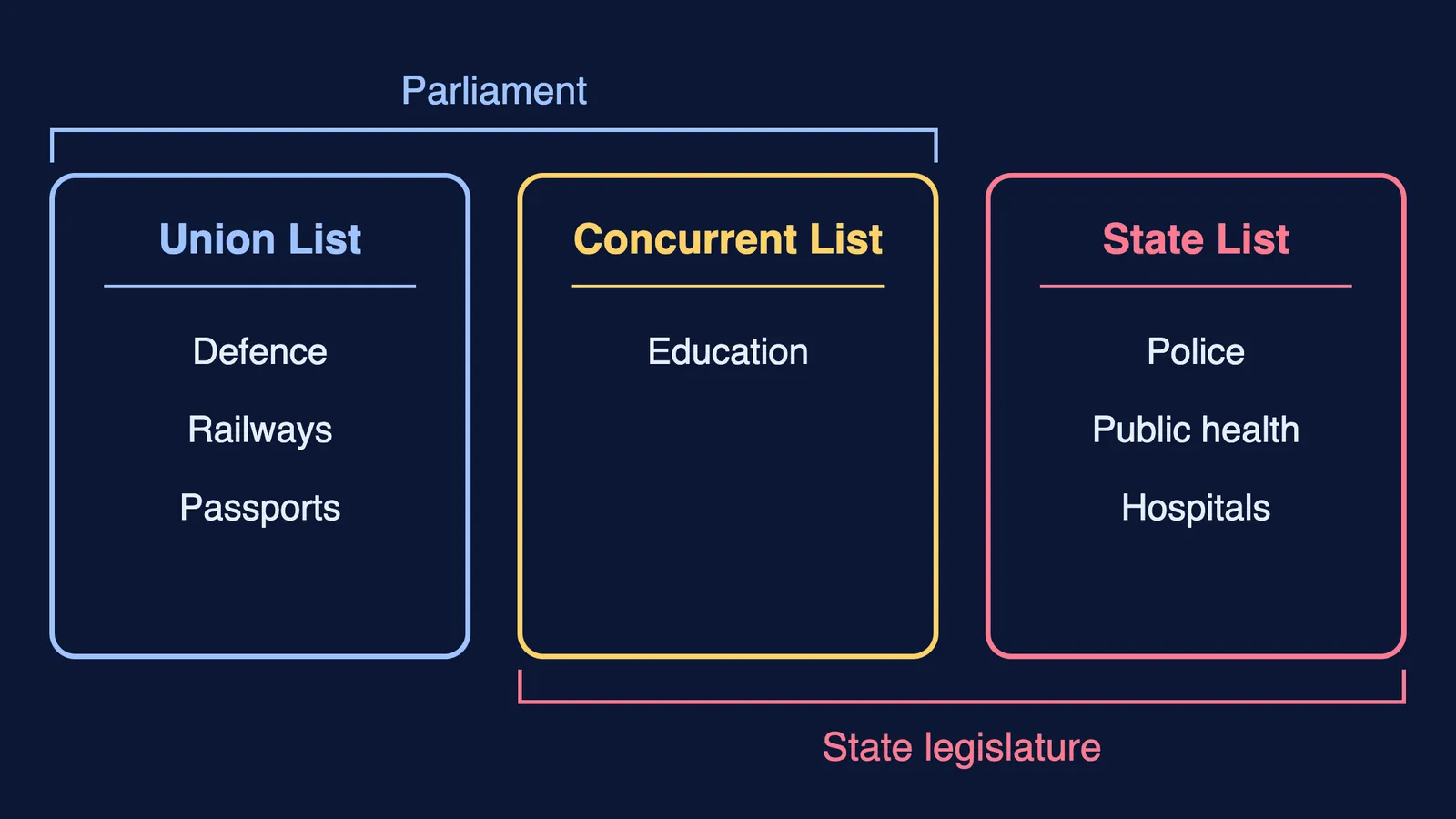
India has one government for the whole country and one in each State. Article 246 and the Seventh Schedule divide the subjects of law-making into three lists:
Union List, where only Parliament makes laws: defence, railways, passports.
State List, where only the State legislature makes laws: police, public health and hospitals.
Concurrent List, where both can make laws: education.
Everyday example: the train to your grandparents' town runs under Union law, the police station near your home works under your State, and your school can be shaped by both central and State education laws.
What does separation of powers mean?
Legislature (Parliament and State assemblies) makes laws.
Executive carries them out. Article 53 vests the Union's executive power in the President, exercised directly or through officers under the President.
Judiciary (the courts) checks that laws and actions follow the Constitution. Article 50, a Directive Principle, tells the State to take steps to separate the judiciary from the executive.
Everyday example: if a government order shuts a weekly market unfairly, the official who signed it does not get to judge whether it was legal. A court decides.
What Fundamental Rights does the Constitution give you?
Part III of the Constitution lists rights you can take to court. Learn each with one example:
Right to Equality: Article 14 promises equality before the law, and Article 17 abolishes untouchability. A school cannot make children sit apart by caste.
Right to Freedom: Article 19 protects freedom of speech and expression, assembling peaceably without arms, moving freely across India and practising any profession, with reasonable limits. Article 21A, grouped under this heading, says the State shall provide free and compulsory education to all children aged six to fourteen.
Right against Exploitation: Article 24 bars children under fourteen from work in factories, mines or other hazardous jobs.
Right to Freedom of Religion: Articles 25 to 28 protect freedom of conscience and the right to practise and propagate religion.
Right to Constitutional Remedies: Article 32 lets you go to the Supreme Court if a Fundamental Right is violated.
What are the Fundamental Duties?
Article 51A lists eleven duties of every citizen. The first ten were added by the 42nd Amendment in 1976, and the eleventh, a parent's or guardian's duty to provide opportunities for education to a child aged six to fourteen, by the 86th Amendment in 2002, as the footnotes in the official text show. Others include respecting the National Flag and Anthem, protecting the environment, developing scientific temper and safeguarding public property.
Rights are what the State owes you; duties are what you owe the country. Not scratching your name into a bus seat is Article 51A(i), safeguarding public property, in action.
How do you write a 5-mark answer on features of the Constitution?
Use this five-line template for each feature:
Name the feature.
Define it in one sentence.
Cite the Article or List.
Give one everyday example.
Say why it matters.
Worked example: "Separation of powers means making laws, carrying them out and judging disputes are done by different organs. Article 50 directs the State to take steps to separate the judiciary from the executive. For example, a court, not the official who signed an order, decides whether the order was lawful. This stops any one group from misusing power."
Guides and chatbots sometimes quote the wrong Article, so learn how to check an AI's Article number against the Constitution. Before you buy a guide, check which parts of the NCERT syllabus were deleted. To see federalism near your home, read who runs a government school and where to raise a problem.
For maths and science, Fermi's AI tutor can work out what you already know and build a plan for the session.


