

On this page
"Constitution: Why and How?" is the first chapter of the NCERT Class 11 political science book Indian Constitution at Work. It asks why a society needs a constitution, and how India's was made. The facts below come from the NCERT chapter itself.
What are the functions of a constitution?
The NCERT chapter defines a constitution as a body of fundamental principles according to which a state is constituted or governed. It then sets out four numbered functions:
Coordination and assurance. It provides a set of basic rules that allow minimal coordination among members of a society. Enforceable rules let you trust others to follow them.
Who decides. It specifies who has the power to make decisions and how the government will be constituted. In India, Parliament decides laws and policies in most instances.
Limits on government. It sets limits on what a government can impose on its citizens, most commonly through fundamental rights such as protection from arbitrary arrest.
Aspirations of society. It enables the government to fulfil the aspirations of a society and create conditions for a just society. In India, the chapter points to the Preamble, Fundamental Rights and the Directive Principles of State Policy.
The chapter adds a fifth idea: a constitution expresses the fundamental identity of a people. India's Constitution, it notes, does not make ethnic identity a criterion for citizenship.
How do you match a provision to its function?
The chapter's "Check your progress" exercise asks you to name the function each provision performs. The first answer is the textbook's; the others are our reading, with reasons.
"The government cannot order any citizen to follow or not to follow any religion": limits on the power of government.
"The government must try to reduce inequalities in income and wealth": aspirations of society, because it asks the government to do something positive, not to hold back.
"The President has the power to appoint the Prime Minister": who decides, because it allocates a decision-making power to an office.
"The Constitution is the supreme law that everyone has to obey": coordination and assurance, because an enforceable rule binding everyone is what lets people trust each other.
"Indian citizenship is not limited to people of any race, caste or religion": fundamental identity, because it defines who "we the people" are.
The quick test: ask whether the provision tells the government what it may not do (a limit), what it should do (an aspiration), or who gets to do it (decision-making). For a short answer, write the function, then one line of reasoning, then one Indian example.
How did the Constituent Assembly of India work?
The NCERT chapter gives these facts.
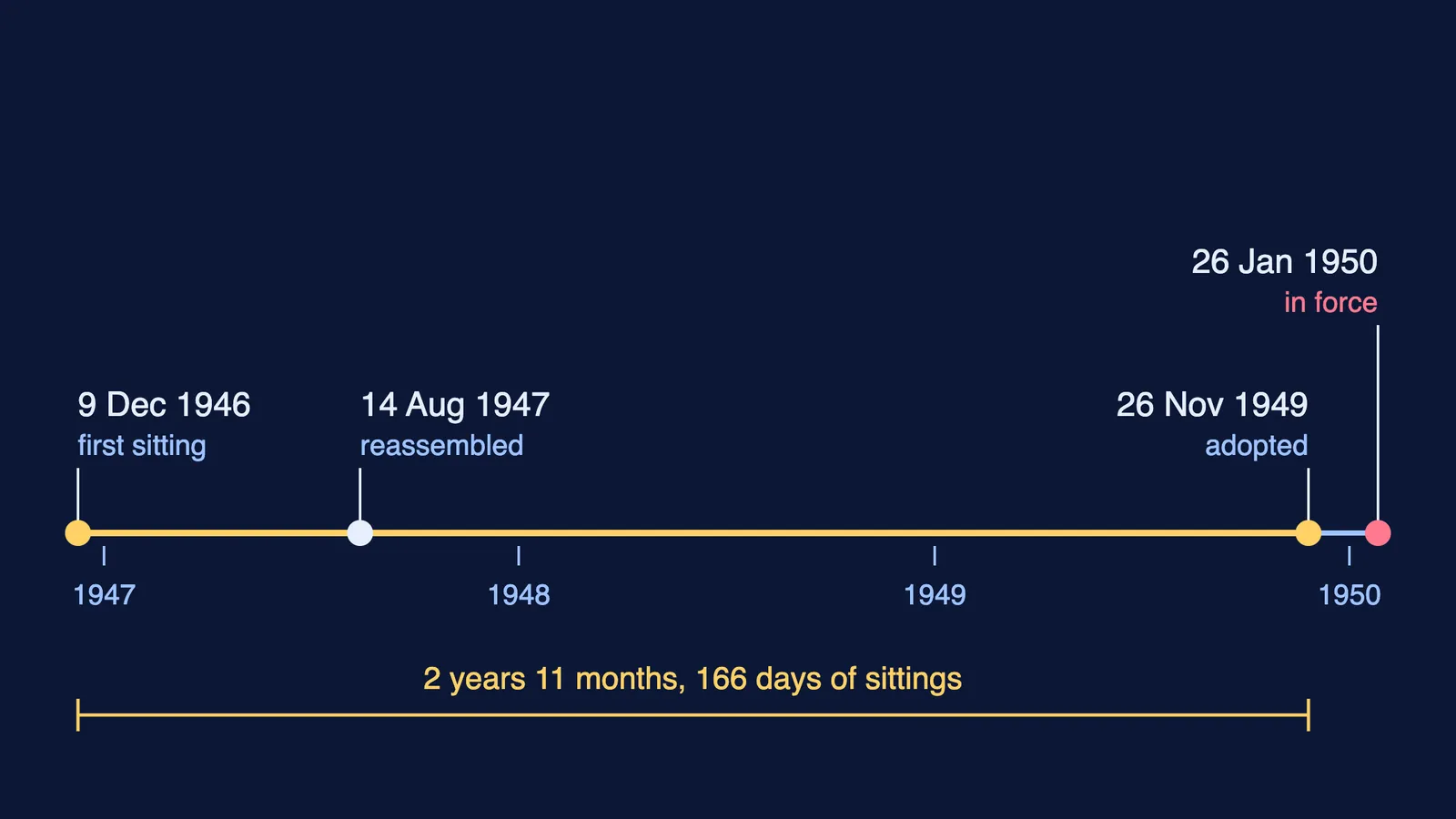
The Assembly held its first sitting on 9 December 1946 and reassembled as the Constituent Assembly for divided India on 14 August 1947.
Its members were chosen by indirect election by the members of the Provincial Legislative Assemblies set up under the Government of India Act, 1935, roughly along the lines of the Cabinet Mission plan.
Under that plan, seats were allotted roughly in the ratio of one seat per 10 lakh people: 292 members from the Provinces and a minimum of 93 seats for the Princely States.
After Partition, membership fell to 299. The Constitution was adopted on 26 November 1949, 284 members signed it on 24 January 1950, and it came into force on 26 January 1950.
The Assembly had eight major committees, usually chaired by Jawaharlal Nehru, Rajendra Prasad, Sardar Patel or B.R. Ambedkar. Ambedkar chaired the Drafting Committee.
It met for 166 days spread over two years and eleven months, and its sessions were open to the press and the public.
Members gave reasons meant to persuade the whole house, what the book calls public reason, and debated almost everything, from judicial powers to property rights. Only universal adult suffrage passed with virtually no debate. The Assembly's values were summed up in the Objectives Resolution, moved by Nehru in 1946.
One line from Ambedkar on 25 November 1949, quoted in the chapter, is worth learning word for word: "We must make our political democracy a social democracy as well."
How should you revise this chapter?
Use three short sittings:
Write the four functions from memory, each with an Indian example.
Redo the matching exercise above without looking.
Explain aloud in two minutes why the Assembly had authority without universal suffrage: credible members, open reasoned debate, and the nationalist movement behind it.
For a warm-up, our guides to constitutional design in Class 9 and the key features of the Constitution in Class 8 help. If you use AI to revise, check any Article number it quotes against the Constitution.
If you don't know where to begin, Fermi's AI tutor can work out what you already know and build a plan for the session, so you sit down to a clear next step.


