On this page
Introducing Western Sociologists is Chapter 4 of the NCERT Class 11 book Understanding Society (NCERT, reprint 2026-27). The CBSE Sociology curriculum for 2026-27 lists it as Unit 9 and gives it 12 of the 80 theory marks. Its topics: the context of sociology, Marx on class conflict, Durkheim on the division of labour, and Weber on interpretive sociology, the ideal type and bureaucracy.
Why did sociology emerge in 19th-century Europe?
NCERT links the birth of sociology to three revolutions (NCERT, Chapter 4):
The Enlightenment put reason and the human being at the centre, so society itself could be studied rationally.
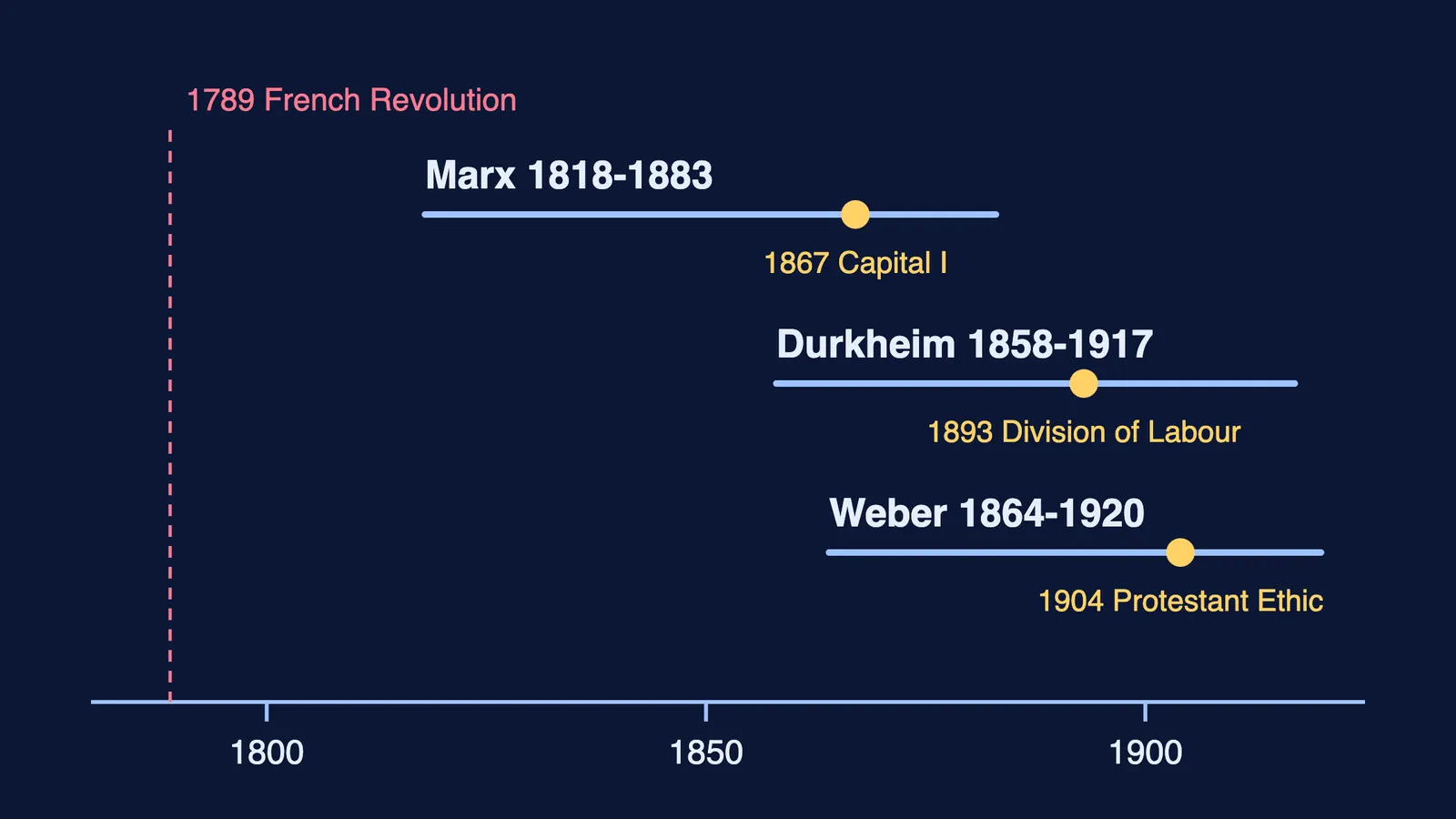
The French Revolution (1789) made individuals and nation-states sovereign and questioned privileges inherited by birth.
The Industrial Revolution, starting in Britain between the late 1700s and the early 1800s, brought factories and mass manufacture. Workers crowded into cities, and the state needed new knowledge about health, sanitation and crime; sociology grew partly to meet that need.
What did Marx say about class conflict?
Karl Marx (1818-1883) saw history as a series of stages: primitive communism, slavery, feudalism and capitalism, which he expected socialism to replace (NCERT, Chapter 4). Each stage is a mode of production. Picture a building: the economic base (productive forces such as land, labour and technology, plus relations of production, or who owns what) holds up a superstructure of law, religion, art and ideas. For Marx, how people earn a living shapes how they think.
A class is people who share a position in the production process. Under capitalism the bourgeoisie own the means of production, while workers have only their labour to sell. Opposed classes fight only once class consciousness is built through political mobilisation. A ruling class spreads a dominant ideology that makes inequality look natural, such as blaming poverty on fate. Alienation separates people from nature, each other, their work's products and themselves.
What is Durkheim's division of labour?
Emile Durkheim (1858-1917) became the first Professor of Sociology in Paris in 1913 (NCERT, Chapter 4). He studied social facts: collective patterns such as law, education and religion that sit outside the individual yet constrain behaviour. They are observed through patterns, as in his study of suicide rates.
In Division of Labour in Society (1893) he sorted societies by the kind of solidarity that holds them together:
Mechanical solidarity: small populations, similar people doing similar work, little tolerance of difference, and repressive law that punishes deviation.
Organic solidarity: large populations, different people who depend on one another, impersonal rules, and restitutive law that aims to repair the wrong.
What are Weber's ideal type and bureaucracy?
Max Weber (1864-1920) wanted sociology to reach an interpretive understanding of social action, meaning behaviour people attach meaning to (NCERT, Chapter 4). The sociologist uses empathetic understanding, feeling with people rather than for them, while keeping value neutrality: describe their values, never judge them.
An ideal type is a model, consistent in its own logic, that brings out a phenomenon's most significant features. It is judged by how much it helps analysis, not by how exactly it copies reality. Weber used it to define three kinds of authority: traditional (custom), charismatic (a "gift of grace") and rational-legal (power marked out by law). Rational-legal authority is seen most clearly in bureaucracy, which has five features:
Qualified officials work within fixed jurisdictions; the post outlasts the person.
A graded hierarchy lets you appeal to a higher official.
Work runs on written documents kept as records.
Office management needs trained staff.
Conduct in office follows rules that keep public and private life apart and make officials accountable.
How do you compare Marx, Durkheim and Weber in one answer?
Take one imagined scene: a garment factory in a growing town.
Marx: owners hold the machines and capital; workers sell their labour and do not own what they stitch. Look for alienation and class consciousness.
Durkheim: cutters, tailors, checkers and packers each depend on the others. This is organic solidarity; a contract dispute settled by compensation is restitutive law.
Weber: the factory's rulebook, job grades and personnel files make it a bureaucracy. Why a worker stays late depends on what it means to her.
The curriculum weights the theory paper 37.5% to knowledge and understanding, 40% to application of knowledge and concepts and 22.5% to formulating, analysing, evaluating and creating (CBSE 2026-27), so practise applying ideas. Practice questions (our own):
Explain the base and superstructure using one example from your town.
Why does a society with organic solidarity need impersonal rules?
Name two features of bureaucracy you can see in your school's admission process, and one way it differs from Weber's ideal type.
For the basics of the subject, read our guide to sociology and society for Class 11, read understanding social institutions, or look ahead to structural change in Class 12 sociology.
Fermi's AI tutor can work out what you already know and build a plan for the session, so you sit down to a clear next step.