On this page
Chapter 3 of the NCERT Class 11 textbook Introducing Sociology, Understanding Social Institutions, is full of terms that look alike. Learn one definition, two perspectives and a set of paired terms, then practise linking the institutions with a worked example.
What is a social institution in sociology?
NCERT defines an institution, in the broadest sense, as "something that works according to rules established or at least acknowledged by law or by custom" (NCERT, Chapter 3). The same chapter stresses that institutions impose constraints on individuals and also provide them with opportunities.
Two perspectives run through the chapter, so learn them first:
Functionalist view: institutions are sets of norms, beliefs, values and roles that arise to meet the needs of society. Family and religion are informal institutions; law and formal education are formal ones.
Conflict view: individuals are not placed equally, so familial, religious, political, economic, legal and educational institutions operate in the interest of the dominant sections, whether by class, caste, tribe or gender.
Family, marriage and kinship: which terms get confused?
In the NCERT chapter, a family is a group of persons directly linked by kin connections, the adult members of which assume responsibility for caring for children (NCERT, Chapter 3). Learn its terms as pairs:
Family of orientation (the family you are born into) and family of procreation (the family in which you are married).
Consanguineous kin (related by blood) and affines (related through marriage).
Matrilocal (the couple lives with the woman's parents) and patrilocal (with the man's parents).
Matrilineal and matriarchal: the chapter notes that matrilineal societies exist, but the same cannot be claimed about matriarchal ones.
Monogamy, serial monogamy (remarriage, but one spouse at a time) and polygamy, which is either polygyny or polyandry.
Endogamy (marrying within your group, such as caste) and exogamy (marrying outside it, such as village exogamy in parts of north India).
The chapter also uses India to question easy generalisations. It reports the sociologist A.M. Shah's view that the joint family has steadily increased in post-independent India, with rising life expectancy as the contributing factor: from 32.5 to 55.4 years for men and from 31.7 to 55.7 years for women between 1941-50 and 1981-85 (NCERT, Chapter 3). The chapter calls this a broad generalisation too. On gender, it notes that the child sex ratio fell from 934 per thousand males in 1991 to 919 in 2011.
For how caste and religion shape public life, our guide to gender, religion and caste in Class 10 is a useful bridge.
How does the chapter define work, power and the state?
Work, paid or unpaid, is "the carrying out of tasks requiring the expenditure of mental and physical effort, which has as its objective the production of goods and services that cater to human needs" (NCERT, Chapter 3). Remember the informal economy: transactions outside regular employment, much of which is not recorded in any direct way in official employment statistics.
Power is the ability of individuals or groups to carry out their will even when opposed by others, and authority is power that is accepted as legitimate. Citizenship rights come in three kinds: civil, political and social. For Indian practice, see our posts on how institutions work in Class 9 and on local governments and the 73rd and 74th Amendments.
What do religion and education add?
The chapter lists three features all religions seem to share: a set of symbols invoking reverence or awe, rituals or ceremonies, and a community of believers (NCERT, Chapter 3). Following Emile Durkheim, sociologists study the sacred realm, which every society distinguishes from the profane. Max Weber argued that Calvinism influenced the growth of capitalism: religion shaping economic life.
For education, Durkheim held that every society needs a common base of ideas, sentiments and practices that education must pass on to all children. Functionalists see schooling as selecting and allocating people to future roles; sociologists who see society as unequal treat it as a stratifying agent, since children attend different kinds of schools depending on their socio-economic background.
How do you link social institutions in one answer?
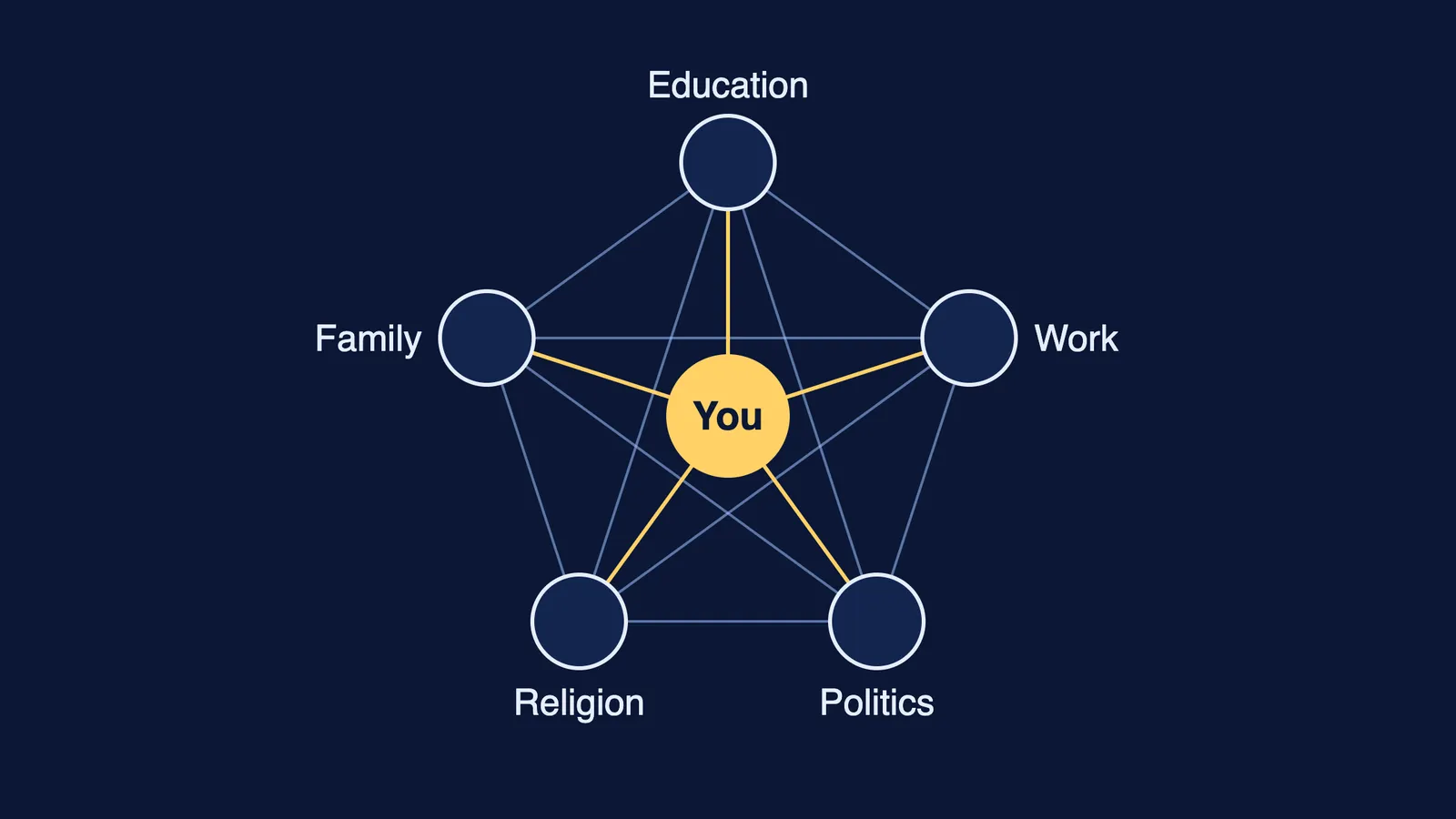
A theme running through the chapter is that institutions are linked: the family to economic and political life, religion to power and the economy. Practise with one event, a family wedding, and run it through all five:
Family, marriage and kinship: two families become affines; residence after marriage is patrilocal or matrilocal; endogamy may decide who counts as a suitable match.
Work and economy: spending, gifts and who does the unpaid labour of hosting.
Politics: who has the authority to decide, and the legal rules on marriage age and registration.
Religion: rituals, symbols and the sense of a sacred occasion.
Education: how schooling and degrees shape who is seen as eligible, and when people marry.
Then write each answer in four moves: define the term, apply one perspective, give an Indian example, and link it to a second institution.
If sociology sits beside physics or maths in your timetable, Fermi's AI tutor can work out what you already know and build a plan for the session, so the science side of your week starts with a clear next step.