On this page
Therapeutic Approaches is Chapter 5 of the NCERT Class 12 psychology textbook, and the CBSE 2026-27 curriculum gives Unit V, Therapeutic Approaches, 9 of the 70 theory marks (CBSE Psychology curriculum 2026-27).
What is psychotherapy in Class 12 psychology?
NCERT describes psychotherapy as a voluntary relationship between a client who seeks treatment and a therapist who treats, to help the client solve psychological problems (NCERT Chapter 5, Therapeutic Approaches, Reprint 2026-27). Only people trained under expert supervision should practise it.
The therapeutic relationship, or alliance, has two components: it is contractual (two willing people enter a partnership) and it lasts a limited time. The therapist offers empathy, unconditional positive regard and strict confidentiality.
How are the types of psychotherapy classified?
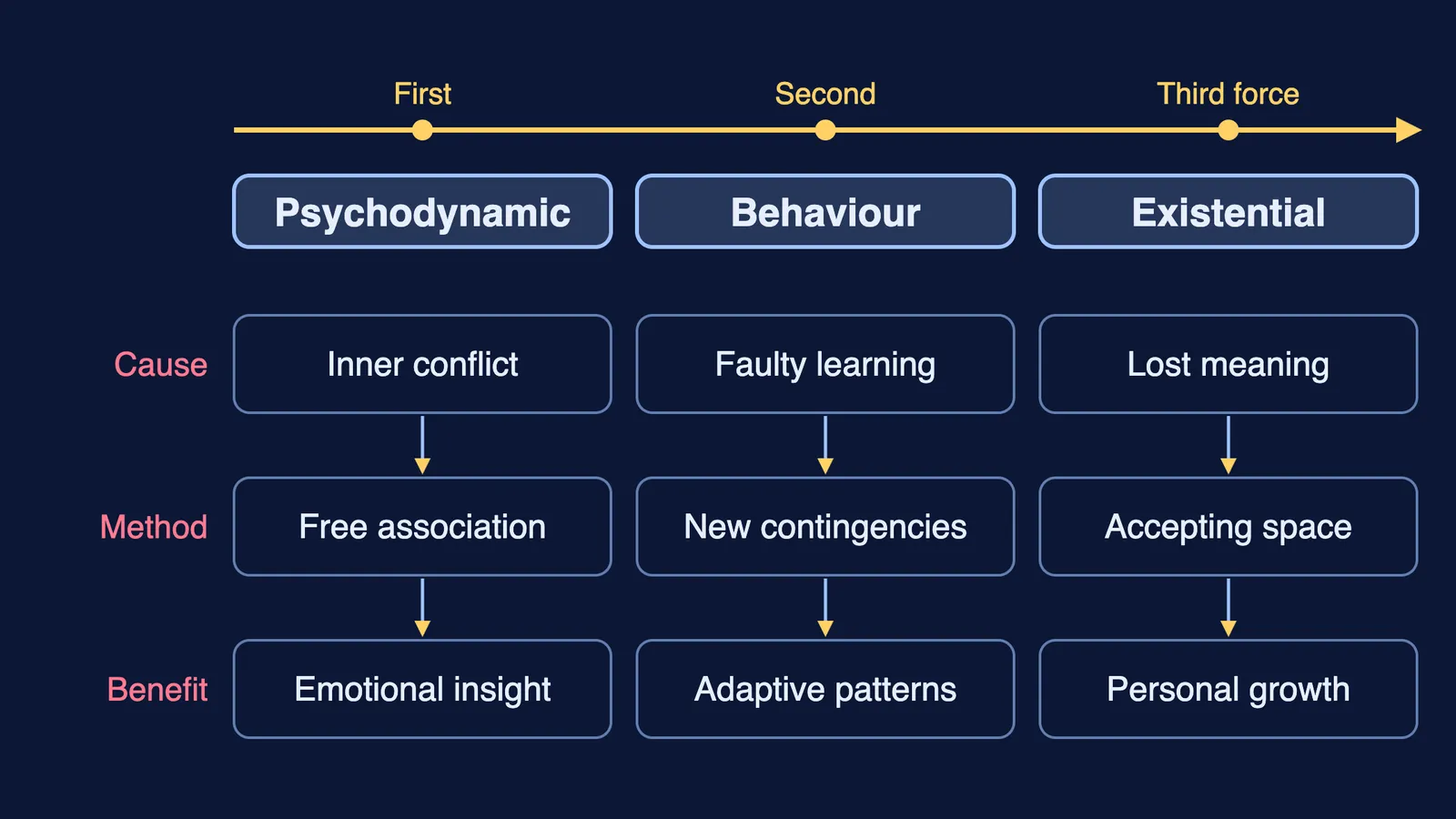
NCERT groups psychotherapies into three systems: psychodynamic (first), behaviour (second) and existential, the third force (last), and compares them on six questions (NCERT).
Cause: intrapsychic conflict; faulty learning of behaviours and cognitions; questions about the meaning of life.
Origin: childhood desires and fears; faulty conditioning and beliefs; present loneliness and alienation.
Chief method: free association and dream reports; setting up new behavioural contingencies; a positive, non-judgmental setting where the client finds the answers.
Relationship: in the first two the therapist interprets or finds the solution; in existential therapy the therapist is a warm facilitator.
Chief benefit: emotional insight; adaptive behaviour and thought patterns; personal growth.
Duration: classical psychoanalysis can run for years and newer psychodynamic versions take 10–15 sessions, while behaviour, cognitive behaviour and existential therapies take a few months.
Therapy starts with a clinical formulation of the client's problem.
How do behaviour therapy, RET and CBT work?
Behaviour therapy applies learning principles to the present (NCERT). A behavioural analysis finds the malfunctioning behaviour, its antecedents and its maintaining factors. Techniques include negative reinforcement, aversive conditioning, positive reinforcement, token economy, differential reinforcement, modelling, and Wolpe's systematic desensitisation, which rests on reciprocal inhibition. Revise conditioning with learning in Class 11 psychology.
Illustration: a therapist's hierarchy for a client afraid of speaking in class might run from reading aloud alone to giving a short talk, moving up only while the client stays relaxed.
Albert Ellis's Rational Emotive Therapy (RET) uses an ABC analysis: irrational beliefs (B) sit between an antecedent event (A) and its consequences (C). Try it on an original case:
A: Riya scores low in one unit test.
B: "I must top every test, or I am a failure."
C: she feels hopeless and stops revising.
The therapist disputes B through gentle, non-directive questioning ("Why must you top every test?") until a rational belief replaces it. Aaron Beck's therapy traces core schemas from childhood, a critical incident that triggers negative automatic thoughts, and cognitive restructuring. NCERT puts cognitive therapy at 10–20 sessions. Cognitive Behaviour Therapy (CBT) combines both with a bio-psychosocial approach.
What do humanistic-existential and alternative therapies add?
These therapies say distress comes from loneliness, alienation and blocked self-actualisation (NCERT).
Logotherapy (Viktor Frankl): treatment for the soul; meaning making, even in hard circumstances.
Client-centred therapy (Carl Rogers): empathy, unconditional positive regard and reflection of feelings.
Gestalt therapy (Fritz and Laura Perls): greater self-awareness and self-acceptance.
Alternative therapies include yoga and meditation. NCERT notes NIMHANS research showing Sudarshana Kriya Yoga reduces depression, and says Vipassana, a mindfulness-based meditation, may help prevent repeated depression. Link them to self and personality for Class 12.
What heals, what is ethical, and what is rehabilitation?
Four healing factors: the techniques, the therapeutic alliance, catharsis, and non-specific patient and therapist variables (NCERT). NCERT lists six ethical standards: informed consent, confidentiality, relieving distress, integrity of the relationship, respect for human rights and dignity, and professional competence.
Rehabilitation helps people with severe disorders such as schizophrenia, whose quality of life may not improve when symptoms fall. It uses occupational therapy, social skills training, cognitive retraining and vocational training. For the disorders, see psychological disorders for Class 12.
How do board questions test this chapter?
In the 2026-27 sample paper, this chapter's questions are a 1-mark assertion-reason item on behaviour therapy, a 2-mark case on an ethics breach, and a 6-mark long answer with an internal choice; the marking scheme splits the RET option 1+3+2 (CBSE sample paper, marking scheme). Practise these:
Distinguish empathy from sympathy. (2 marks)
A hostel warden gives points for tidy rooms, which residents swap for a film night. Name the technique and explain it. (2 marks)
Draw an ABC analysis for a student who believes "everyone must like me". (3 marks)
Compare behaviour and existential therapy on cause, relationship and benefit. (4 marks)
Arjun's schizophrenia symptoms have eased, but he avoids people and work. Suggest and justify a rehabilitation plan. (6 marks)
This guide is for exam study, not treatment: if you need help, talk to a trusted adult or a qualified professional, or call Tele MANAS, the toll-free 24/7 national helpline on 14416 (Ministry of Health and Family Welfare, via PIB).
If you also study physics, chemistry or biology and don't know where to start, Fermi's AI tutor can work out what you already know and build a plan for the session.