On this page
Learning is Chapter 5 of the NCERT Class 11 psychology textbook, and nearly every idea in it has an example you have already lived. Here is the chapter in order, one everyday situation worked three ways, and what parents should know about learning disabilities.
What is learning in Class 11 psychology?
The NCERT Learning chapter defines learning as "any relatively permanent change in behaviour or behavioural potential produced by experience".
The key word is permanent: the chapter says changes from fatigue, habituation or drugs are temporary, so they are not learning. Learning is also inferred. A teacher sees only your performance, such as reciting a poem.
What is classical conditioning?
Ivan Pavlov won the 1904 Nobel Prize in Physiology or Medicine for work on the physiology of digestion. During those studies he noticed dogs salivating at the sight of an empty plate.
In his experiment, as the NCERT chapter describes it, a bell sounded and food followed. After repeated trials, the dog salivated to the bell alone.
Unconditioned stimulus (US): food, which produces salivation without learning.
Unconditioned response (UR): salivation to food.
Conditioned stimulus (CS): the bell, once it signals food.
Conditioned response (CR): salivation to the bell.
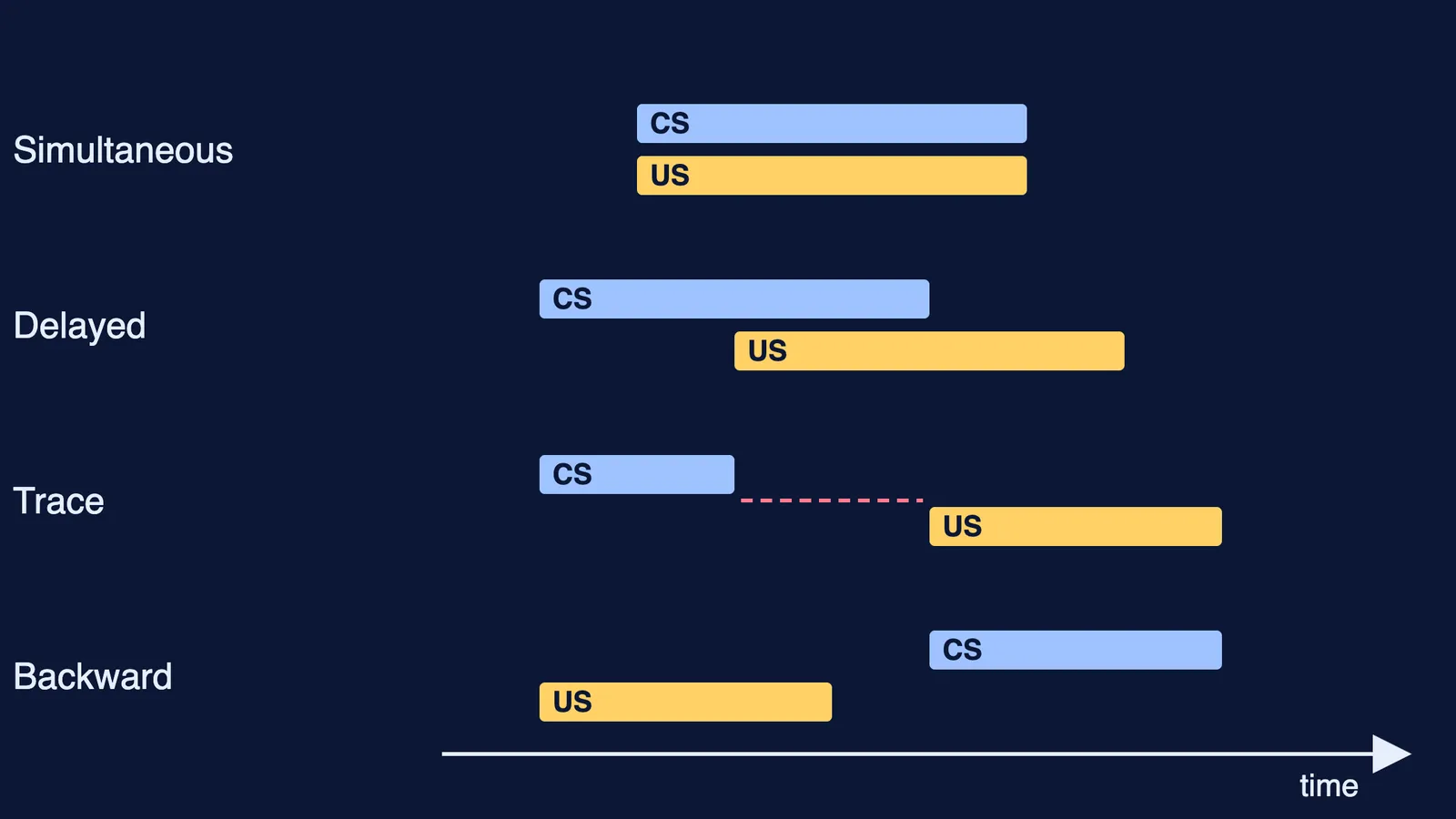
The textbook calls this S-S learning: one stimulus becomes a signal for another. Timing matters. In delayed conditioning the CS starts first and ends before the US ends; in trace conditioning there is a gap between them; in backward conditioning the US comes first. NCERT says delayed conditioning works best and backward conditioning rarely works.
Fear can be learned this way too, as our post on how phobias are learned and unlearned explains.
How is operant conditioning different?
B.F. Skinner studied voluntary behaviour, which he called operants. In the NCERT chapter, a hungry rat in a Skinner box presses a lever by accident, food drops, and over trials it presses sooner.
A reinforcer, in NCERT's words, is "any stimulus or event, which increases the probability of the occurrence of a (desired) response".
Positive reinforcement: something pleasant follows, such as praise.
Negative reinforcement: the response removes or avoids something unpleasant, like wearing a seat belt to avoid a fine.
Punishment: suppresses a response; it is not negative reinforcement.
The chapter also describes the partial reinforcement effect: responses rewarded only sometimes are harder to extinguish than those rewarded every time. That may help explain why phone-checking sticks, which our piece on phone use and dopamine explores.
What is observational learning?
The NCERT chapter describes a study by Albert Bandura in which children watched a five-minute film of a model attacking a Bobo doll. One group saw the model rewarded, one saw the model punished, and one saw neither.
In Bandura's original 1965 paper, children who saw the model punished copied significantly fewer aggressive acts than the other two groups. Once all the children were offered attractive rewards for copying, the differences vanished: all three groups had learned the behaviour equally.
NCERT's conclusion: observers learn by watching the model, but whether they perform the behaviour depends on whether the model was rewarded or punished.
How do you tell which type of learning it is?
Riya, a Class 11 student, hears a notification ping. Ask three questions in order:
Is it a reflex set off by a signal? Her stomach tightens at the ping on results day, because pings have come before bad news. Classical conditioning: the ping is the CS.
Is it a voluntary action shaped by what followed? She checks her phone more because sometimes there is a message. Operant conditioning, on a partial schedule.
Was it picked up by watching? Her younger brother starts checking his tablet the same way. Observational learning.
For a long answer: name the type, give the NCERT definition, label your example with the terms, then add one process such as extinction or generalisation. Conditioning starts with a reflex, so if the reflex arc from biology is hazy, the Fermi Concept Library has every concept in biology with its own lesson.
What are learning disabilities, and what should parents do?
The NCERT chapter calls learning disability a heterogeneous group of disorders that make reading, writing, speaking, reasoning or mathematics difficult, and notes they occur in children of average to superior intelligence. Signs it lists include confusing b and d or was and saw (dyslexia) and trouble following spoken instructions. It says learning disabilities are not incurable and that remedial teaching goes a long way in helping these children learn.
The Schedule of the Rights of Persons with Disabilities Act, 2016 names "specific learning disabilities", including dyslexia, dysgraphia, dyscalculia, dyspraxia and developmental aphasia.
A textbook list is not a diagnosis. If you see a pattern, note specific examples for a few weeks and take them to the school counsellor or special educator, who can refer your child for assessment by a qualified professional. To open the conversation: "Reading seems to take you longer than your friends, even when you work hard. That isn't laziness. Shall we ask someone who knows how to check?"
Still weighing the subject itself? Read should your child take psychology in Class 11.