

On this page
No one is born knowing what a lift or an injection is, yet plenty of people dread both. Many phobias are learned, and the same brain machinery that learned the fear can learn something new on top of it. Seeing a phobia as a memory explains how it is treated.
How do phobias develop?
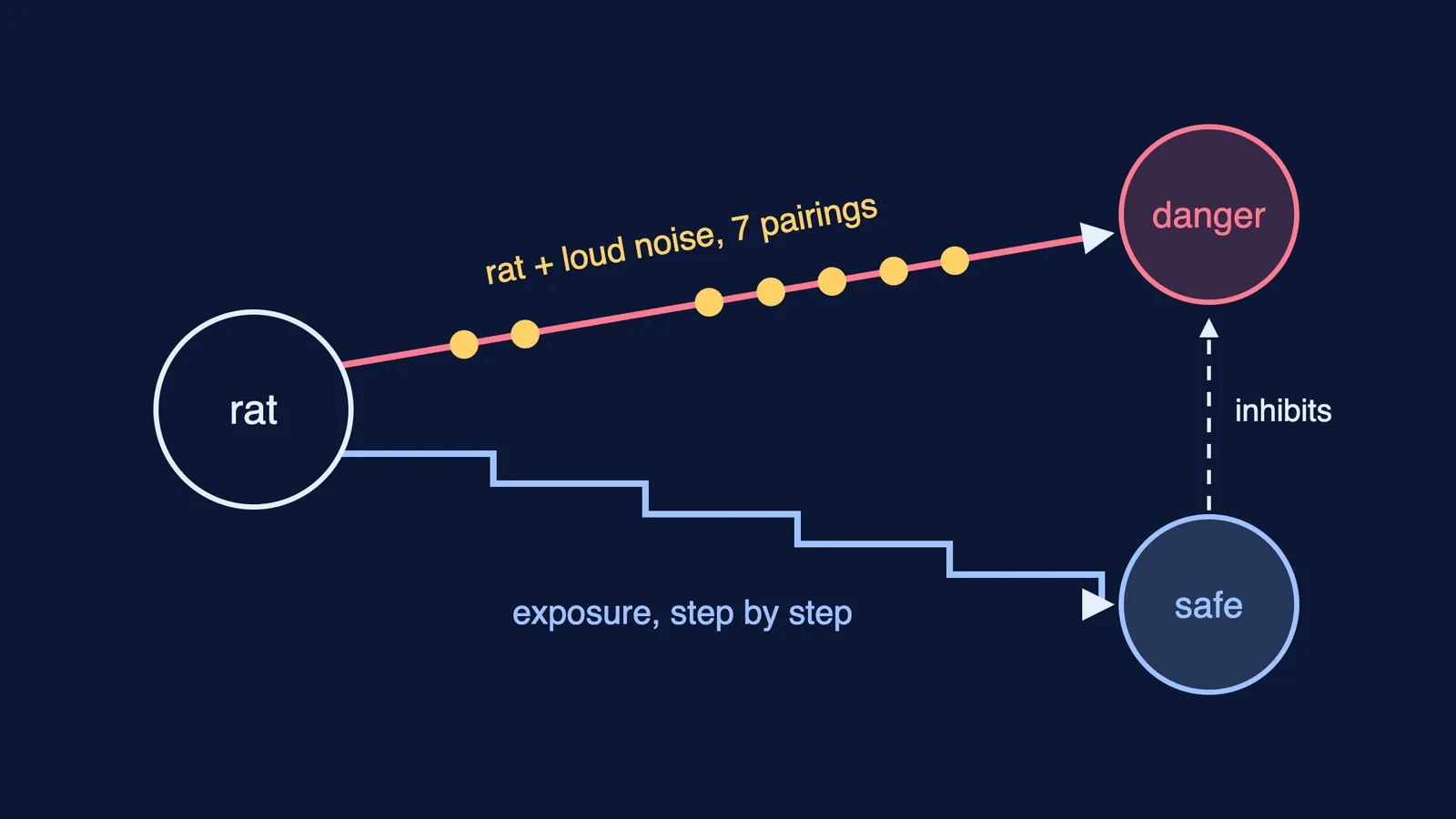
The classic demonstration is a 1920 study by John Watson and Rosalie Rayner, Conditioned emotional reactions (DOI record). An infant called Albert B. was calm around a white rat until, at eleven months old, the researchers began striking a steel bar behind his head as he touched the rat. After seven of these pairings, the rat alone made him cry and crawl away. The fear also spread to things that looked similar: a rabbit, a dog and a seal-fur coat. The study had just one child, and it would not be allowed today, but its lesson stuck. A neutral thing paired with a frightening one can become frightening by itself. Psychologists call this classical conditioning.
A bad experience is not the only route. Olsson and Phelps reviewed the evidence in Social learning of fear (Nature Neuroscience, 2007). They describe fears that are acquired by watching someone else react with fear, and by being told something is dangerous. So a child can pick up a parent's fear of dogs without ever being bitten.
What does the amygdala have to do with fear?
The amygdala is a small structure deep in the brain. Phelps and LeDoux's review Contributions of the amygdala to emotion processing (Neuron, 2005) brings together animal and human studies showing the amygdala is involved in implicit emotional learning and memory, and also in inhibiting and regulating emotion. "Implicit" means learning that works without conscious effort. That helps explain why knowing something is harmless does not always calm a racing heart.
If the nervous system chapter in your biology textbook is hazy, the Fermi Concept Library gives each concept in biology its own lesson and shows where it sits in the map.
How common are phobias?
The World Mental Health Surveys (Wardenaar et al., Psychological Medicine, 2017) interviewed 124,902 people in 25 surveys across 22 countries about specific phobia, an intense fear of a particular thing or situation. They found a lifetime prevalence of 7.4%, and 5.5% in the past year. The median age of onset was 8 years, so phobias often begin in childhood. Only 23.1% of people with a phobia in the past year reported any treatment.
How does exposure therapy unlearn a fear?
The surprising part is that the old memory is not erased. Bouton's review Context and behavioral processes in extinction (Learning and Memory, 2004) sets out evidence that extinction "does not destroy the original learning". Instead it creates new learning that depends strongly on context. Afterwards, the brain holds two competing memories: "this is dangerous" and "this turned out safe".
Craske and colleagues turned this into practical guidance in Maximizing exposure therapy: an inhibitory learning approach (Behaviour Research and Therapy, 2014). Their strategies include expectancy violation (testing a feared prediction and seeing it fail), variability, practising in multiple contexts, and removing safety signals such as always holding someone's hand. The aim is to learn something new, not just to sit there until the fear fades.
Treatment can be quick. In Öst's One-session treatment for specific phobias90113-7) (1989), 20 patients had a single session of exposure plus modelling that lasted 2.1 hours on average. At follow-up, an average of four years later, 90% were much improved or completely recovered. It was a small series with no comparison group, so it shows what is possible rather than what every patient can expect.
What can you do with this as a student or parent?
This is everyday understanding, not treatment. If a fear is stopping you from going to school, travelling or getting medical care, see a doctor or psychologist. In India, the free 24/7 Tele MANAS helpline is 14416.
For everyday nervousness, try a prediction check. It borrows the expectancy-violation idea:
Write the prediction in one line: "If I stand at the front of the class, I will freeze and everyone will laugh."
Rate how sure you are, from 0 to 100.
Do a small version of it, such as answering one question aloud.
Write down what actually happened, then rate the prediction again.
Repeat in a different room or with different people, because new learning is tied to context.
For parents, try naming the prediction instead of only saying "don't be scared": "You think the dog will jump on you. Shall we watch it from the gate for a minute and see what it actually does?" It lets your child test the prediction at their own pace. Staying calm yourself also matters, because fear can be learned by watching.
Calm breathing can take the edge off while you practise. Our post on whether deep breathing reduces exam stress has a four-minute routine. And since a safe memory is still a memory, read how sleep helps you remember what you studied to see how the brain stores new learning overnight.


