On this page
Your heart is thumping, the hall has gone quiet and the question paper hasn't arrived yet. Slow breathing is a calming tool you can use right there: it needs nothing, and it has been tested on students. Here is what studies found, and a routine to practise this week.
Does deep breathing actually reduce exam stress?
The most direct test comes from a classroom. In a 2016 study by Kiat Hui Khng in Cognition and Emotion, 122 Primary 5 students were split into a deep-breathing group and a control group before a timed maths test. The children who took deep breaths reported less anxiety and scored better on the test.
Its analysis suggests breathing helped students keep unhelpful thoughts in check, and the boost to scores tended to be larger in children whose bodies reacted most strongly in test-like situations.
Wider evidence points the same way, with a caveat. A 2023 meta-analysis in Scientific Reports pooled 12 randomised trials with 785 adults and found breathwork was linked to lower stress than control conditions, a small-to-medium effect. The same paper found similar effects on anxiety across 20 trials, and its authors urged caution to avoid "a miscalibration between hype and evidence".
So breathing helps, modestly. It takes the edge off; it does not replace preparation.
What happens to your heart rate when you breathe slowly?
Heart rate rises as you breathe in and falls as you breathe out, a pattern called respiratory sinus arrhythmia, as explained in a review of slow-breathing physiology in the journal Breathe.
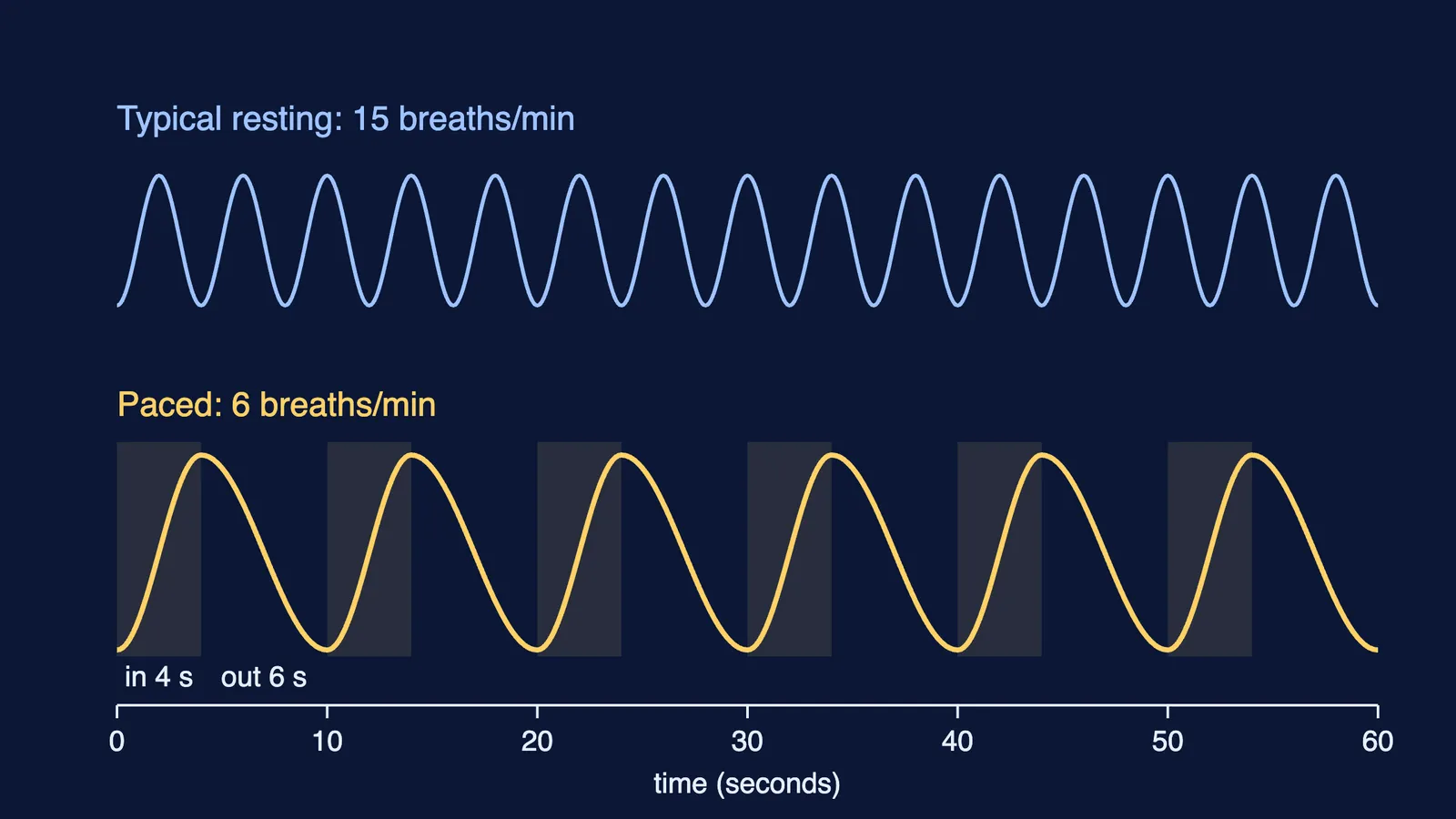
That review defines slow breathing as 4 to 10 breaths per minute, while the typical resting rate is 10 to 20 breaths per minute.
When you slow into that range, the beat-to-beat gaps in your heart rate vary more. A systematic review of 15 studies in Frontiers in Human Neuroscience found slow breathing increased heart rate variability, which it links to parasympathetic activity, the calming branch of the nervous system. People in those studies reported more relaxation and alertness and less anxiety and arousal.
What does the evidence say about pranayama?
Pranayama is the breathing practice of yoga. In a 2025 study in Applied Psychophysiology and Biofeedback, 40 adults new to pranayama did one session of Nadi Shuddhi pranayama. Compared with their own readings beforehand (there was no separate control group), their systolic blood pressure fell and their heart rate variability shifted towards parasympathetic activity.
For students specifically, a 2025 meta-analysis in Annals of Neurosciences found yoga-based programmes reduced anxiety and improved heart rate variability, though only four trials could be pooled.
A 2023 randomised trial in Cell Reports Medicine gave 108 adults one of three five-minute daily breathing exercises or mindfulness meditation for a month. The breathing exercises, especially cyclic sighing (a double inhale followed by a long, slow exhale), improved mood and lowered breathing rate more than meditation did.
How do you do slow breathing before an exam?
This routine combines those patterns. It has not been tested as a package, so practise it at home first.
Minute 1, settle. Sit back, feet flat, hands on your thighs. Do three cyclic sighs: breathe in through your nose, take a second short breath in on top, then breathe out slowly through your mouth. Breathe normally for the rest of the minute.
Minutes 2 and 3, pace. Breathe in through your nose for a count of 4 and out for a count of 6. That is 10 seconds a breath, or 6 breaths a minute: 12 slow breaths in two minutes.
Minute 4, plan. Keep the 4-and-6 rhythm and, on each exhale, say one line of your plan to yourself: "Read the whole paper. Start with the section I know best. Move on when my time for a question is up."
If you feel dizzy or light-headed, stop and breathe normally. Do it once a day before the exam, ideally before a mock test, so on the day it feels familiar.
For the plan in minute 4, our minute-per-mark guide to time in the exam hall gives you the numbers, and what to do when others finish early helps you stick to them.
What if four minutes of breathing isn't enough?
Sometimes the panic is really about a chapter you haven't finished. Breathing can't fix that, but a plan can. Fermi's AI tutor can work out what you already know and build a plan for the session, so you sit down to a clear next step instead of a blank page.
Breathing is for everyday exam nerves. If worry is stopping you from sleeping, eating or studying for days at a time, talk to a parent, a school counsellor or a doctor. Tele MANAS, the national mental health helpline from the Ministry of Health and Family Welfare, answers on 14416 or 1-800-891-4416.
If you are a parent, our guide to managing your own anxiety about your child's exams has a plan for your side of the table. Start tonight: four minutes, 4 in and 6 out.