

On this page
A pressure washer is neat fluid mechanics. Two school-physics equations, continuity and Bernoulli, explain almost everything it does; here they are, worked out for a real home machine.
How does a pressure washer work?
It has three working parts: a motor-driven pump, a high-pressure hose and a lance ending in a tiny nozzle. The pump raises the pressure of ordinary tap water; the nozzle turns that pressure into speed.
A typical home model, the Kärcher K 3, is rated at up to 120 bar and 380 litres an hour, with a rated input power of 1.6 kW, according to the manufacturer's technical data. One bar is 100,000 pascals, so 120 bar is about 120 times the pressure of the air around you. We treat the rating as a gauge pressure, measured above the atmosphere, which is how pump pressures are usually quoted; if the difference is fuzzy, read our guide to gauge pressure and absolute pressure.
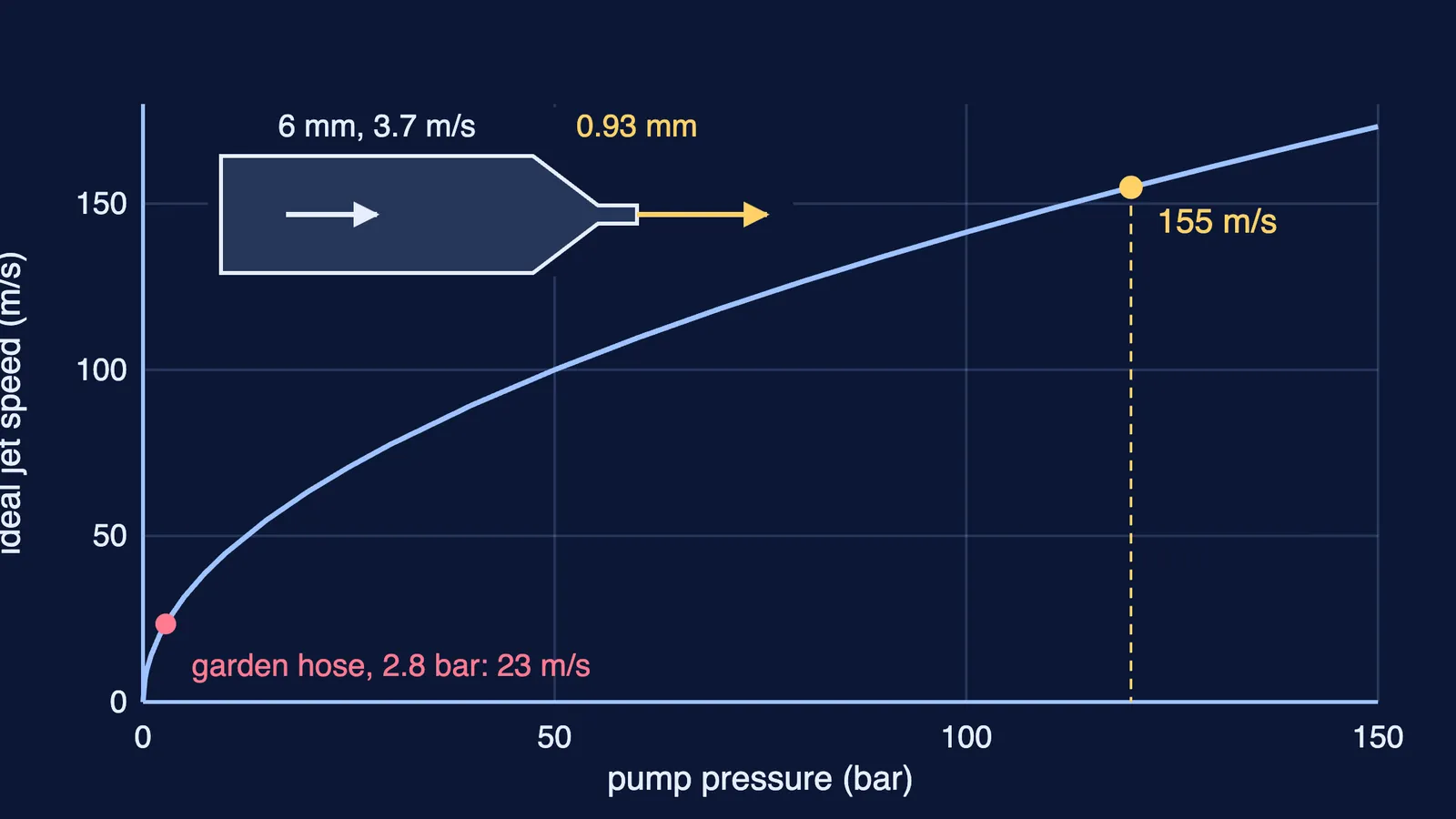
For comparison, a case report in the International Journal of Emergency Medicine notes that an average garden hose emits about 40 psi (roughly 2.8 bar), while pressure washers range from 1,300 to 4,000 psi (Sampson, 2008).
Why does a narrow nozzle make the water faster?
The continuity equation says the volume flow rate is Q = Av, area times average speed, and that A1v1 = A2v2 for an incompressible fluid (OpenStax University Physics, section 14.5). Water hardly compresses, so every litre the pump pushes into the hose must leave through the nozzle in the same time. A hole with one-fortieth of the area means water moving forty times faster.
Bernoulli's equation says p + ½ρv² + ρgh stays constant along a streamline for an incompressible, frictionless fluid (OpenStax, section 14.6). Inside the lance the water is slow and at high pressure. Just outside the nozzle it is at atmospheric pressure, so the gauge pressure p has become kinetic energy: ½ρv² = p, which gives v = √(2p/ρ).
The two equations do different jobs. Bernoulli sets the jet speed from the pump pressure. Continuity tells you how small the hole must be for the pump's whole flow to leave at that speed. A pichkari squirting water across a courtyard uses the same idea, with your hand as the pump.
How fast is the jet? A worked example
Take the manufacturer's figures of 120 bar and 380 litres an hour, and water density 1000 kg/m³.
Convert units: p = 1.2 × 10⁷ Pa and Q = 380 L/h = 1.06 × 10⁻⁴ m³/s.
Jet speed: v = √(2 × 1.2 × 10⁷ / 1000) ≈ 155 m/s, about 560 km/h.
Nozzle size: A = Q/v ≈ 6.8 × 10⁻⁷ m², a hole about 0.93 mm across.
Hose speed: assume a 6 mm inner diameter (our assumption, not a spec). The area is 2.8 × 10⁻⁵ m², so water in the hose moves at only 3.7 m/s. The area ratio is about 42, and so is the speed ratio.
Power check: hydraulic power is pQ ≈ 1.27 kW, below the rated input power of 1.6 kW.
Kickback: the jet carries away momentum at a rate ρQv ≈ 16 kg·m/s every second, a reaction force of about 16 N that you feel through the lance, roughly the weight of a 1.7 kg bag.
These are ideal upper limits: friction in the hose and nozzle makes the real jet slower. Knowing when Bernoulli's equation cannot be used is part of answering well.
If continuity and Bernoulli still feel like two formulas rather than one picture, the Fermi Simulation Lab has interactive simulations for ideas that are easier to see than to read. For more numericals like this, the Fermi Problem Library has a step-by-step solver that explains the reasoning rather than printing an answer.
What changes when you swap the nozzle?
A smaller hole does not raise the ideal speed. v = √(2p/ρ) depends only on pressure; at the same pressure a smaller hole lets less water through.
A fan nozzle spreads the jet. The same energy lands on a line instead of a point, which is gentler on paint and wood.
A point jet concentrates it. Kärcher describes its dirt blaster as a rotating point jet for stubborn dirt on non-sensitive surfaces (product page).
Is a pressure washer jet dangerous?
Yes, if it meets skin. A fast jet can push water under the skin, and Sampson's report notes that such an injury may show only an innocuous entrance wound or no visible break in the skin (Sampson, 2008). Never point the lance at people, pets or your own hand. If a jet does break the skin, get medical help straight away, even if the wound looks small.
When you want a plan for the whole fluids chapter rather than one example, Fermi's AI tutor can work out what you already know and build a plan for the session.


