

On this page
You are halfway through a fluids numerical and ask an AI for help. It writes P + ½ρv² + ρgh = constant, plugs in numbers and gives an answer. Nobody asked whether Bernoulli's equation was allowed in the first place.
Bernoulli's equation is conservation of energy for a moving fluid, and it only works under certain conditions. Here is a short doubt routine that makes checking them a habit.
When does Bernoulli's equation not apply?
Along a streamline, the sum of pressure, kinetic energy per unit volume and potential energy per unit volume stays constant, according to the NCERT Class 11 Physics chapter on mechanical properties of fluids.
The same NCERT chapter says Bernoulli's equation ideally applies to non-viscous fluids, needs the fluid to be incompressible, and does not hold for non-steady or turbulent flows.
NASA's Glenn Research Center says the form of the equation it presents assumes flow that is inviscid, incompressible and steady, with no heat added and negligible change in height, and holds only along a single streamline. It warns that using this form for supersonic flow gives the wrong answer (NASA Glenn, Bernoulli's equation).
Red flags in exam problems:
Friction matters: a long, narrow pipe, or a thick liquid such as honey or glycerine.
The flow is fast enough to turn turbulent, like the white-water rapids NCERT describes.
A pump, fan or turbine sits between your two points and adds or removes energy.
A gas moves at a large fraction of the speed of sound, so its density changes.
Your two points are not on the same streamline.
Where is the pressure measured, and why does it matter?
In a moving fluid, pressures at the same height can differ if the flow speeds differ, as OpenStax University Physics explains in its Bernoulli section. So "the pressure in the pipe" means nothing until you say where.
The second trap is gauge versus absolute pressure. In the OpenStax fire-hose example, the answer is a gauge pressure because the starting pressure was given as gauge, and water leaving the nozzle is at atmospheric pressure. NCERT's derivation of Torricelli's law uses the same idea: the hole is at atmospheric pressure, and for a tank open at the top the efflux speed becomes v = √(2gh).
Mix gauge at one point with absolute at the other and you are off by a whole atmosphere. Ask the AI to label every pressure before substituting.
Is the flow steady, and what if it is not?
In steady flow, the map of streamlines does not change with time, and the NCERT fluids chapter notes that flow stays steady only at low speeds, below a critical speed. A draining tank is the classic grey area: the water level falls, so the flow changes over time. NCERT handles this by taking the tank's cross-section to be much larger than the hole's, so the top surface is approximately at rest. A good AI answer should name that approximation, not slip it in.
What should you ask the AI? A three-question routine
Paste your problem, then ask these before you accept any number:
"Where exactly is each pressure in this problem measured, and is each one gauge or absolute?"
"Is this flow steady and smooth? What would make it unsteady or turbulent here?"
"Which Bernoulli assumption is this problem closest to breaking, and would that make the real answer higher or lower?"
How does the routine work on a narrowing pipe?
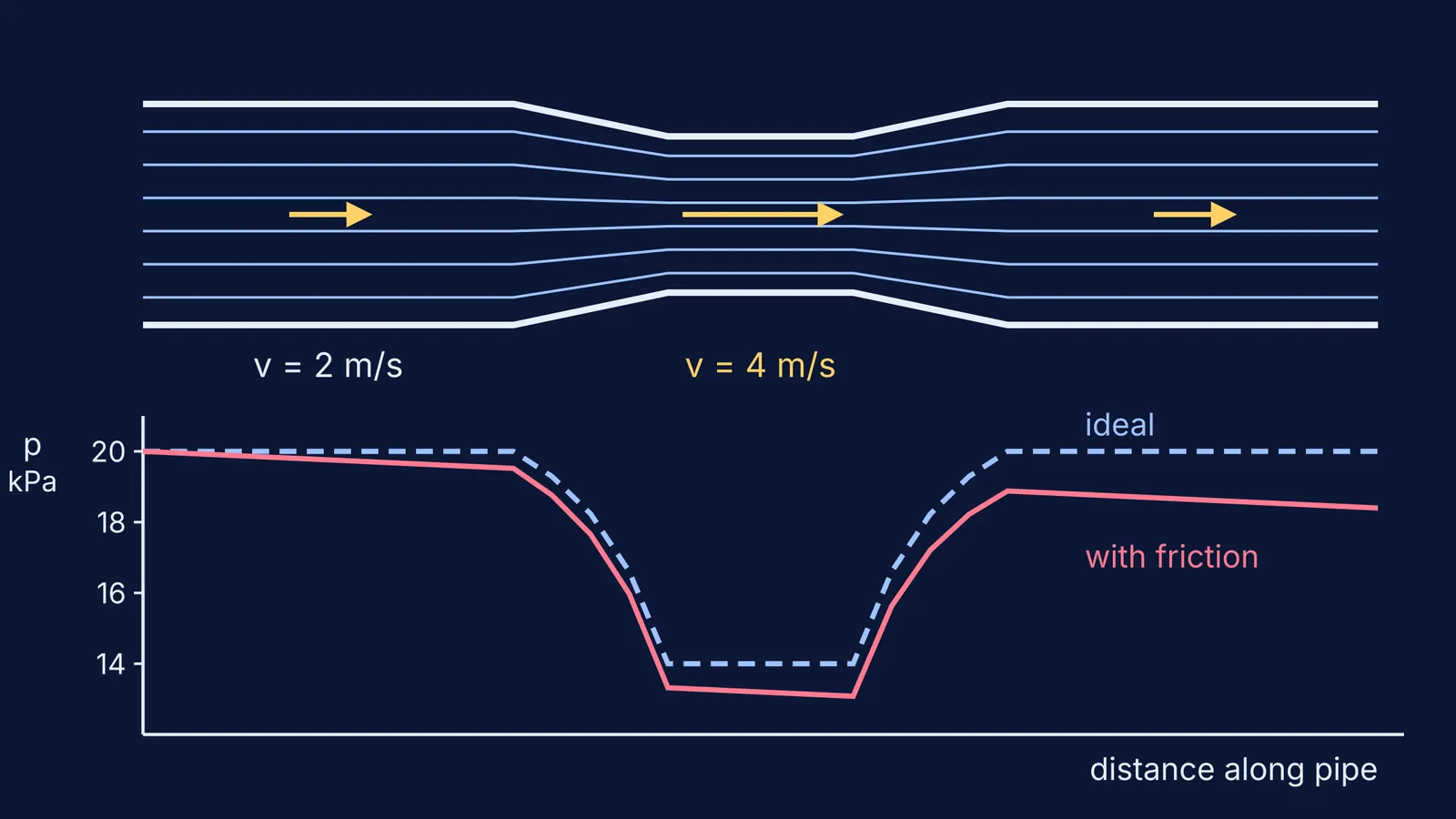
Water flows through a horizontal pipe at 2 m/s, and the cross-sectional area halves at a narrow section. By the continuity equation Av = constant from the NCERT fluids chapter, the speed doubles to 4 m/s. Bernoulli then gives a pressure drop of ½ × 1000 × (4² − 2²) = 6000 Pa, or 6 kPa.
Now run the routine:
Where is pressure measured? At the wall, at the same height, so the ρgh terms cancel. Take both readings as gauge, so they match.
Is the flow steady? Yes, if the supply is constant and the speeds are low.
Which assumption is weakest? Friction. In a real pipe, some energy is lost to viscosity, so the pressure further down the pipe reads lower than ideal Bernoulli predicts.
So 6 kPa is the ideal drop. A real gauge would show a larger drop, and the gap grows with pipe length.
How do you practise this with an AI tutor?
Treat the three questions like a units check: part of every fluids problem. Our earlier guide on asking AI what assumptions a physics formula makes uses the same habit for other chapters, and the meaning of each term in Bernoulli's equation is worth rereading if the energy-per-volume idea feels shaky.
Fermi's AI tutor holds a line of reasoning across a whole session and decides whether to explain, ask or show, so you can work through all three questions on one problem without starting over. If you find it hard to picture faster flow and lower pressure in a narrow section, the Fermi Simulation Lab has interactive simulations for ideas that are easier to see than to read.
Next, try the Bernoulli narrowing-pipe prediction exercise, and ask the three questions before you check your answer.


