

On this page
We learn to solve physics by taking a formula, like v = u + at, and plugging in the numbers we are given. But real life is rarely that neat.
Every formula you use in school is built for a simplified version of reality. To make the mathematics solvable, the person who derived the formula had to ignore things. They assumed the surface had no friction, the string had no mass, or the gas molecules took up zero space.
If you only ever memorise the formula, you never learn the boundaries of the world it describes.
Why are assumptions so hard to see?
A 2009 study published in Science Education looked at how people solve physics problems. The researcher, David Fortus, tested participants who already held a degree in physics. He found that they could all solve well-defined textbook problems.
But when given an open-ended, real-world scenario, they struggled. The study concluded that making the constraining assumptions needed to turn a messy reality into a neat physics problem was the most difficult step of all.
Textbook problems do this work for you. They hand you an idealised world and ask you to find the answer. As a result, you get very good at doing the calculation, but you never practice deciding which factors are safe to ignore.
Ask the AI: what assumptions does this physics formula make?
If you want to understand a formula rather than just use it, you have to test its limits. When you are stuck on a concept, you can sit down with Fermi's AI tutor and ask it this exact prompt:
> "List every assumption behind this formula. Then, give me one scenario where each assumption fails, and ask me to predict what happens next."
Because Fermi can work out what you already know and build a plan for the session, it will guide you through the breakdowns one by one.
Example 1: Constant acceleration
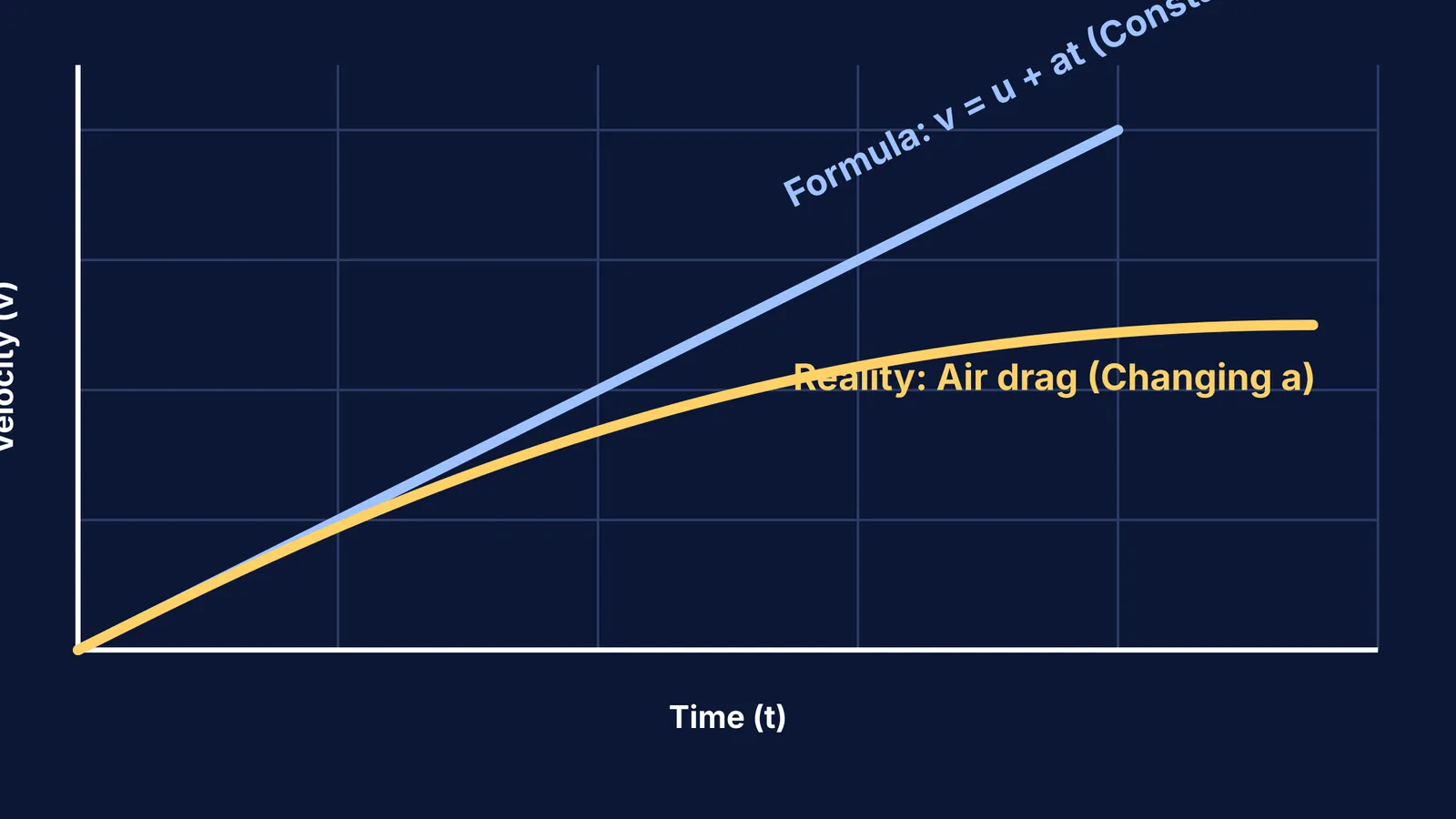
Take the kinematics equation v = u + at. If you ask the AI for its assumptions, it will tell you that the formula assumes acceleration (a) remains perfectly constant.
Then, it will give you a scenario where the assumption fails: a skydiver falling from a plane. As the skydiver speeds up, air resistance grows. The net force decreases, which means the acceleration drops. If you try to calculate their speed after ten seconds using v = u + at, your answer will be completely wrong. (For more on this, you can read about acceleration given as a function of v or x: how to integrate it.)
Example 2: The ideal gas law
If you bring the ideal gas law (PV = nRT) to the tutor, it will list two massive assumptions:
The gas molecules have zero volume.
The molecules do not attract or repel each other.
When does this fail? The tutor might ask you to imagine compressing the gas to a very high pressure. At high pressure, the molecules are squeezed tightly together. Suddenly, their actual volume matters. They also start to attract each other, pulling themselves closer. The ideal gas law breaks down, and you have to use a different model. (This is also why the free expansion of an ideal gas is a special case where no work is done.)
Practice finding the edges
Formulas are not magic spells; they are tools with strict operating conditions.
If you want to move past plugging in numbers, bring a formula to the Fermi Problem Library. Before you let the step-by-step solver explain the reasoning, write down every assumption you think the problem is making. You will start to see the physics hiding behind the algebra.


