

On this page
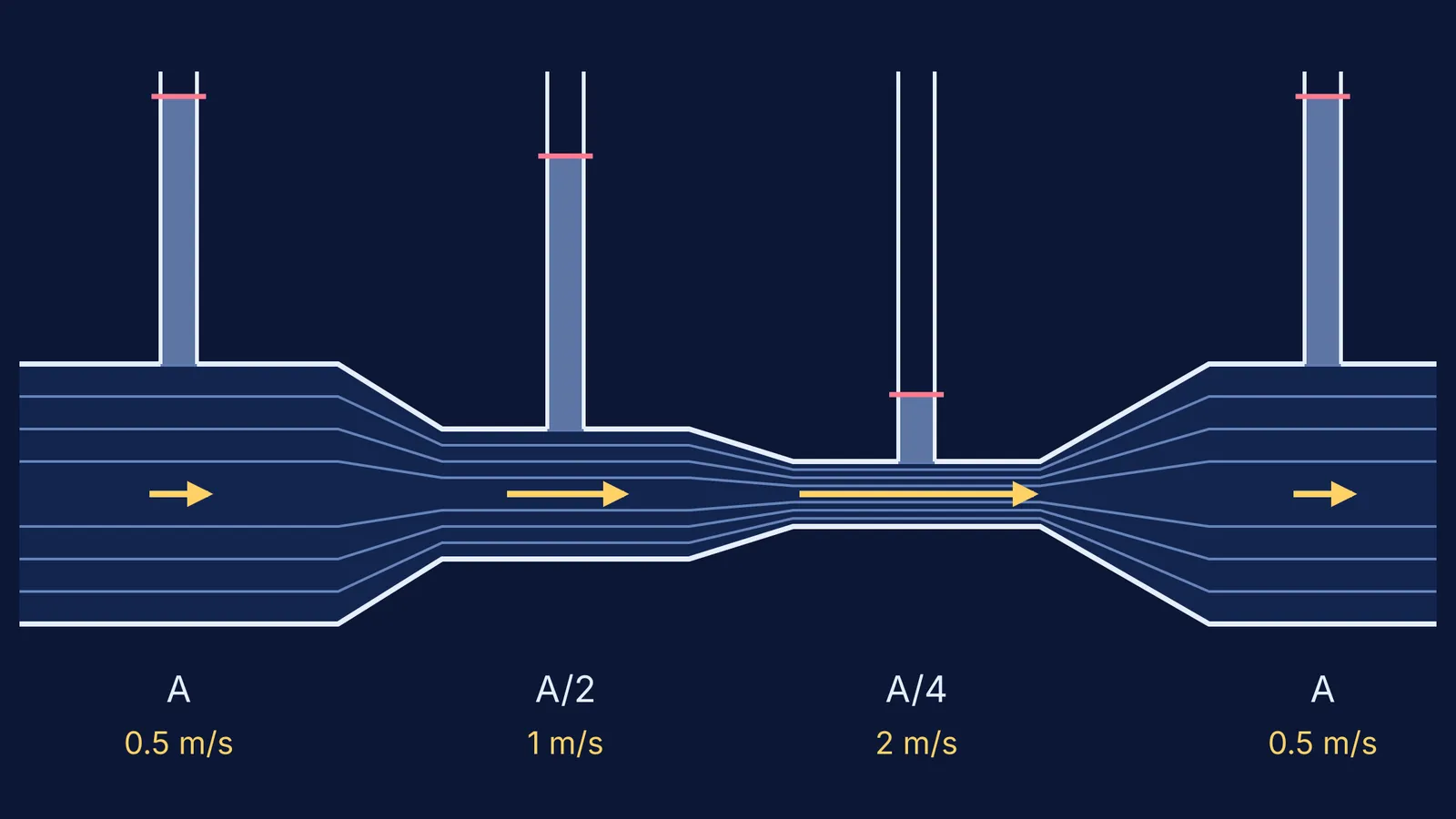
Picture water flowing through a level pipe that narrows to half its area, then to a quarter, then widens again. Before you press play in a simulation, write down two predictions for every section: how fast the water moves and how high it rises in a thin standpipe on top. Two equations give you every number.
What happens to speed and pressure when a pipe narrows?
The first equation is continuity. NASA's page on mass flow rate states that "the mass flow rate through a tube is a constant", and for constant density that means area times speed is the same at every section. Halve the area and the speed doubles.
The second is Bernoulli's equation. NASA Glenn's Bernoulli page defines it this way: static pressure plus dynamic pressure, half of density times speed squared, is constant throughout a steady, inviscid, incompressible flow. So where the speed goes up, the pressure must come down.
Get the cause the right way round: the water speeds up entering the neck because the pressure behind it is higher than the pressure ahead.
Worked example: predict every section before you run it
Apply continuity and Bernoulli to water (density 1000 kg/m³) and sections of area A, A/2, A/4 and back to A. Give the inlet a speed of 0.5 m/s and a gauge pressure of 2500 Pa.
Speeds from continuity: 0.5 m/s, 1.0 m/s, 2.0 m/s, then back to 0.5 m/s.
Pressure in the first neck: 2500 − ½ × 1000 × (1.0² − 0.5²) = 2500 − 375 = 2125 Pa.
Pressure in the narrow neck: 2500 − 500 × (2.0² − 0.5²) = 2500 − 1875 = 625 Pa.
Pressure at the outlet: speed is back to 0.5 m/s, so the ideal pressure is back to 2500 Pa.
Standpipe heights from h = p/(ρg) with g = 9.81 m/s²: about 25.5 cm, 21.7 cm, 6.4 cm and 25.5 cm.
Notice the pattern. Each halving of the area doubles the speed, but the pressure term goes with speed squared, so the second narrowing costs four times as much pressure as the first (1500 Pa against 375 Pa).
What will the simulation show that the equations miss?
NASA's Bernoulli page warns: "If you ignore the restrictions, you may often get an incorrect 'answer' from the equation." Real water has viscosity, so with friction switched on the outlet standpipe sits a little below the inlet one: energy that ideal Bernoulli leaves out. Use this checklist:
Double the inlet speed: predict that every speed doubles and every pressure drop becomes four times larger.
Swap water for a less dense liquid at the same speeds: predict smaller pressure drops, in proportion to density.
Turn friction on, if the simulation allows it: predict that the outlet reads lower than the inlet.
Write each prediction down before you move the slider; the ones you get wrong are what to revise. Our guide to common pressure, buoyancy and Bernoulli mistakes covers the errors that show up most often in exam problems.
Does faster air over a wing really cause lift?
The textbook story: the top of a wing is longer, air over it must meet the air underneath at the back edge, so it moves faster and the pressure drops. NASA's page on the equal transit theory lists what is wrong with it: symmetric wings and flat plates also produce lift, air going over the top actually reaches the back edge before air going underneath, and the theory predicts "much less" lift than is measured. NASA's Venturi theory page adds that a wing is not a nozzle: there is no second wall.
Bernoulli's equation is fine; the story's reason for the speed is not. In a pipe, the walls fix the area, so continuity tells you the speed. Over a wing there is no top wall, so path length tells you nothing. In his paper How do wings work? in Physics Education (2003), Holger Babinsky says the popular explanation "misleadingly invokes Bernoulli's equation" and explains lift through pressure gradients and the curvature of streamlines instead. When air follows a curved path, the pressure on the inside of the curve has to be lower, and that is what lowers the pressure above the wing. NASA's flow turning page describes lift as "a force generated by turning a moving fluid".
For the history, read about Daniel Bernoulli and Hydrodynamica and George Cayley and the idea of lift, drag and thrust.
How should you practise this?
Sketch the pipe, write the speeds, then the pressures, and only then run the simulation. The Fermi Simulation Lab has interactive simulations for ideas that are easier to see than to read, and the predict-then-run habit works on any of them. If you get stuck partway through a calculation, Fermi's AI tutor notices where you are stuck and decides whether to explain, ask or show.
Start with the four-section pipe above, and keep going until your standpipe predictions match.


