

On this page
Bernoulli's equation connects the pressure, speed and height of a fluid in motion. If you want to know why a fast-moving fluid drops in pressure or how water climbs up a pipe, this equation provides the framework.
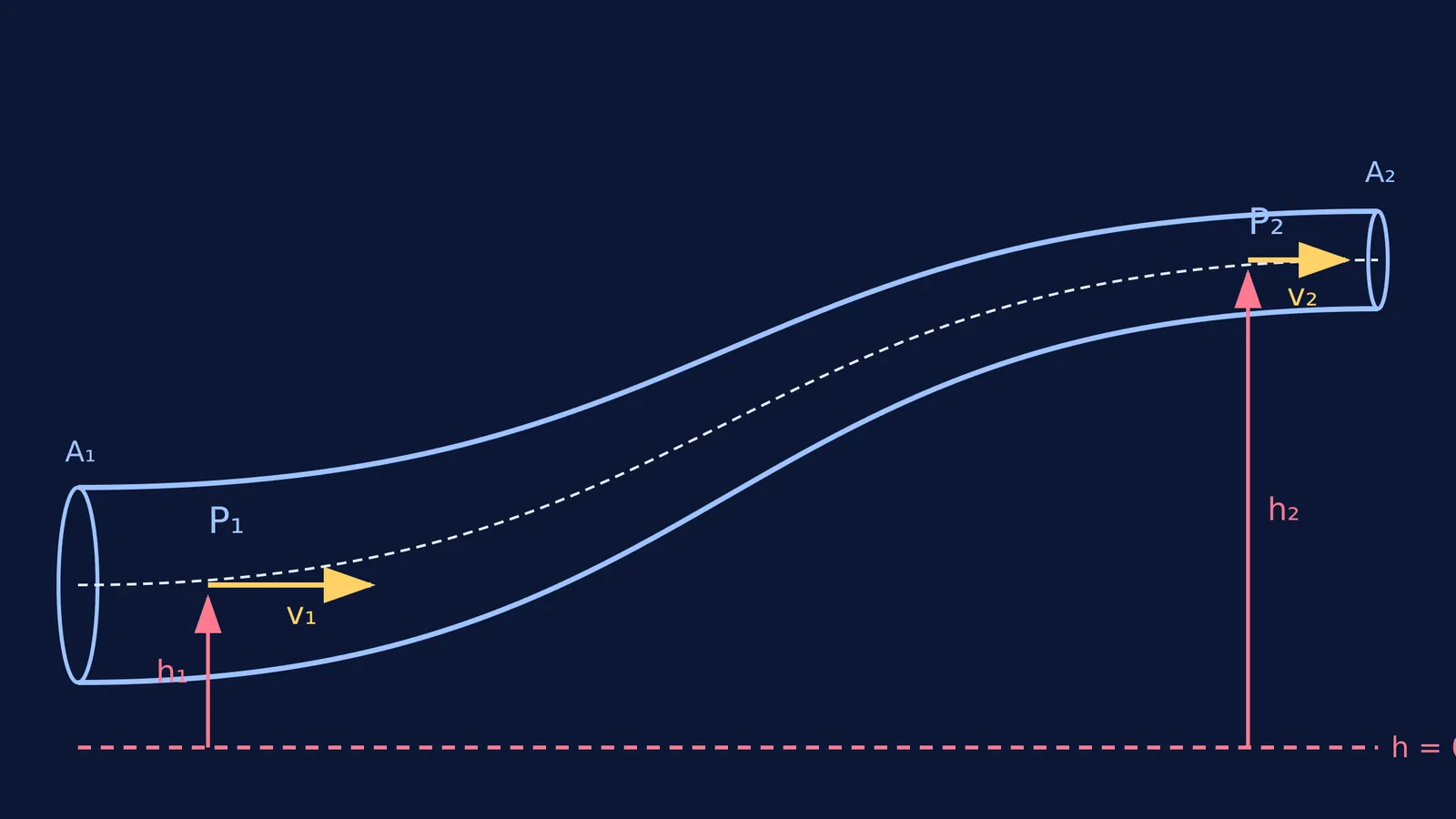
At first glance, the equation looks like a long string of variables: P + ½ρv² + ρgh = constant. However, once you break it down, it is simply the principle of conservation of energy applied to fluids.
What does Bernoulli's equation mean?
To understand the equation, you have to look at the units. As OpenStax College Physics points out, Bernoulli's equation is a statement of conservation of energy for an incompressible fluid in the absence of friction.
Instead of looking at the total energy of a massive body of water, the equation looks at the energy of a small, fixed volume. Every term in Bernoulli's equation represents an energy density, which means the energy per unit volume of the fluid.
What is the pressure energy term (P)?
The first term, P, is the static pressure of the fluid. We usually think of pressure as force per unit area, measured in pascals (N/m²). But pressure also represents work done per unit volume.
As derived in OpenStax College Physics, multiplying N/m² by m/m yields J/m³, which is energy per unit volume. This "pressure energy" is the work the fluid pressure does to push a volume of fluid along the pipe. When you see pressure in this equation, you are looking at the fluid's ability to do work on its surroundings.
What does the kinetic energy term (½ρv²) represent?
If you know the formula for the kinetic energy of a solid object (½mv²), this second term will look very familiar. Because Bernoulli's equation deals with energy per unit volume, the mass (m) is replaced by density (ρ), which is mass per unit volume.
This term represents the kinetic energy of the fluid due to its motion. When a pipe narrows, the fluid has to speed up to get the same amount of mass through the smaller gap. As the velocity (v) increases, the kinetic energy term increases. To keep the total sum constant, the pressure or height must drop.
What is the potential energy term (ρgh)?
The final term accounts for gravity. It is the fluid equivalent of gravitational potential energy (mgh). Once again, density replaces mass.
This term represents the potential energy of the fluid due to its height (h) above an arbitrary reference level, where g is the acceleration due to gravity. If a pipe goes uphill, the fluid gains potential energy, which usually comes at the cost of pressure or speed.
Understanding how these energy forms trade off against each other makes it easier to tackle other mechanics challenges, whether you are finding the unknown density of Two immiscible liquids in a manometer or exploring Pascal's law in hydraulic machines.
When does Bernoulli's equation apply?
To use this equation accurately, your fluid flow must meet a few strict conditions. The principle holds true for an incompressible, frictionless fluid in steady flow, as outlined in OpenStax University Physics.
This means:
Steady flow: The velocity of the fluid at any specific point does not change over time.
Incompressible: The density (ρ) of the fluid remains constant. This works well for liquids like water, but not for gases moving at very high speeds.
Non-viscous: There is no internal friction within the fluid. Thick fluids like honey lose energy to heat as they flow, meaning the total mechanical energy is not conserved.
If you are struggling to set up the two points on a streamline and balance the energies, the Fermi Problem Library has worked problems with a step-by-step solver that explains the reasoning rather than printing an answer. And if you need to review fluid dynamics from the ground up, the Fermi Concept Library contains every concept in physics, chemistry, biology, mathematics and computing, each with its own lesson and its place in the map.


