

On this page
The Holi *pichkari* (water gun) is a childhood staple, but it is also a perfect, hand-held physics laboratory. If you have ever wondered how a gentle push on a plunger can send a jet of water flying across a courtyard, the answer lies in fluid dynamics.
When you learn about fluids in physics, it can seem like a list of disconnected formulas. But a pichkari connects them into one visible action. If you are learning the science behind the festival, alongside the chemistry of mixing Holi colours, the physics of the squirt gun is a great place to start.
How does the piston build pressure?
When you push the plunger of a simple syringe-style pichkari, you are applying a force over the area of the piston.
According to Pascal's law, a pressure change at any point in an enclosed, incompressible fluid is transmitted equally to all points throughout the fluid 1. Because water cannot be easily compressed, the pressure you create at the back of the barrel travels instantly to the water at the front, pushing it against the only exit: the nozzle. This is similar to the principles you might use when explaining air pressure with straws and bottles, except here we use a liquid.
Why does the water shoot so fast?
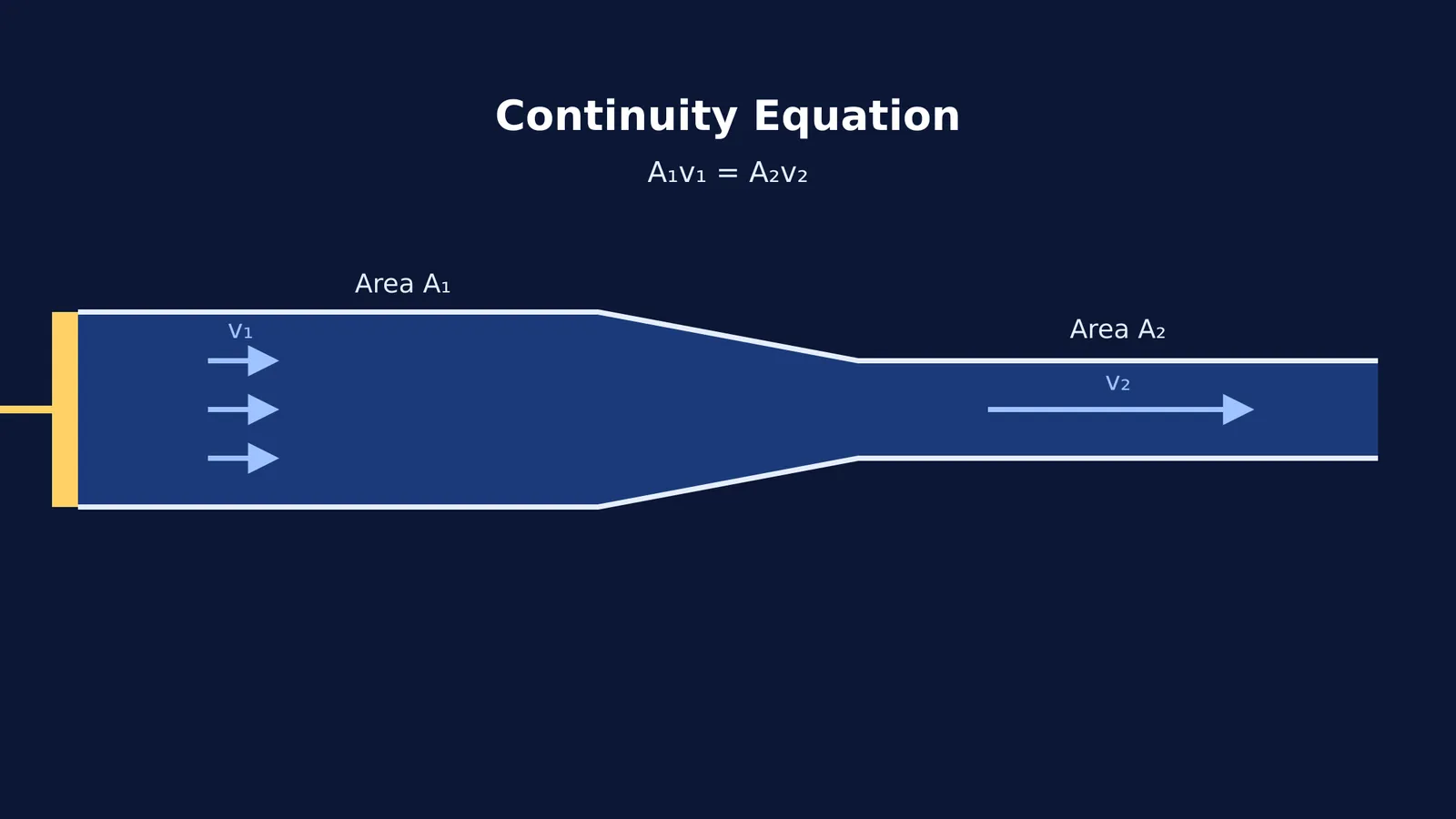
This is where the shape of the pichkari matters. The barrel where the water sits is wide, but the nozzle at the tip is very narrow.
The flow of water must follow the continuity equation, which states that for an incompressible fluid, the volume flow rate (A × v) remains constant 2. The equation is written as A₁v₁ = A₂v₂, where A is the cross-sectional area and v is the fluid's velocity.
Because the nozzle area (A₂) is much smaller than the barrel area (A₁), the water's velocity (v₂) must increase drastically to maintain the same flow rate. If the barrel is ten times wider than the nozzle in area, the water exits the nozzle ten times faster than the speed at which you push the piston.
How do you predict velocities in a pipe?
If you need to solve a continuity equation problem for a nozzle or a pipe, use this simple checklist:
Identify the two areas: Note A₁ and A₂. Remember that if you are given a radius or diameter, the area scales with the square (A = πr²).
Check your units: Ensure both areas and both velocities are in matching units (for example, m² and m/s).
Apply the equation: Set up A₁v₁ = A₂v₂ to find the missing value.
How can toys help you learn physics?
Memorising A₁v₁ = A₂v₂ from a textbook often leads to mistakes because you are trying to remember the letters without picturing the water. Linking equations to real objects makes them stick.
If you are struggling to picture how pressure, velocity and area interact, you can try the Fermi Simulation Lab, which provides interactive simulations for the ideas that are easier to see than to read. Seeing a live, interactive model of fluid flow lets you change a pipe's width and watch the velocity vectors update in real time. This turns abstract maths into a visible mechanism.
The next time you fill a pichkari, you will know exactly why it works: you are trading area for speed.


