

On this page
Holi is a festival of vibrant sights, but the colours scattered in the air and smeared on faces are also a hands-on introduction to chemistry and physics. When children ask where the colours come from or what happens when they mix them, they are asking fundamental questions about pigments, light, and molecular structure.
You can use the preparation and play of Holi to demonstrate these scientific principles actively, turning a cultural celebration into a memorable learning experience.
Where do natural Holi colours come from?
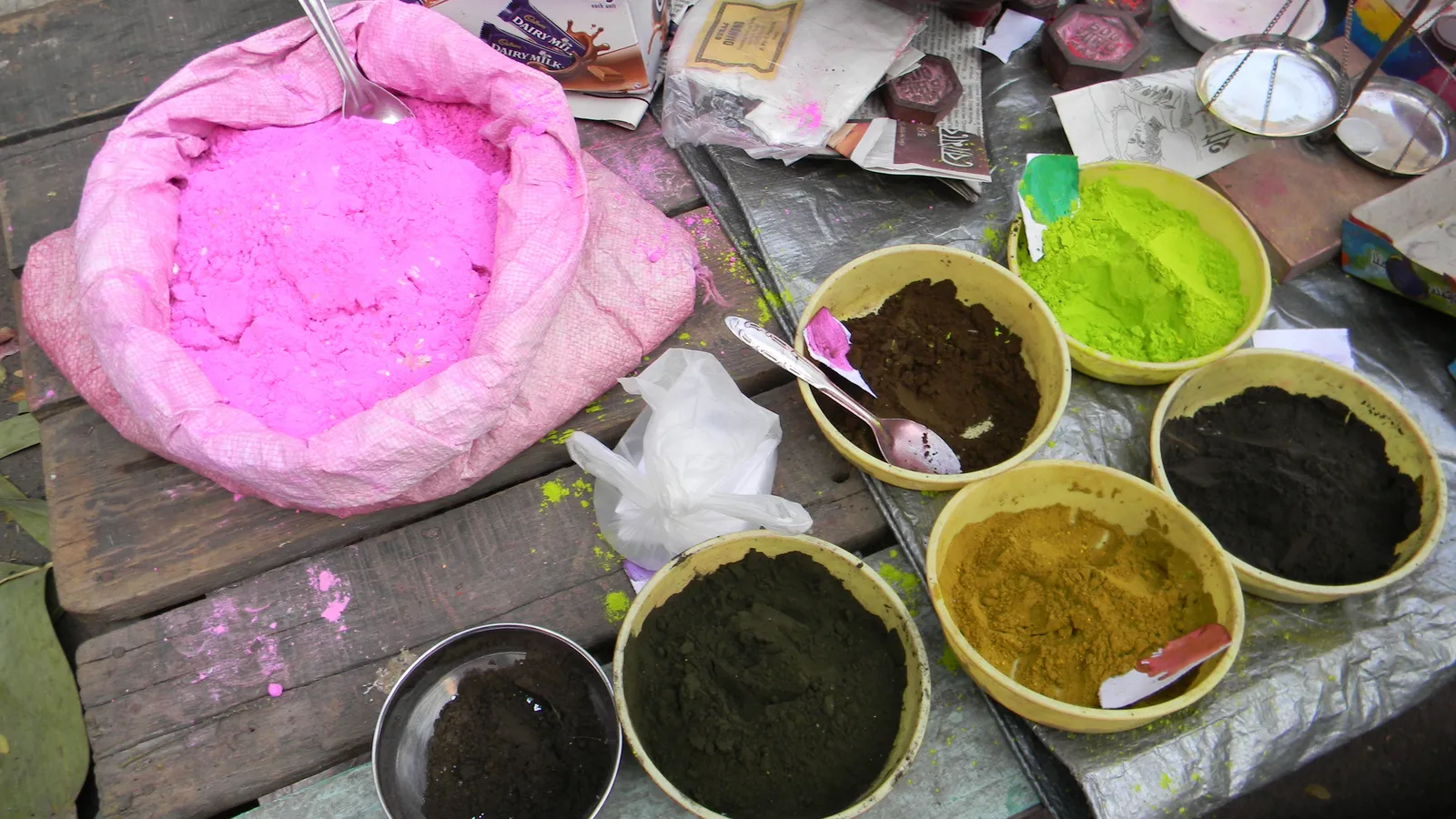
Traditionally, Holi colours (gulal) were made from natural sources: flowers, leaves, and spices. The vibrant hues we see in nature are the result of specific pigment molecules produced by plants.
Unlike synthetic dyes, which are manufactured in a laboratory, plant-based pigments are extracted directly from nature. For example, the bright yellow of turmeric comes from a bioactive compound called curcumin. The red and pink shades often come from anthocyanins found in flowers like hibiscus, while the greens are derived from chlorophyll in leaves.
When you make your own natural Holi colours at home—such as by blending turmeric with cornflour for yellow, or beetroot juice with flour for pink—you are performing a basic extraction and creating a pigment mixture. In your kitchen, the water from the beetroot acts as the solvent, pulling the anthocyanins out of the vegetable cells so they can bind to the starch in the flour. Drying this mixture leaves you with a fine, pigmented powder.
How does turmeric work as a pH indicator?
A fascinating experiment you can do with natural Holi colours involves turmeric. The yellow compound in turmeric, curcumin, is amphoteric, meaning it can react to both acids and bases. Because of this, turmeric acts as a natural acid-base indicator.
In acidic or neutral environments, curcumin remains its characteristic yellow. However, when exposed to a basic (alkaline) solution, it undergoes a chemical change. Research confirms that in a basic environment, such as a weak acid and strong base titration, curcumin changes from yellow to pinkish-yellow around a pH of 7.58 (Sarmila et al., 2021).
If your child is studying chemistry and wants to see how pH balances shift, they can review conjugate acid-base pairs. If they want to understand how these molecules behave, they can explore the Fermi Concept Library: every concept in physics, chemistry, biology, mathematics and computing, each with its own lesson and its place in the map.
What is subtractive colour mixing?
When children mix red and blue Holi powders and see purple, they are observing subtractive colour mixing. This is fundamentally different from how light mixes on a computer or television screen, which is additive mixing.
In subtractive colour mixing, physical pigments absorb (or "subtract") certain wavelengths of white light and reflect others (Kruschwitz, 2018). When a child looks at a pile of yellow powder, they see yellow because the pigment molecules are absorbing blue light and reflecting red and green light (which combine in the eye to look yellow).
When physical pigments are mixed together, they absorb more light combined than they did separately. Mixing a wide variety of paint or powder colours eventually absorbs almost all the visible light across the spectrum, resulting in a dark, muddy brown or black.
The physics of how light is absorbed and reflected governs everything we see. Students learning about the visible spectrum often start by looking at the dispersion of white light by a glass prism. To visualise how filters overlap to block light, they can turn to the Fermi Simulation Lab: interactive simulations for the ideas that are easier to see than to read.
How can you talk about science during play?
You do not need to deliver a lecture while people are throwing water balloons. Instead, use these small, observation-based prompts to spark curiosity without interrupting the fun:
Ask "what if" before they mix: Before they dump a cup of blue water into a yellow bucket, ask them what colour they think will result. Let them test their hypothesis.
Observe the stains: Notice which colours wash off easily and which require soap. This leads to a conversation about solubility and how some pigment molecules bind to the proteins in our skin.
Compare natural and synthetic: Compare how natural homemade flour-based colours feel and dissolve compared to store-bought synthetic powders.
Holi is inherently messy, and science is often at its best when it is, too. By linking the joy of the festival to the principles of chemistry and optics, you help your child see that science is not just found in textbooks—it is quite literally in their hands.


