

On this page
You cannot see the air around you, but it pushes against everything with surprising strength. Standard atmospheric pressure at sea level is 14.7 pounds per square inch. This pressure is the weight of a column of air reaching from the ground to the very top of the atmosphere. Because the fluids and gases inside our own bodies push outward with equal force, we do not feel crushed by this weight.
Showing this invisible force to a child makes an abstract physics concept real. Air pressure might sound like a dry topic, but it drives everything from the weather outside to how a vacuum cleaner works. Here are three simple experiments you can do at home to demonstrate air pressure, along with the science behind each one.
How do you keep water trapped in a straw?
This is the easiest experiment to start with, and you only need a glass of water and a drinking straw.
Place the clear drinking straw into the glass of water.
Put your thumb firmly over the top hole of the straw to seal it completely.
Lift the straw out of the water. The liquid will stay trapped inside the straw.
Remove your thumb, and the water will immediately drop out.
When you seal the top with your thumb, no air can enter to push down on the water from above. The atmospheric pressure from the room is pushing upward on the water at the bottom of the straw. This upward push is much stronger than the tiny weight of the water trying to pull it down, so the water stays suspended. When you lift your thumb, air rushes in from the top, the pressure equalises, and gravity pulls the water down.
Can a piece of card hold up a glass of water?
This classic experiment proves that air pressure pushes upward as well as downward. You will need a glass, some water, and a thick piece of card (like an index card or a piece from a cereal box).
Fill the glass completely to the brim with water. It is important that there is no air left at the top.
Place the sturdy card over the top of the glass. Make sure there are no gaps around the rim.
Keep your hand flat against the card and quickly turn the glass upside down over a sink or a large bowl.
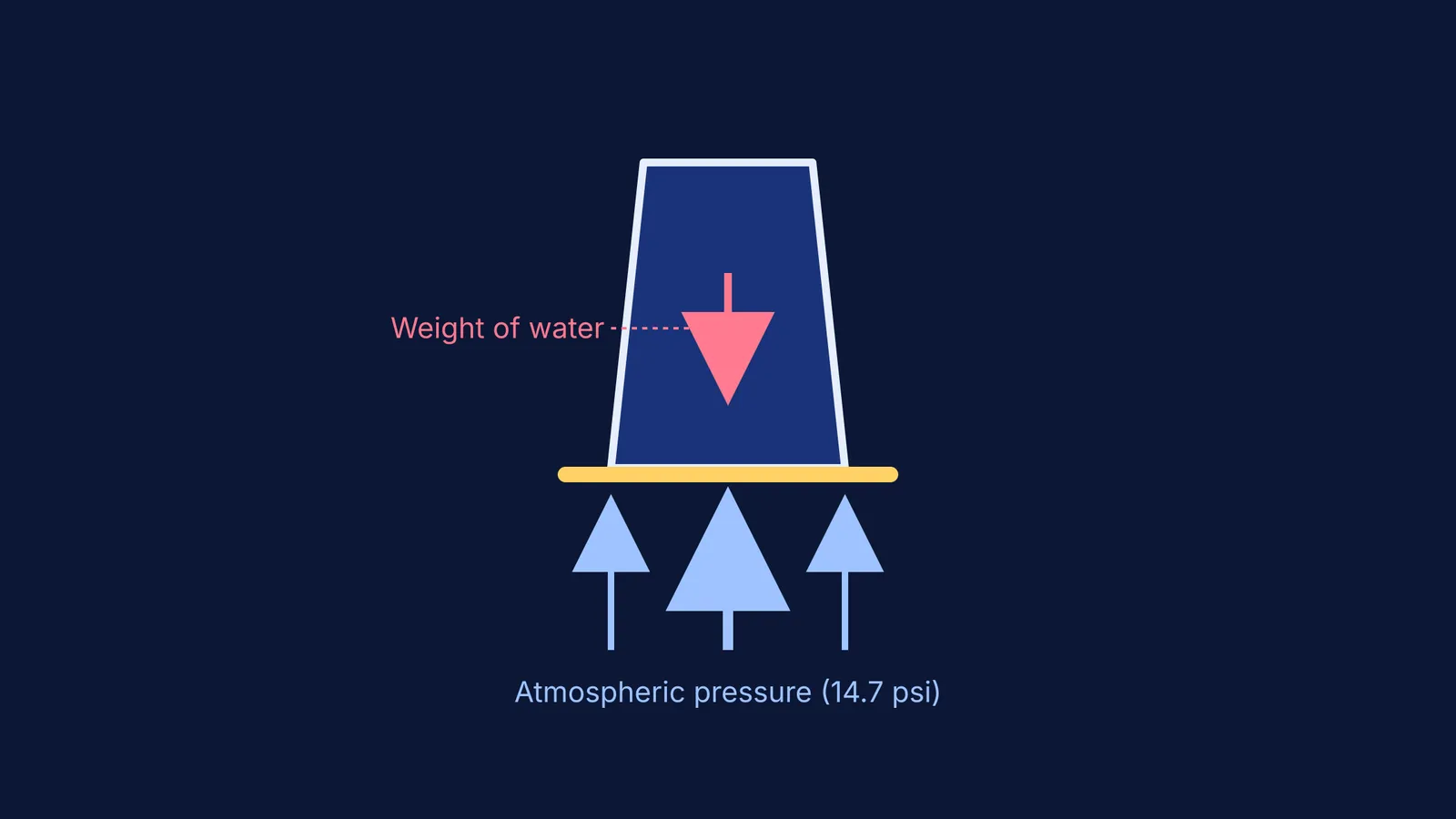
Slowly take your hand away from the card. The card will stay attached to the glass, holding the heavy water inside.
It looks like a magic trick, but it is just physics. The atmospheric pressure in the room is pushing up against the outside of the card. Because the glass is full of water and has no air trapped inside to push down, the upward air pressure is vastly stronger than the downward weight of the water.
Ideas like pressure, forces and fields can sometimes be hard to picture. This is where the Fermi Simulation Lab can help, offering interactive simulations for the ideas that are easier to see than to read.
Why is it hard to blow up a balloon in a bottle?
This experiment shows that air takes up physical space and pushes back when it is compressed. You will need an empty plastic bottle and a balloon.
Push the empty balloon into the plastic bottle and stretch the neck of the balloon over the mouth of the bottle.
Ask your child to try and blow up the balloon. They will find it nearly impossible to inflate it by more than a tiny bit.
Take the balloon out, carefully poke a small hole in the bottom of the plastic bottle, and set the balloon back up in the same way.
Try blowing it up again. This time, the balloon inflates easily.
In your first attempt, the bottle is already full of air. As you blow into the balloon, you try to compress the trapped air inside the bottle. That trapped air increases in pressure and pushes back against the balloon, preventing it from expanding. In the second attempt, the hole gives the air an escape route. The air leaves the bottle, making room for the balloon to expand.
Next steps for curious minds
Once your child sees that air has pressure, they will likely start noticing its effects everywhere—from how a syringe pulls in medicine to why their ears pop on a fast elevator. Asking questions about these everyday moments turns the whole world into a laboratory.
If your child wants to explore more science topics, the Fermi Concept Library contains every concept in physics, chemistry, biology, mathematics and computing, each with its own lesson and its place in the map.


