On this page
You are on question 22. Two rows ahead, a chair scrapes, someone walks to the invigilator and hands in their sheet. Then another. Your stomach drops and you start doing maths that has nothing to do with the paper: “If they are done, what am I missing?”
Here is the short answer. Their pace tells you almost nothing about their score, and nothing at all about yours. What helps is having a plan you set before the exam, so a moving chair has no say in what you do next.
Does finishing an exam early mean a higher score?
Not reliably. In a study of 183 students in an undergraduate psychology statistics course, published in Psychology Learning & Teaching, students recorded how long they took on each of three tests. The researchers found test completion time “was sometimes negatively correlated with test performance, but not consistently so”. Students’ earlier grades were linked to their test scores. Time taken was not, at least not consistently.
A 2011 conference study of 119 graduate students by Ramazan Basturk found no significant link between testing time and scores on multiple-choice or essay exams. On mechanical calculation questions, faster students did slightly better, but the author called the effect minimal.
People who leave early include those who knew everything, those who gave up on the hard section, and those who never checked their work. From your seat, they all look the same. So someone leaving tells you very little about how they did.
Why does it make you panic anyway?
One well-cited model, attentional control theory (Eysenck and colleagues, Emotion, 2007), proposes that anxiety weakens goal-directed attention and increases attention to anything that feels like a threat. In an exam hall, the goal is the question in front of you. The “threat” is the student who just stood up.
The same paper also notes that anxiety does not always lower the quality of your work, for example when it pushes you to try harder. So the aim is not to feel nothing. It is to give that nervous energy a clear next step. If the jolt feels like fear, reading about reframing test anxiety as energy can help, and so can our guide to handling other exam hall distractions.
What should you do in the 30 seconds after someone leaves?
Use the same short routine every time, so you don’t have to decide anything while your heart is racing:
Name it. Say in your head: “That’s their paper, not mine.”
Breathe out slowly once, longer than you breathe in.
Check the clock against your checkpoint, not against the room.
Put your finger on the next question number and read its first line.
Practise these steps in your mock tests until they happen almost on their own. In a mock, ask a friend or parent to stand up and walk out at random moments so you can practise.
How do you plan a paper so other people’s pace doesn’t matter?
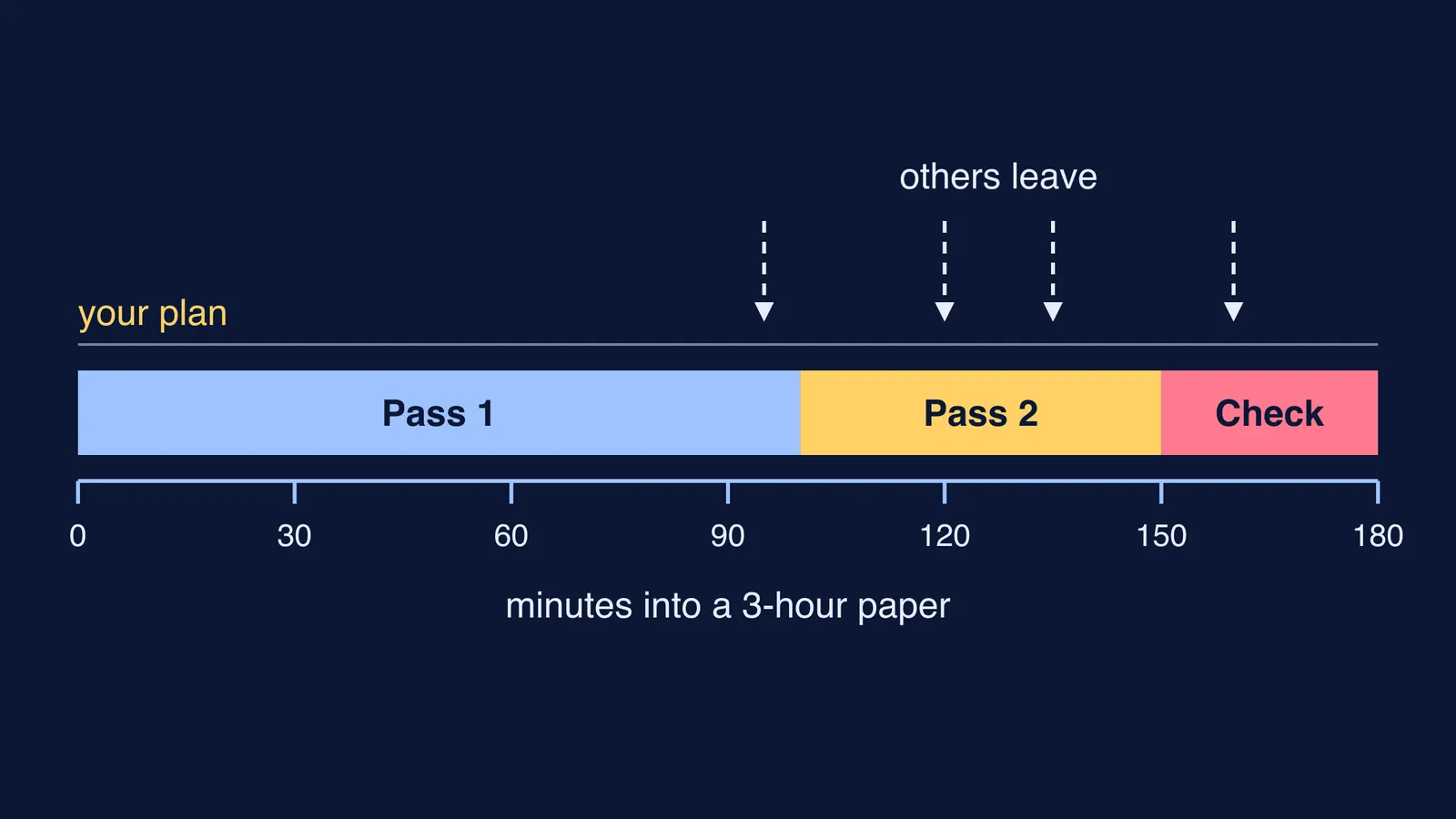
Set checkpoints before the exam. Here is a worked example for a 3-hour (180-minute) paper. Adjust the times to fit your own paper’s pattern:
Pass 1, minutes 0 to 100: answer every question you can do with confidence. Mark the others and move on.
Pass 2, minutes 100 to 150: go back to the marked questions, easiest first.
Check, minutes 150 to 180: re-read your answers, check units and signs, and make sure every answer is in the right place.
When someone leaves, look at the clock and choose one of three moves:
Ahead of your checkpoint: keep going at the same pace. Use the spare time for checking, not for leaving.
On your checkpoint: do nothing differently.
Behind your checkpoint: skip the question you are stuck on and pick up the quickest marks left. Running late is about the clock, not the person leaving.
Notice that none of the three moves depends on who stood up. Sitting until the end is not a sign you are slow. It is extra time to check for mistakes, and leaving early gives that time away.
If you struggle to set your own checkpoints, practise them on paper first. When you revise, Fermi’s AI tutor can work out what you already know and build a plan for the session, so the topics that slow you down get practice before the exam does.
What can parents say after the paper?
Skip “How many people finished before you?” Ask “Did you stick to your plan?” and “Which questions do you want to look at again?” Those questions keep attention on things your child can change.
If exam worry is affecting sleep, eating or daily life, talk to a doctor or counsellor. You can also call Tele MANAS, the Government of India’s free 24/7 mental health helpline, on 14416.
When the paper is over, write down the questions you left or guessed. Work through them in the Fermi Problem Library, where a step-by-step solver explains the reasoning. If tomorrow brings another paper, here is how to reset after a paper that felt hard.