On this page
Your 15-year-old has been saving photos of copper-red hair for weeks. The school diary says natural hair colour only. You do not have to choose between your child's self-expression and the school's rule. You can respect both, and timing does most of the work.
Why does my teen care so much about their hair?
Because it is theirs. In a study of 68 sixth, eighth and tenth graders and their parents, adolescents treated personal issues as under their own jurisdiction, while parents saw the same issues as more open to parental authority (Smetana and Asquith, Child Development, 1994). Personal reasoning increased with age in that study, so a teen who argues harder for personal choices at 15 than at 11 is following a common pattern, not necessarily being defiant.
The same study found something reassuring. Adolescents and parents agreed that parents should keep authority over moral and conventional issues, the shared social rules of a family or group. A school grooming code is that kind of rule. That gives you common ground: "this is the school's rule" is a different conversation from "I don't like it".
Hair colour at school sits between the two. Issues with both personal and conventional parts are what the researchers called multifaceted, and in their study these were the issues families discussed most. Expect to talk it through more than once.
The UN Convention on the Rights of the Child, in Article 12, gives a child who can form their own views "the right to express those views freely in all matters affecting the child" (UNICEF, Convention text). Our piece on choice and autonomy in parenting explains why real choices build motivation.
Should parents back the school rule or the child?
Split the question in two:
At home and in the holidays, your family decides, and your teen gets a real say.
During term, the school decides. Read the rule yourself in the school diary or handbook, not a classmate's version, because rules differ between schools.
If your teen thinks the rule is unfair, they can raise it with the class teacher, the student council or at the parent-teacher meeting, not by arriving on Monday with blue hair. Making a calm case is a skill worth practising; our guide to negotiation skills for students shows how to prepare and find shared interests.
When is the best time to dye hair if school doesn't allow it?
At the start of a long break, such as the summer vacation or the Diwali or winter holidays. The safety steps below come from the NHS page on hair dye reactions.
A holiday hair plan:
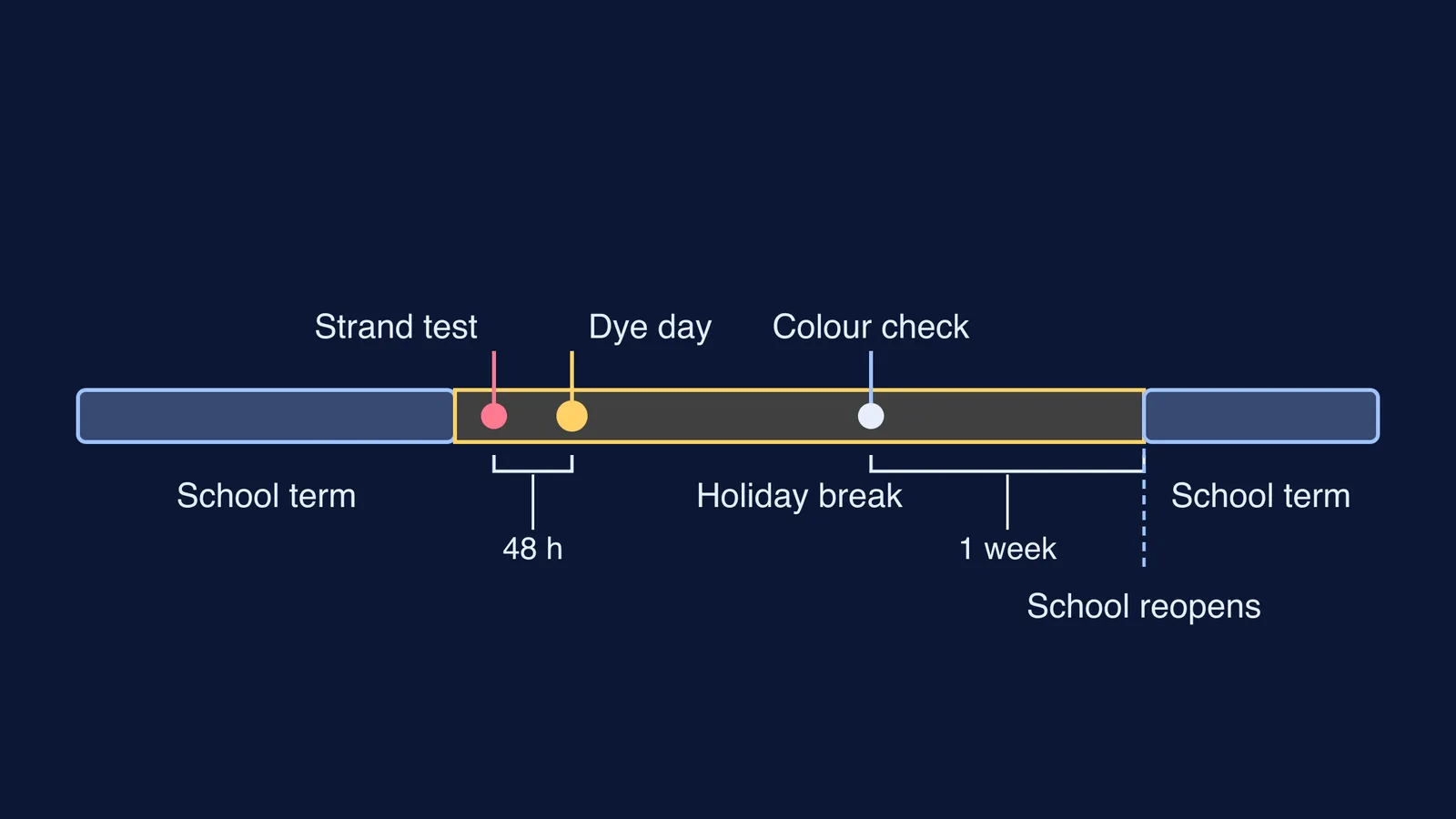
Mark the first and last days of the break on the family calendar.
Choose a colour your teen is willing to wash out, trim or dye back before school reopens.
Test first. The NHS advises testing the dye on a strand of hair at least 48 hours before you want to use it, following the instructions on the packet.
Know the risky ingredient. Many permanent and some semi-permanent dyes contain PPD (paraphenylenediamine), which can irritate skin or cause allergic reactions, and a past black henna tattoo raises the risk, according to the NHS.
Wear gloves, keep to the stated time, and wash out with mild shampoo straight away if the scalp reacts. See a doctor if symptoms get worse, and get emergency help if the lips, mouth, throat or tongue swell.
A week before school reopens, check the colour against the rule together and fix it if needed.
If the holiday also has a revision goal, Fermi's AI tutor can work out what your child already knows and build a plan for the session, so study time is planned around the fun rather than squeezed in at the end.
What can I say to my teen about dyeing their hair?
A short script you can adapt:
You: "I can see this matters to you, and it's your hair. The school rule isn't mine to change this term, though."
You: "What if we plan it for the first week of the holidays? You pick the colour, and I'll help with the test and the timing."
Teen: "Can I at least ask the school about the rule?"
You: "Yes. Let's write down your reasons and work out who to ask."
If you're both stuck: "Let's take a break and talk again on Sunday."
Avoid mocking the look or quietly overruling their choice of holiday colour. That turns a timing question into a fight about who they are. For the tone of these talks, see how to talk to a teenager without arguing.
India's Tele-MANAS service offers free counselling from trained professionals on 14416 or 1-800-891-4416 (MyGov). For most families, though, it really is about hair: agree the term rule, put the colour on the calendar, and let your teen pick the shade.