

On this page
When conversations with teenagers turn into arguments, it is often because parents offer solutions instead of space.
Why do conversations turn into arguments?
For parents, the instinct to help is automatic. When a teenager mentions a bad mark on a test or a problem with a friend, an adult's first thought is usually to fix it. This means stepping in with a plan, a strategy, or a lecture about what to do next. It comes from a place of love and experience.
However, teenagers are at a developmental stage where autonomy is deeply important to them. Their brains are wiring themselves for independence. When they hear advice they did not ask for, they often interpret it as a lack of trust in their own ability to handle the situation or make good choices. The conversation quickly shifts from the original problem to a defence of their independence, which is how a quiet chat about study habits becomes a shouting match.
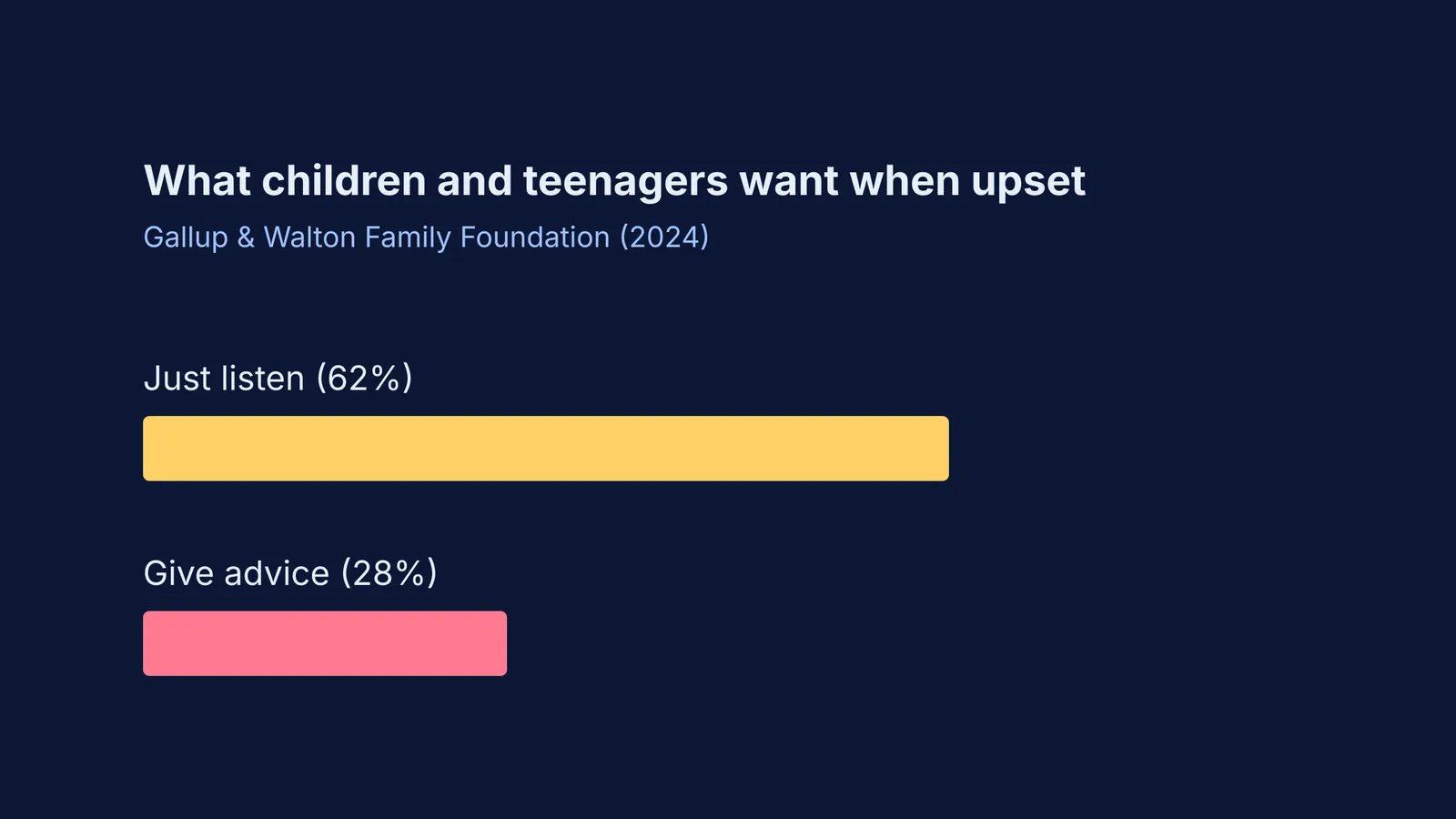
A 2024 survey by Gallup and the Walton Family Foundation found that 62% of children and teenagers (ages 10–18) just want their parents to listen when they are upset, while only 28% want advice.
When parents jump straight to problem-solving, teenagers feel dismissed and their emotional experience is invalidated. The fastest way to stop an argument is to stop trying to fix the problem immediately. This approach helps set expectations vs pressure in a healthy balance, separating your desire for their success from their immediate need to vent.
How to talk to your teenager without fighting?
Changing the dynamic takes practice, especially if lectures have become your default response over the years. Here are four practical changes to how you start and hold conversations that reduce friction.
Choose the right moment
Timing is half the battle when communicating with young adults. Bringing up a difficult subject—like a bad grade, an uncompleted chore, or a missed curfew—the moment your teenager walks through the door or right before bed is a recipe for conflict. Wait until everyone is rested and fed. Car journeys often work exceptionally well because the side-by-side seating feels less confrontational than direct face-to-face eye contact across a dining table.
Listen first, fix later
Your primary goal in the first ten minutes of any conversation should be gathering information, not imparting wisdom. Nod, acknowledge their feelings, and use neutral prompts like, "That sounds really frustrating," or "What happened next?" If they feel you are genuinely trying to understand their perspective without judging them, they are far less likely to become defensive.
Keep it to one topic
When an argument starts, it is tempting to bring up past mistakes to prove a point. If you are talking about homework routines, do not pivot to how messy their room is or their screen time last weekend. Stick to the issue at hand. Piling on grievances makes the teenager feel attacked from all sides, which guarantees an argument and ensures nothing gets resolved.
Use the 'Ask First' framework
The most practical tool to avoid lecturing is to hand the steering wheel back to your teenager. When they come to you with a problem, pause and use a simple script:
"Do you want me to just listen, or are you looking for advice?"
If they say they just want you to listen, honour that boundary. By giving them the choice, you validate their emotions and show respect for their growing independence. This makes it easier for them to approach you when they do genuinely need help, such as when dealing with serious exam stress in teenagers.
How does independence affect learning?
The friction parents experience when offering advice is the exact same friction teachers and tutors see when students are struggling with difficult subjects like physics or mathematics. If a student is frustrated by a problem and an adult steps in to solve it for them, the student learns nothing and often tunes out completely. Their sense of agency is removed.
Learning happens when the student does the heavy lifting and thinking. Instead of overriding their process, the goal is to guide them just enough so they can take the next step themselves. Fermi's AI tutor applies this principle directly to study time. Rather than simply printing an answer to a tough equation, it notices where a student is stuck, holds a line of reasoning, and decides whether to explain, ask, or show. It acts as a guide, writing on a board or running a simulation, which keeps the student in control of their own learning journey.
Allowing teenagers to struggle slightly—whether with a complex physics problem or a personal frustration—builds resilience. You can support this at home by talking about failure at home as a normal, necessary part of the process. By offering a listening ear instead of a lecture, you give them the space to figure things out for themselves.


