On this page
Many schools around the world now ban phones in class, and many Indian parents wonder whether their child's school should too. The research is more mixed than the headlines suggest. Bans seem to help some students, especially those who were struggling, but a ban on its own does not fix how much a teenager uses a phone after school.
Do phone bans in schools improve results?
A widely cited study comes from England. Economists Louis-Philippe Beland and Richard Murphy linked schools' phone policies in four English cities to national exam data, and found that exam scores rose by about 0.07 standard deviations after a ban, with the gains driven by the lowest-achieving students. The abstract on IDEAS/RePEc describes the restriction as a low-cost way to reduce educational inequality.
A standard deviation is a measure of how spread out scores are, so 0.07 of one is a small average shift in scores.
In Norway, economist Sara Abrahamsson combined national records with a survey of middle schools' phone rules. Her 2024 discussion paper reports that after a ban, girls made fewer health care visits for psychological symptoms, bullying fell for both boys and girls, and girls' grades improved, most of all for girls from poorer homes. It is a working paper, so it has not yet been through a journal's peer review.
Does banning phones improve wellbeing?
Here the best recent evidence is cautious. The SMART Schools study, published in The Lancet Regional Health Europe in 2025, compared 1,227 students aged 12 to 15 in 30 English secondary schools, 20 with restrictive rules and 10 with relaxed ones.
Students in restrictive schools reported using their phones about 40 minutes less during the school day, according to the full paper. But the study found no difference in mental wellbeing, anxiety, depression, sleep or teacher-reported attainment between the two kinds of school, and no difference in phone time on weekdays or weekends overall. What did stand out was overall use: students who spent more time on phones and social media had worse wellbeing, sleep and attainment. That is a link seen at one point in time, not proof of cause.
What do schools report after a ban?
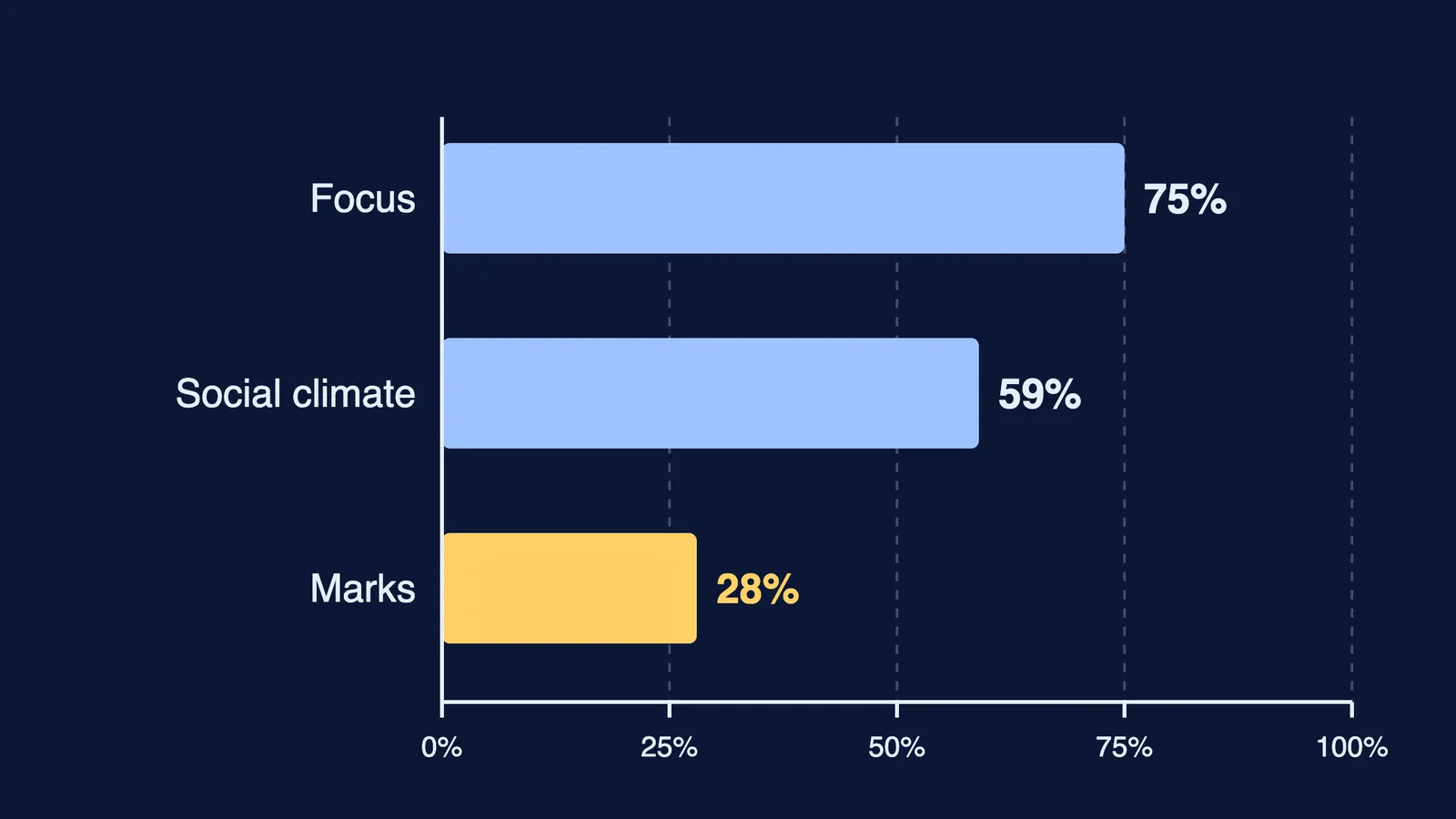
Dutch secondary schools now keep phones out of classrooms under a national agreement. A ministry-commissioned evaluation by the Kohnstamm Instituut and Oberon found that 75% of secondary schools surveyed reported a positive effect on concentration, 59% on the social climate and 28% on learning outcomes. These are schools' own reports, not test scores, and some teachers also described more work enforcing the rule.
Bans are spreading fast. UNESCO's Global Education Monitoring Report counted 60 education systems (30%) with smartphone bans by the end of 2023, and 79 (40%) by the end of 2024.
Why do the studies disagree?
What they measure. Exam scores, teacher reports and school surveys are different yardsticks.
Who they look at. Average effects can hide large gains for students who were easily distracted.
What happens after school. In the SMART Schools study, students in strict schools used phones less at school but not less overall.
How strict the rule is. A phone switched off in a locker is not the same as one face-down on the desk.
What can you do at home this month?
Whatever your child's school decides, you can run the same experiment at home. Try this two-week plan together:
Week one, notice. Write down daily phone time from the phone's own settings, and how many problems got finished in each study session.
Week two, park it. During study blocks the phone goes in another room, switched to silent. Keep the same log.
Compare honestly. Did more problems get done? Did evenings feel calmer? Decide together what to keep.
A script that works better than a lecture: "I'm not taking your phone. Let's test whether it changes your study sessions, and you decide what we keep."
Our posts on keeping your phone in another room while you study and on a one-week test of phone notifications and focus give you more to work with. If your child's school is introducing a ban, here is how to reach your child in an emergency.
A parked phone leaves a gap, and a clear next task fills it best. Fermi's AI tutor can work out what you already know and build a plan for the session, so you sit down to a next step instead of a blank page.
If your teenager seems persistently low, anxious or withdrawn, talk to a doctor or counsellor, or call the government's toll-free Tele MANAS helpline on 14416.