On this page
India runs one of the largest school meal programmes in the world. The official PM POSHAN page says the scheme, earlier called the Mid-Day Meal Scheme, covers all children in Classes I-VIII in government and government-aided schools: about 11.80 crore children in 11.20 lakh schools (PM POSHAN, Ministry of Education). The national programme began on 15 August 1995, and an upper primary meal is set at a minimum of 700 calories and 20 grams of protein, according to the same page.
So does a hot lunch change what a child learns? Here is what researchers found, and where the evidence is thin.
Does the mid-day meal improve test scores?
The clearest study on learning is by Tanika Chakraborty and Rajshri Jayaraman, published in the Journal of Development Economics in 2019. A 2001 Supreme Court directive told states to serve free meals in government primary schools, and states started at different times. That let the authors compare children by how many years of meals they could have received, given their age and state, using reading and arithmetic tests from the ASER survey (working paper, IZA DP 10086).
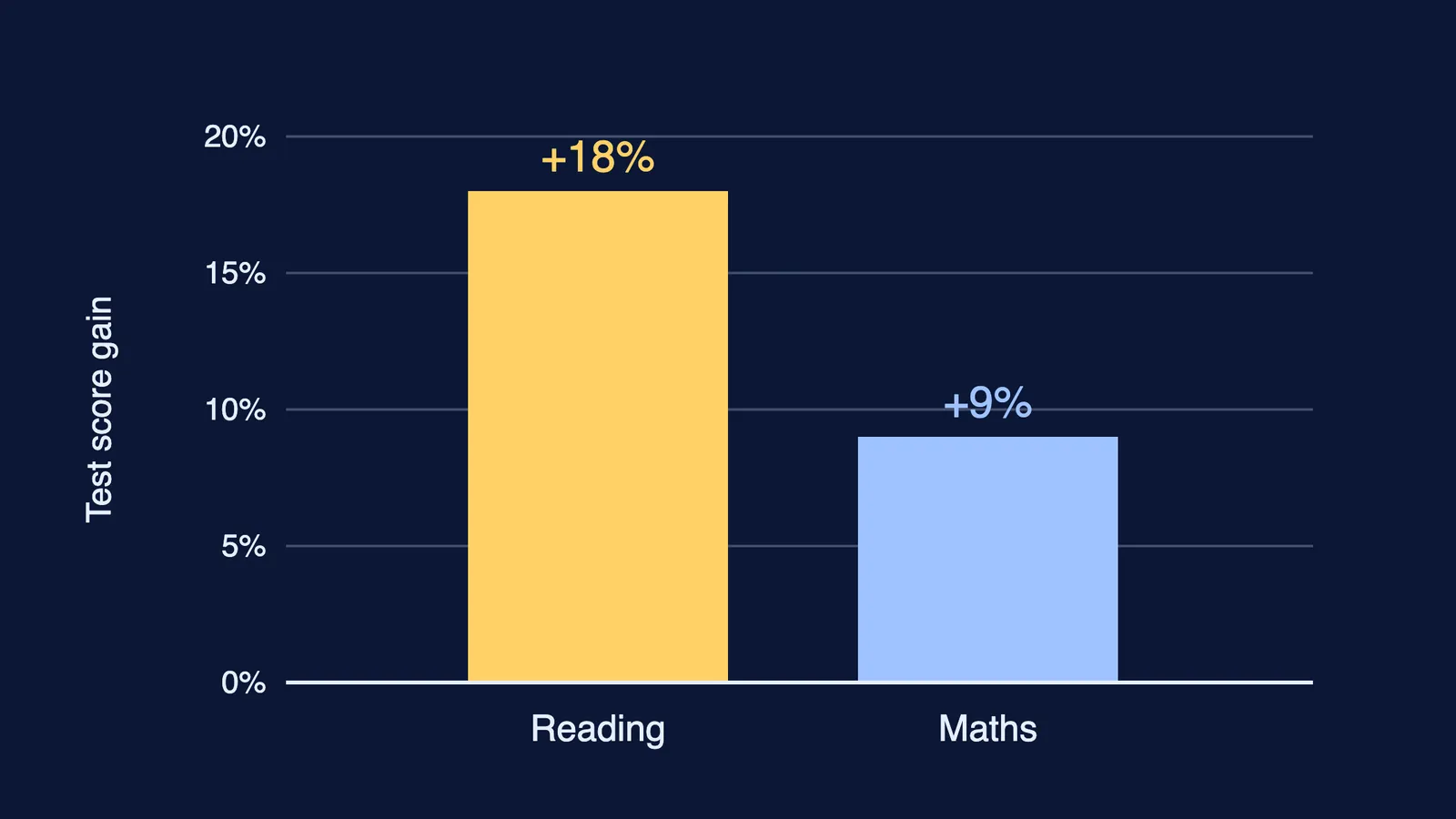
Children with up to five years of exposure to mid-day meals had reading scores 18% (0.17 standard deviations) higher than children with less than a year of exposure (Chakraborty and Jayaraman, IZA DP 10086).
The maths gain was smaller: 9% (0.09 standard deviations), according to the same paper. The gains grew with each year of exposure, but more slowly over time.
Teaching inputs combined with the meal were linked to significantly higher learning; general school infrastructure was not. A meal can help a child come to class fed. Teaching still does the rest.
Does the mid-day meal improve attendance?
Farzana Afridi studied schools in one rural area of India as they switched to cooked meals. Girls in grade one had average monthly attendance more than 12 percentage points higher (Afridi, Journal of Development Studies, 2011). The effect for grade one boys was positive but not statistically significant, and the effect on enrolment was not significant.
If your child is older and missing days, our guide on school attendance shortage and board exams explains what is at stake.
What did studies find about nutrition?
In an earlier study, Afridi found that children's daily nutrient intake rose by 49% to 100% of what the meal provided (Afridi, Journal of Development Economics, 2010). In plain terms, families cut some food at home, but most of the school meal was extra food. The same study found the meal cut a primary school child's daily protein deficiency by 100%, the calorie deficiency by almost 30%, and the iron deficiency by nearly 10%.
That small dent in the iron gap matters, because low iron is linked to tiredness. Our explainer on why anaemia makes people tired covers the biology.
In Andhra Pradesh, Abhijeet Singh, Albert Park and Stefan Dercon found the meal acted as a safety net, giving large and significant health gains to children whose families suffered drought (Economic Development and Cultural Change, 2014).
A 2021 study looked at the next generation. Children born to mothers with full mid-day meal exposure had height-for-age scores 0.40 standard deviations higher than children of mothers with no exposure (Chakrabarti and colleagues, Nature Communications). Other researchers pushed back. Harshpal Singh Sachdev, Clive Osmond, Anura Kurpad and Tinku Thomas argued that the real benefit from the observed average rise in exposure was about one-third of that figure (Nature Communications, 2022). The fair reading is that some long-term benefit is possible, but its size is still debated.
What can parents do with this evidence?
The studies point to food, attendance and teaching working together. A checklist:
Ask your child what they ate this week, and whether the meal came every school day. The PM POSHAN page says social audit of the scheme is mandatory in every district, so asking about the meal is a normal question.
Do not count the lunch as breakfast. A midday meal comes after the morning lessons. Our piece on breakfast and school performance explains what the research says about the morning.
Watch for tiredness that does not go away. Since the meal closes only a small part of the iron gap, talk to a doctor if your child is often pale or exhausted, rather than guessing at supplements.
Track attendance. A meal only helps on the days your child is in school, and the learning gains grew with years of exposure.
Ask about teaching, not only the building. The 2019 study linked gains to teaching inputs combined with the meal, not to infrastructure alone.
When your child is home and stuck on a lesson, Fermi's AI tutor can work out what they already know and build a plan for the session, so the next step is clear.
The short answer: the best evidence links years of mid-day meals to better reading and maths scores, with bigger gains where teaching is also in place.